
Social Development and Social Services (Subtopic of topic 2)
LINK OF OTHER SUBJECTS >>>>>
Social Development and Social Services (Subtopic of topic 2)
Social Development and Social Services
Social
development is the improvement of the welfare of the people in the
community. It deals with the development in social, cultural and
political aspects of the society. Social development is the process of
improving people’s living standards, reducing poverty and unemployment,
enabling people to invest in profitable ventures, widening trading
opportunities and reducing inequalities among the people.
Meaning of Social Development and Social Services
Explain the meaning of social development and social services
Social development
is a long-term process. There are a number of factors that must be
considered to achieve social development. People should get a balanced
diet, good shelter and health care. The government also has to provide
important services which will facilitate them in production. Such
services are banking, insurance, loan facilities and social security
protection. These will support production of goods and services which
will stimulate high levels of living, high income, more employment
opportunities and better education.
Social services
are those services which are in a form of consumption. They include
education, housing, insurance, health, pension schemes, and cultural
affairs. Sports, games and entertainment. From these services, people
get satisfaction. These services are provided by the government through
its agencies and the private sectors as well.
It
is very difficult to draw a line between social development and social
services because they are closely relate. The third President of the
United Republic of Tanzania, Mr. Benjamin William Mkapa, named them as
social hardware infrastructure and software infrastructure. He meant
that social hardware infrastructure are those services which help
directly to improve production in the country and are usually in a form
of investment. These include transportation and communication, and water
supplies for agricultural purposes. The social-software infrastructures
are those services which provide aids to the services. These include
banking and others.
Different Social Services Provided in Tanzania
Analyse the different social services provided in Tanzania
Education sector
The
United Republic of Tanzania realizes that equality education is the
pillar of national development, for it is through education that the
nation obtains skilled manpower to serve in various sectors of the
national economy. It is through quality education that Tanzania will be
able to create a strong and competitive economy which can be effectively
cope with the challenges of development and which can also easily and
confidently adapt to the changing market and technological conditions
in the region and the global economy.
As
at 2011, the structure of the formal education and training system in
Tanzania constituted 2 years of pre-primary education, 7 years of
primary education, 4 years of junior Secondary (ordinary level), 2 years
of Senior Secondary (advanced level) and up to 3 or more years of
Tertiary Education. Specifically, the education system has three levels,
namely basic, secondary and tertiary levels. Basic level includes
pre-primary, primary and non-formal adult education. Secondary level
includes ordinary and advanced education, while tertiary level includes
programs and courses offered by non-higher and higher education
institutions.
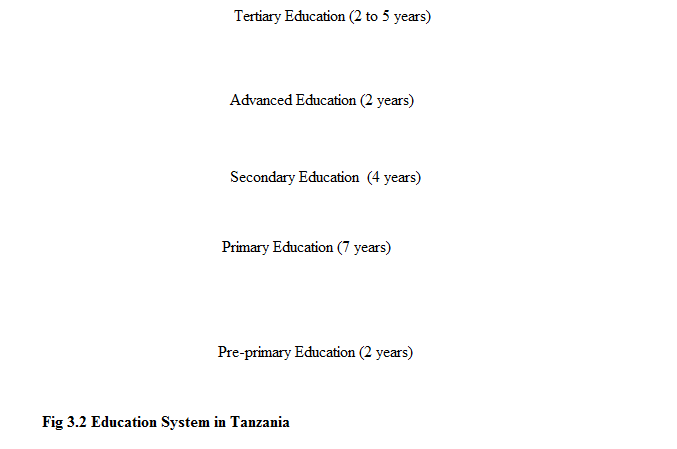
The current education system
The
overriding goal of the United Republic of Tanzania is that of
eradicating poverty under the framework of Tanzania Development Vision
2025 and the Poverty Reduction Strategy 2015. Both of these identify
education as a priority. The Ministry of Education and Vocational
Training (MoEVT) therefore recognized the need to develop the Primary
Education Development Plan (PEDP), 2002 -2006, and Adult and Non-formal
Education Strategy and implementation Plan (ANEIP), 2003/04 – 2007/08.
Both
the PEDP and ANEIP have been developed within the context of the
Education and Training Policy (1995) and the Education Sector
Development Programme (ESDP 2000). PEDP aimed at providing Universal
Primary Education (UPE). It was expected that all school-age children (7
to 13 years old) would be enrolled in primary schools by the year 2006.
This translates into a total of 6.5 million children. The key
components of PEDP are:
- Enrollment expansion
- Quality improvement
- Capacity building
- Institutional arrangements
- Finance and resource allocation.
Those
who missed basic education for various reasons are being absorbed into
non-formal education centres under the approved Adult Education/Non
Formal Education (AE/NFE) strategy and plan, developed after five years
of experience in piloting the Complementary Basic Education in Tanzania
(COBET) and the Integrated Community Based Adult Education (ICBAE).
The
ANEIP is expected to contribute to the creation of lifelong learning
mechanisms, to improve people’s livelihood and to be used for the
creation of awareness of prevention of HIV and AIDS. ANEIP will also
contribute to the creation of a conducive environment to address gender
issues, sustained socio-economic development, good governance and
poverty reduction. The plan targets to enroll 3.5 million adults and
almost a million out out-of school children and youth.
Secondary
education does not currently absorb all primary school-leavers. In 2002
a total of 497 688 pupils completed Standard VII. Out of 497 688 pupils
only 107 282, which is about 21.7%, were admitted to secondary
education in both public and private schools. The age range in ordinary
level secondary schools is 14 to 17 years and in advanced level it is 18
to 19. In the real situation, however, there is a wide range of age
groups in both ordinary and advanced levels depending on age at first
enrollment in primary schools and other factors.
Although
initial enrollment in primary education is almost equal between girls
and boys, fewer girls than boys complete primary and secondary levels or
attain higher-level education. There are a number of reasons for this
disparity: gender relations, pregnancy at young age, and parental
preference for boys to continue with education.
The accessibility, quality, efficiency and distribution of education services in Tanzania.
The
Education and Training Policy adopted in a policy for the education
sector reform. The importance of education for Tanzania’s development is
also echoed in the National Strategy for Growth and Reduction of
Poverty (NSGRP) which builds on three pillars: growth and reduction of
income poverty , improvement of quality of life and social well-being,
and governance accountability.
The
main role of the Ministry of Education and Vocational Training (MoEVT)
is so set policies based on accessibility, equality, distribution
efficiency. In addition, the ministry is responsible for improving the
education standards in the country, to systematize school; syllabi and
oversee the implementation, to arrange the format of examinations for
primary and secondary schools and distribution of school necessities and
to promote national culture.
In
the implementation of the education policy in Tanzania, the government
through the Ministry of Education and Vocational Training (MoEVT)
introduced various programs. Some of those programs are the Primary
Education Development Program (PEDP) and the Secondary Education
Development Program (SEDP). The aim is to improve the education system
in the country and increase the enrollment ratio in schools.
From
1995, communities have played a big role in the establishment of
primary and secondary schools. The community builds schools and the
central government supports it in many ways such as providing teaching
materials, books and teachers. Today about 90% of the schools are
community-owned schools.
Achievement of the government in the provision of education.
Following the education sector reforms established by the Tanzanian government, the following achievements have been observed:
- Increased gross and net enrollment of boys and girls, including children with disabilities, in primary schools from 90.5% in 2004 to 99% in 2010.
- Increased enrollment of orphans and other disadvantaged children in attending and completing, primary education from 2% in 2000 to 30% in 2010.
- At least 50% of boys and girls aged 14 to 17 years had been enrolled in ordinary level secondary schools by 2010.
- At least 25% of boys and girls were enrolled in advanced level secondary schools by 2010.
- Pupils who have passed primary education are given access to secondary education.
- The introduction of Information and Communication Technology studies (ICT) in primary and secondary schools gives students skill to fit in the modern society.
Problems facing the government in the provision of education services.
Despite
the achievements registered by the government in the education sector,
the sector is still facing numerous problems, including:
- Poor resource allocation to the sector. The education sector has inadequate laboratories, libraries and their equipment, textbooks and reference books for students and teachers.
- Lack of qualified teachers.
- The number of teachers is less compared to the number of students enrolled into Tanzanian schools.
- Low salaries to the teaching profession which forces many people to leave the profession.
- Unavailability of electricity in remote areas which discourages teachers to go to the villages once employed. As a result, they decide to find employment in private schools.
- Lack of important school infrastructures like classes, desks, offices, toilets and teacher’s houses.
- Transport problems for both students and teachers from their homes to schools, making them waste a lot of valuable time while on transit.
- Lack of in-service training for the teachers.
Activity 7
Suggest some possible measures or solutions in the challenges facing the education sector in Tanzania.
Health Sector
For
a period of almost fifty years, health services delivery has been
largely done by the government, with a limited number of private health
institutions especially in large towns or cities of the country. After
independence, health care facilities were redirected towards rural areas
and free medical health services were introduced except for Grades I
and II. In 1977, private health services for profit were banned under
the Private Hospitals Regulation Act, 1977. This act had negative
implications on health services in the country. However, after a series
of major economic and social changes, the government adopted a different
approach to the role of the private sector.
New
were developed that favoured the private sector. The importance of the
private sector in health care delivery was further recognized with an
amendment to the Private Hospitals Regulation Act, 1977 which resulted
into the establishment of the Private Hospitals Regulation (Amendment)
Act, 1991. Following this act, individual qualified medical
practitioners and dentists could now manage private hospitals, with the
approval of the Ministry of Health.
The National Health Policy
The
National Health Policy was introduced in the early 1970s in the wake of
the Arusha Declaration 1967. The broad objective of the National Health
Policy was to provide comprehensive basic health services equitably to
the whole population. Strong emphasis was put on promotion of health and
prevention of diseases rather than curative services. It also called
for a shift from building large hospitals to smaller to smaller health
centres throughout the country. In addition, emphasis was given to
training mid-level health workers to manage these health units.
The
government of Tanzania has clear polices on the implementation of
health services to its people. These policies, currently the citizens
are required to share the costs of the services provided in those
hospitals.
The specific objectives of the health services in Tanzania are:
- To reduce diseases and death so as to raise the life expectancy of Tanzanians. The government gives more attention to special groups like children under five years, cold people.
- To make sure that primary health care services are available and are offered efficiently to the people.
- To prevent and control communicable and non-communicable diseases such as HIV and AIDS, malaria, tuberculosis, diseases caused by malnutrition, environmental health, and working places as well as chemical control.
- To enlighten the citizens about the preventable diseases in order to know them and find techniques of controlling them.
- To create cooperation among the public sector, the private sector, religious organizations and non-governmental organizations that provide health services.
- To provide education and increase the number of professional health workers.
- To identify, rehabilitate the infrastructure according to the needs of the disabled, and lay down rehabilitation systems.
- To evaluate health policies, laws and standards of giving health services.
Primary Health Care (PHC) Approach
Following
the Alma Ata Declaration of 1978, the government adopted the PHC
approach as a means of achieving “Health for all by the year 2000”. The
Alma Ata Declaration defined Primary Health Care as the essential health
care based on practical, scientifically sound and socially acceptable
methods and technology. Under PHC, health services are made universally
accessible to individuals and families, through their full participation
and at an affordable cost.
- Provision of essential health care in all villages through village workers.
- PHC committees at each level to promote community involvement and intersect oral collaboration.
- Strengthening health services especially at district level.
The
purpose of primary health is to strengthen the health of the citizens
from the family to national level by involving the citizens themselves.
This includes education, prevention and treatment.
Public health education
Public
health is mainly concerned with identifying prevailing health problems
and disseminating information about the public methods of preventing and
controlling them. This is an integral part of community involvement in
Primary Health Care (PHC). It is assumed that the health of an
individual, the family and the community at large is dependent upon
factors such as environment, socio-cultural traditions and lifestyles.
Hence,
public health education focuses on strengthening and addressing g
issues related to agricultural development, child upbringing,
environmental sanitation and development in general. For instance,
school children are a special target group for health education through
the school health program. Public health education is provided by a
variety of methods including mass media, dissemination of health
education materials and through dialogue with communities.
Public
health education is a very important method in offering health
services. It involves communication technology and sends messages to the
individuals, families, and the society in order to reduce diseases in
the society. The government uses a variety of technologies like the
media, signboards, fliers, journals, books and websites.
Environmental health and hygiene
Our
health depends very much on how our environment is properly maintained.
Our land, plants, air, water bodies, buildings and sewage must be well
taken care of. The diseases which attack people are mostly caused by an
unhygienic environment. Our environment may be degraded by many economic
activities, such as the smoke produced form the industries which
contaminates the air and destroys the ozone layer. Waste water from
industries which contains chemicals is thrown into the rivers. Human
beings are also affected by water pollution as they use this water for
different purposes.
The accessibility, quality, efficiency and distribution of health services in Tanzania
The
distribution of health facilities has a heavy rural emphasis because
more than 70% of the population lives in rural areas. Plans for the
establishment of health facilities have in the past taken into
consideration the population ratio. However with time this has in some
areas been seriously overtaken by the high population growth rate. The
health system and specially the government’s referral system assume a
pyramidal patter of a referral system recommended by health planners,
which is from dispensary to consultant hospital.
The
structure of health services at various levels in the country starts
with the village health service. This is the lowest level of health care
delivery in the country.
They
essentially provide preventive services which can be offered in homes.
Usually each village health post has two village health workers chosen
by the village government amongst the villagers and given a short
training before they start providing services.
Dispensary
is the second stage of health services. The dispensary caters for 6000
up to 10,000 people and supervises all the village health posts in a
particular ward. Health centres come after dispensaries. Health centres
are expected to cater for 50,000 people which is the approximate
population of one administrative division.
District
hospitals are another important level in the provision of health
services in the country. Each district is supposed to have a district
hospital. District hospitals provide services to an average of 250 000
people. In Tanzania, almost all districts have districts hospitals. In
those few districts without district hospitals, Faith Based Organization
(FBO) hospitals are designated as district hospitals.
Referral
hospitals are the highest level of hospital services in the country.
currently there are four referral hospitals, namely Muhimbili National
Hospital (MNH) which caters for the eastern zone; Kilimanjaro Christian
Medical Centre (KCMC) which caters for the northern zone; Bugando
Hospital which caters for the western zone; and Mbeya Hospital which
serves the southern highlands.
However,
there are some diseases and cases that require special treatment whose
facilities and equipment are not available in the country. Depending on
the resources available, some patients have to be sent abroad for
treatment.
The Role of Government in the Provision of Social Services
It
is the duty of the government to promote the welfare of its people. In
Tanzania particularly, the government is trying its level best to
improve the provision of social services. There are a number of economic
and social sector reforms and policies which the government has
implemented. These are like Primary Health Service Development Plan. The
plan intends to minimize the problem of human resource shortage through
advocacy for increased funding and reallocation of staff for optimum
utilization.
Meaning of Social Development and Social Services
Explain the meaning of social development and social services
The
National Healthy Policy of 2007. The healthy policy vision is to have a
healthy community, which will contribute effectively to individual
development and the country as a whole. The mission is to facilitate
provision of basic health services, which are proportional, equitable,
of high quality, affordable, sustainable and gender sensitive.Government
provision of health, education and water services has consistently been
rated as the key public priority. The government plays a vital role in
the provision of social services. The following are the roles:
The Role of the Government in the Provision of Social Services
Appraise the role of the government in the provision of social services
Government
provision of health, education and water services has consistently been
rated as the key public priority. The government plays a vital role in
the provision of social services. The following are the roles:
To
make policies which support private and non-governmental institutions
in the provision of social services2. To construct and maintain the
transportation system.3. To distribute teaching and learning materials
to schools.4. To distribute important facilities to hospitals and other
areas where health services are provided.5. To educate Tanzanians on
environmental preservation so that water sources are not polluted.6. To
train the required personnel who will assist in the provision of social
services. Examples of such personnel are teachers; water experts;
railways; road and electrical engineers; doctors and nurses.7. To train
citizens on the best use of those social services and be responsible.
The citizens must realize that social services are for their own use
hence they should protect them
Appraising the role of the government in the provision of social services in Tanzania.
The
government plays a vital role in ensuring that social services provided
to the citizens. Effective access to functioning and well equipped
social services is a prerequisite ofimproving the quality of life and
for promoting the well-being of all Tanzanians. The following are some
of the evidences on the role of our government in the provision off
social services to its people:The government has extended the provision
of water in many places in rural and urban areas. For instance, Kahama,
Shinyanga Water Supply Project from Lake Victoria and the Chalinze Water
Supply Project which was implemented in the year 2001, targeted at
supplying water to 105 000 people for the 18 villages by the year 2015.
The
Tanzanian government has continued to focus on education provision
since independence. The aim is to address the shortage of skilled
national manpower. In the mid-1970s, a decision was made by the
government to introduce Universal Primary Education (UPE) by 1984.
Funding was concentrated on primary education and secondary school
enrolment. The statics for primary enrolment and adult literacy in the
early 1980s were impressive. For instance, the Gross Enrolment Ratio
(GER) in 1980 was 98%.
In
the 1980s the government allowed private and voluntary sectors to run
non-governmental schools. The education sector expanded rapidly. Higher
education in Tanzania during the late 19th century was predominantly
provided by the University Of Dares Salaam (UDSM).
The
University of Dares Salaam was first established in 1961 as a College
of the University of London. In 1963 it became a Constituent College of
the University of East Africa. In August 1970, it became a national
University.
In
1965, Sokoine University of Agriculture (SUA) was established as the
second university in the country. It started as an Agricultural college
offering Diploma training in the discipline of agriculture. The
establishment of this university showed the importance of agriculture in
the country. With the dissolution of the University of East Africa and
the consequent establishment of the University of Dares Salaam (UDSM) in
1970, the College was transformed into a Faculty of Agriculture of UDSM
and thereby started offering Bachelor of Science in Agriculture.
In
1965, Sokoine University of Agriculture (SUA) was established as the
second university in the country. It started as an Agricultural college
offering Diploma training in the discipline of agriculture. The
establishment of this university showed the importance of agriculture in
the country. With the dissolution of the University of East Africa and
the consequent establishment of the University of Dares Salaam (UDSM) in
1970, the College was transformed into a Faculty of Agriculture of UDSM
and thereby started offering Bachelor of Science in Agriculture.
1994,
the Institutional Transformation Programme was initiated and since
then, there has been a considerable increase in students‟ numbers.
Several other tertiary training institutions have become universities.
More recently, a number of private universities have been opened, mainly
run by religious bodies. Vocational training as also provided in
National VocationalTraining Centres. In 1994, these came under the newly
formed Vocational Education and Training Authority (VETA). VETA
colleges offer a wide range of courses.
Since
2001, there has been a dramatic expansion of primary education due to
the introduction of the Primary Education Development Programme (PEDP).
In 2002, standard one enrolments increased by 43.1%. The enrolment in
primary school has increased by 5.8% between 2006 and 2010. Gross
Enrolment Ratio (GER) was 106.4% in 2010 and Net Enrolment Ratio was
95.4%, indicating adequate absorption capacity at primary schools for
all school ages (7 to 13).
In
2003, the government embarked on ambitious plans for the expansion of
the secondary education through the Secondary Education Development
Programme (SEDP). All those are the efforts which the government is
doing to raise the level of education in Tanzania, hence eradicating the
problem of illiteracy and unemployment.
The
government, in collaboration with other stakeholders, has continued
with the implementation of the Child Health strategic Plan (2005 - 2010)
and the Road Map strategic Plan to accelerate reduction of maternal,
newborn and child deaths. Notable achievements have been recorded. The
deaths of children fewer than five years of age (the probability of
dying between birth and fifth birthday) have continued to decline
significantly. The rate declined from 12 per 1000 live births in 2004/
05 to 91 per 1000 live births in 2007/08 and thereafter to 811 child
deaths per 1000 live births in 2009/10.
The
government provides free primary education to the pupils. For instance,
Primary Education Development Programme Phase 2 of 2007 -2011 aims at
ensuring that the objective of providing free pre-primary and primary
education is achieved. The enrolment in primary schools has increased by
5.8 percent between 2006 and 2010. The government also provides loans
to students of higher learning institutions through the Higher Education
Students Loan Board (HESLB).
The
government provides modern medical equipment and rehabilitation to most
off its hospitals. For instance , general rehabilitation of Muhimbili
National Hospital, Amana, Temeke, Mwananyamala and other regional
hospitals in the country.
The
government also provides assistance to health researchers, for instance
Ifakara Health Research Centre. The Government recruits new personnel
from health colleges found inTanzania like Muhimbili College of Health
Sciences and others. It also provides medicine to its health centres
through the government agent, namely Medical Stores Department (MSD).
Activity 9
Apart
from the successes our government achieved in the building of secondary
schools almost in every ward in the country, what challenges are facing
these schools? Suggest some possible solutions for alleviating those
challenges.


No comments