
FORM ONE MATHEMATICS STUDY NOTES TOPIC 7-9.

An
algebraic expression – is a collection of numbers, variables, operators
and grouping symbols.Variables - are letters used to represent one or
more numbers
Symbols to form Algebraic Expressions
Use symbols to form algebraic expressions
The parts of an expression collected together are called terms
Example
- x + 2x – are called like terms because they have the same variables
- 5x +9y – are called unlike terms because they have different variables
An algebraic expression can be evaluated by replacing or substituting the numbers in the variables
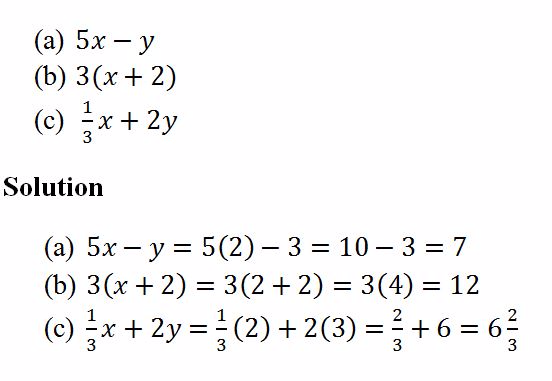
Example 1
Evaluate the expressions below, given that x = 2 and y = 3
Example 2
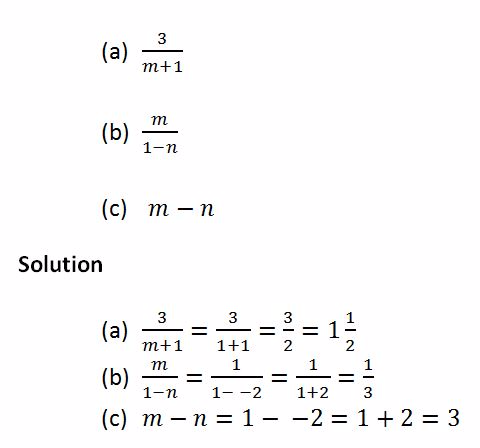
Evaluate the expressions below, given that m = 1 and n = - 2
An expression can also be made from word problems by using letters and numbers
Example 3
A rectangle is 5 cm long and w cm wide. What is its area?
Solution
Let the area be A.
Then
A = length× widith
A = 5w cm2
Simplifying Algebraic Expressions
Simplify algebraic expressions
Algebraic expressions can be simplified by addition, subtraction, multiplication and division
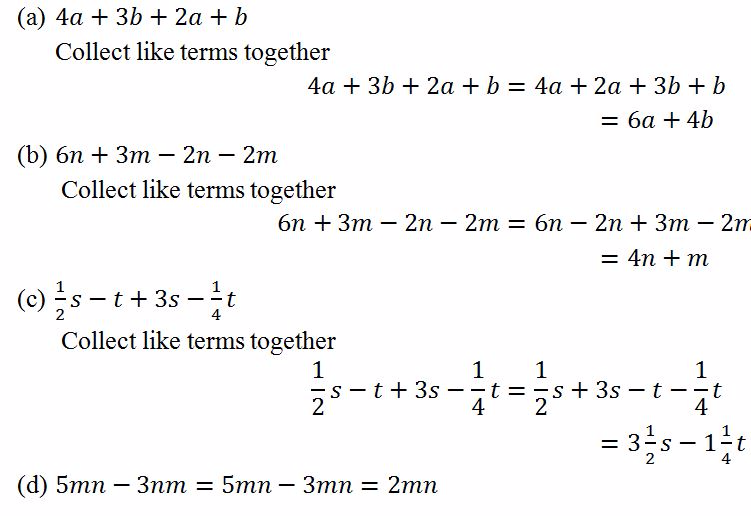
Addition and subtraction of algebraic expression is done by adding or subtracting the coefficients of the like terms or letters
Coefficient of the letter – is the number multiplying the letter
<!--[endif]-->Multiplication and division of algebraic expression is done on the coefficients of both like and unlike terms or letters
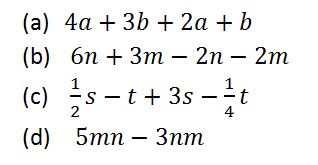
Example 4
Simplify the expressions below
Solution
Equations with One Unknown
An equation – is a statement that two expressions are equal
An Equation with One Unknown
Solve an equation with one unknown
An equation can have one variable (unknown) on one side or two variables on both sides.
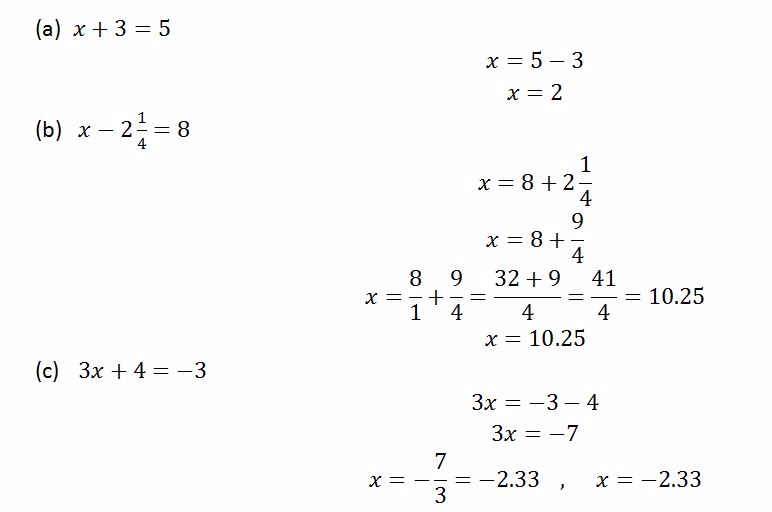
When you shift a number or term from one side of equation to another, its sign changes
- If it is positive, it becomes negative
- If it is negative, it becomes positive
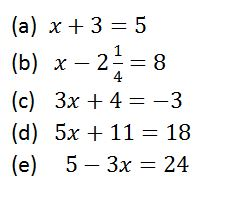
Example 5
Solve the following equations
Solution
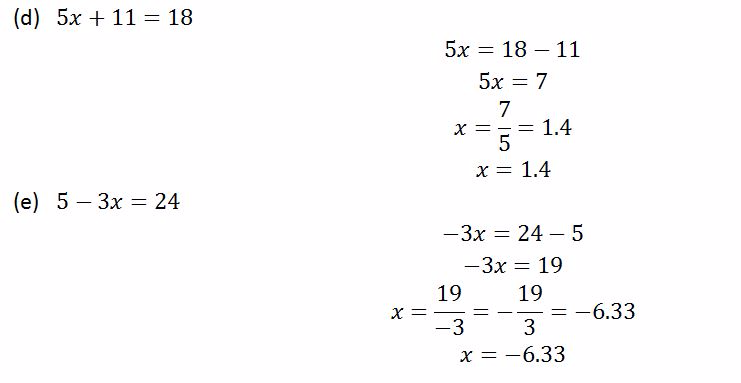
An Equation from Word Problems
Form and solve an equation from word problems
Some word problems can be solved by using equations as shown in the below examples
Example 6
Naomi is 5 years young than Mariana. The total of their ages 33 years. How old is Mariana?
Solution
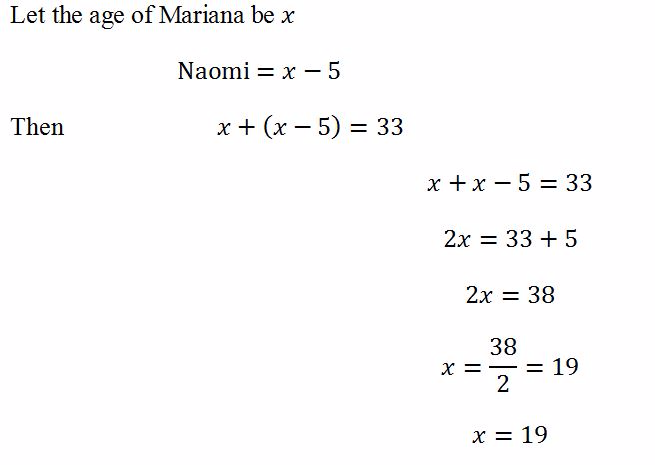
Mariana is 19 years
Equations with Two Unknowns
Simultaneous Equations
Solve simultaneous equations
Simultaneous equations – are groups of equations containing multiple variables
Example 7
Examples of simultaneous equation

A simultaneous equation can be solved by using two methods:
- Elimination method
- Substitution method
ELIMINATION METHOD
STEPS
- Choose a variable to eliminatee.g x or y
- Make sure that the letter to be eliminated has the same coefficient in both equations and if not, multiply the equations with appropriate numbers that will give the letter to be eliminated the same coefficient in both equations
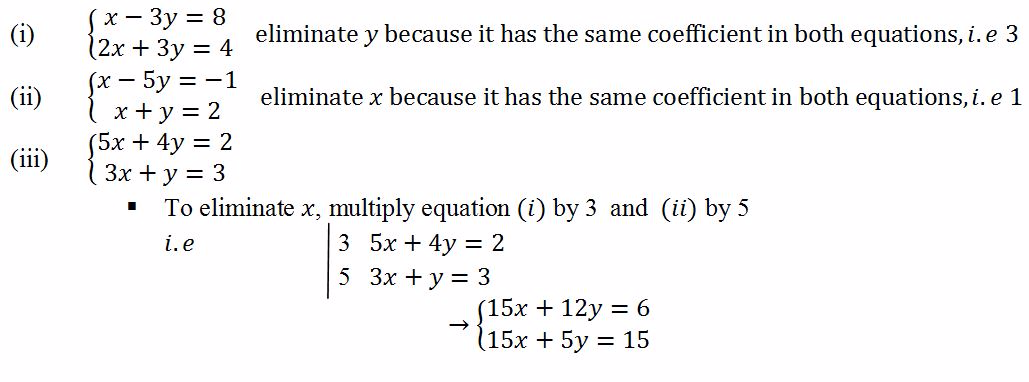
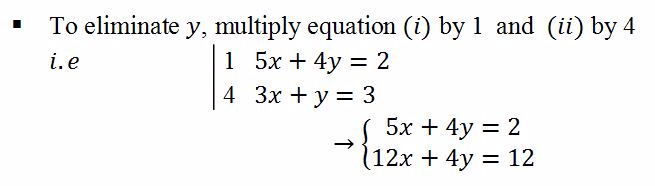
- If the signs of the letter to be eliminated are the same, subtract the equations
- If the signs of the letter to be eliminated are different, add the equations
Example 8
Solve the following simultaneous equations by elimination method
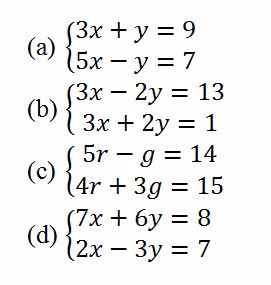
Solution
- Eliminate y
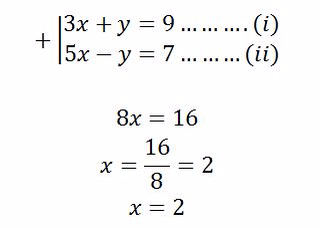
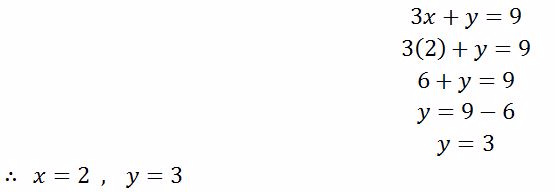
To find y put x = 2 in either equation (i) or (ii)
From equation (i)
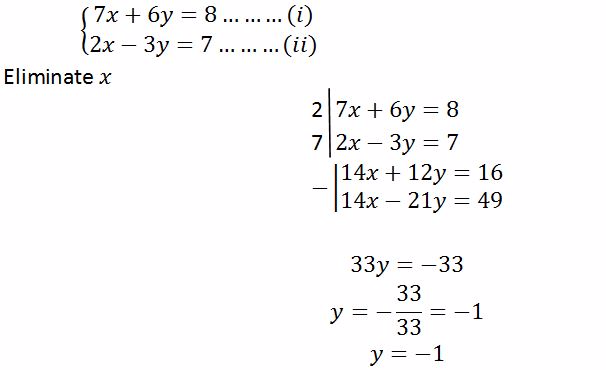
(b)Eliminate x
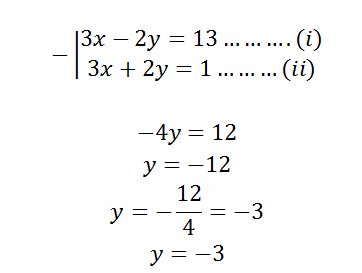
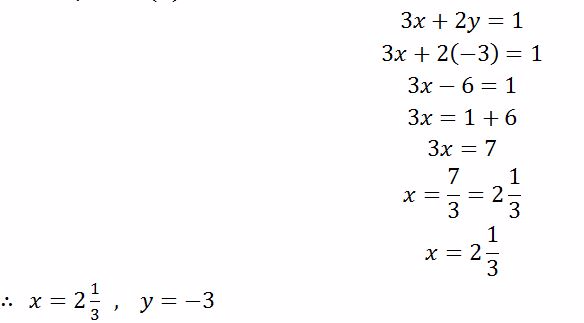
In order to find y, put x = 2 in either equation (i) or (ii)
From equation (ii)
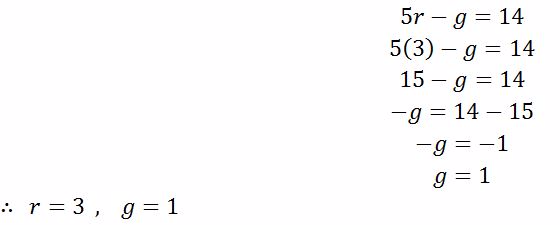
(c) Given
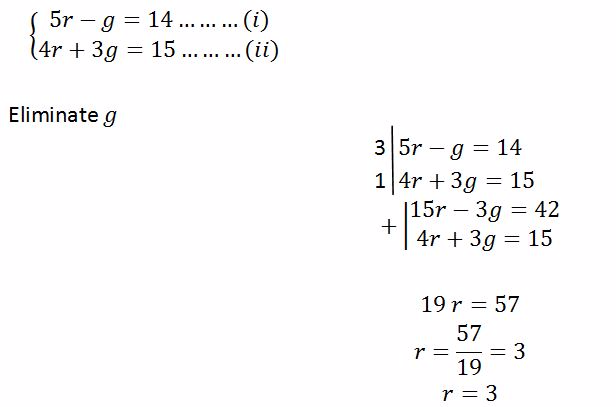
To find g put r = 3 in either equation (i) or (ii)
From equation (i)
(d) Given
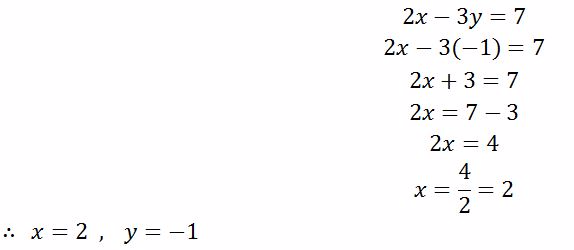
To find x, put y = - 1 in either equation(i) or (ii)
From equation (ii)
BY SUBSTITUTION
STEPS
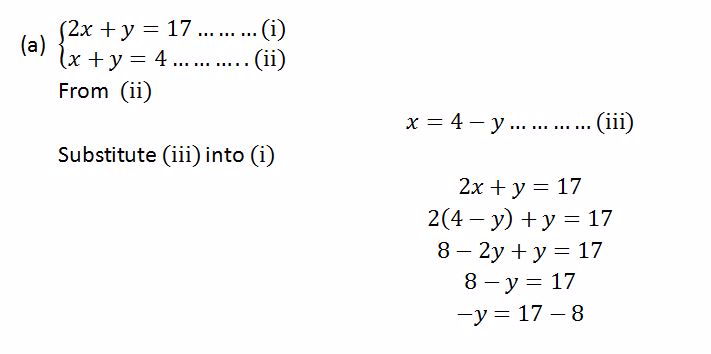
- Make the subject one letter in one of the two equation given
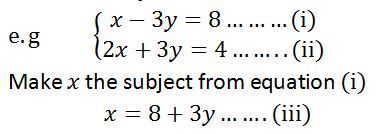
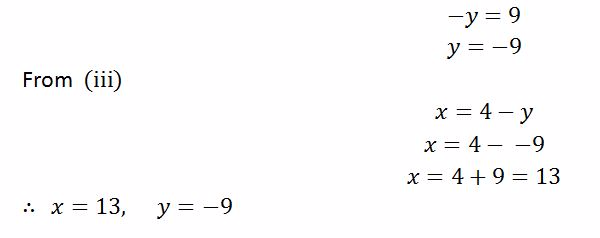
- Substitute the letter in the remaining equation and proceed as in case of elimination
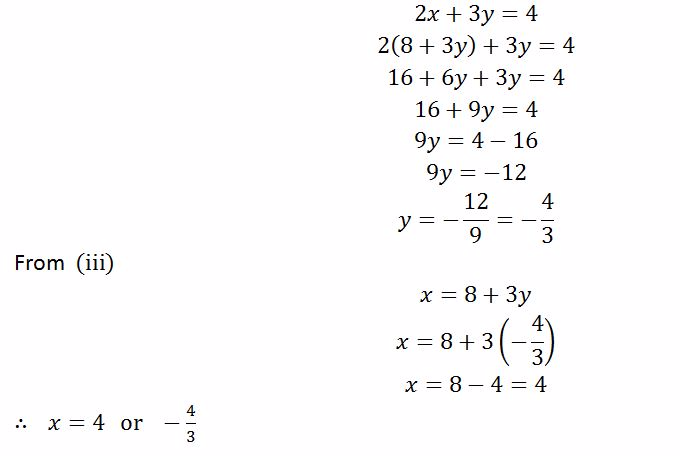
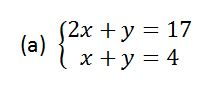
Example 9
Solve the following simultaneous equations by substitution method
Solution
Linear Simultaneous Equations from Practical Situations
Solve linear simultaneous equations from practical situations
<!--[endif]-->Simultaneous equations can be used to solve problems in real life involving two variables
Example 10
If
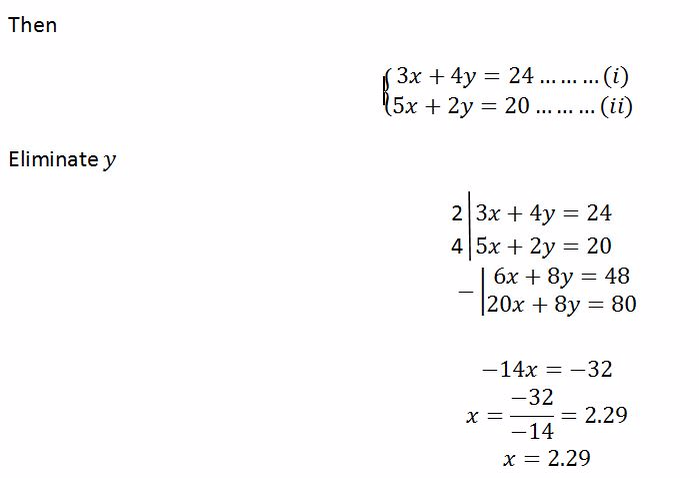
3 Mathematics books and 4 English books weighs 24 kg and 5 Mathematics
books and 2 English books weighs 20 kg, find the weight of one
Mathematics book and one English book.
Solution
Let the weight of one Mathematics book = x and
Let the weight of one English book = y
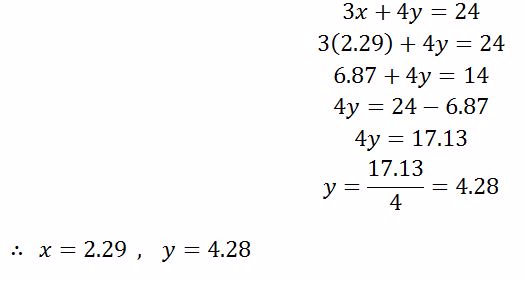
To find y, put x = 2.29 in either equation (i) or (ii)
From equation(i).
An
inequality – is a mathematical statement containing two expressions
which are not equal. One expression may be less or greater than the
other.The expressions are connected by the inequality symbols<,>,≤
or≥.Where< = less than,> = greater than,≤ = less or equal and ≥ =
greater or equal.
Linear Inequalities with One Unknown
Solve linear inequalities in one unknown
An
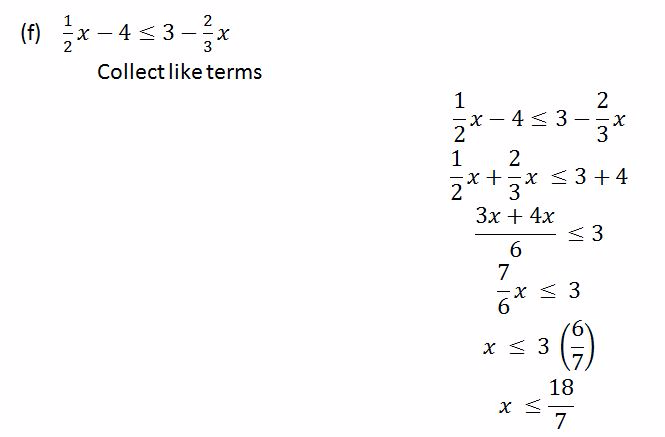
inequality can be solved by collecting like terms on one side.Addition
and subtraction of the terms in the inequality does not change the
direction of the inequality.Multiplication and division of the sides of
the inequality by a positive number does not change the direction of the
inequality.But multiplication and division of the sides of the
inequality by a negative number changes the direction of the inequality
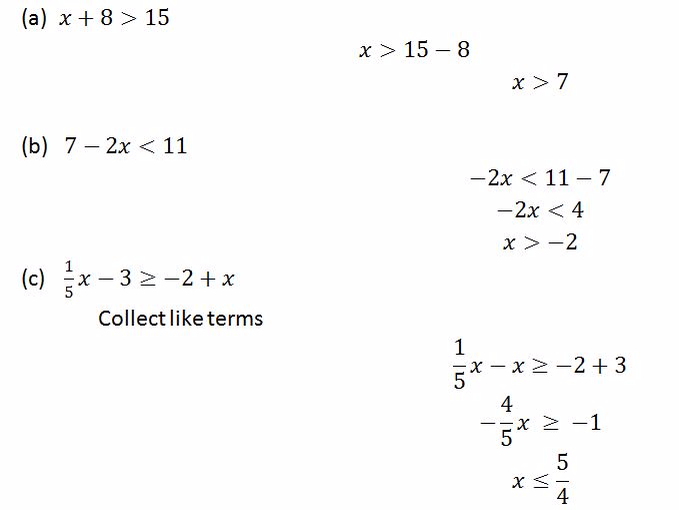
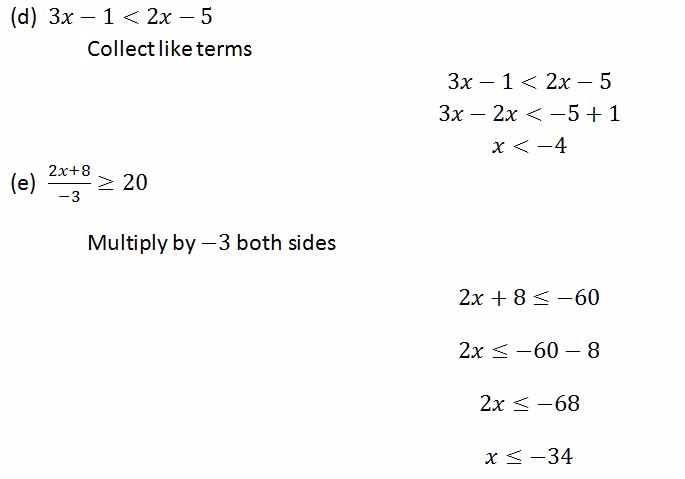
Example 11
Solve the following inequalities

Solution
Linear Inequalities from Practical Situations
Form linear inequalities from practical situations
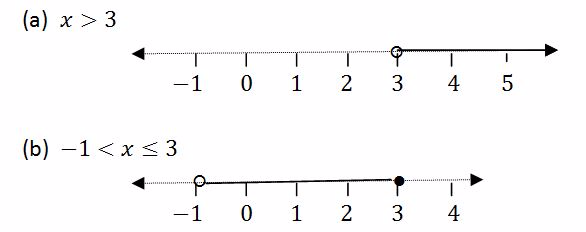
To represent an inequality on a number line, the following are important to be considered:
- The endpoint which is not included is marked with an empty circle
- The endpoint which is included is marked with a solid circle
Example 12
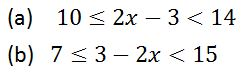
Compound statement – is a statement made up of two or more inequalities
Example 13
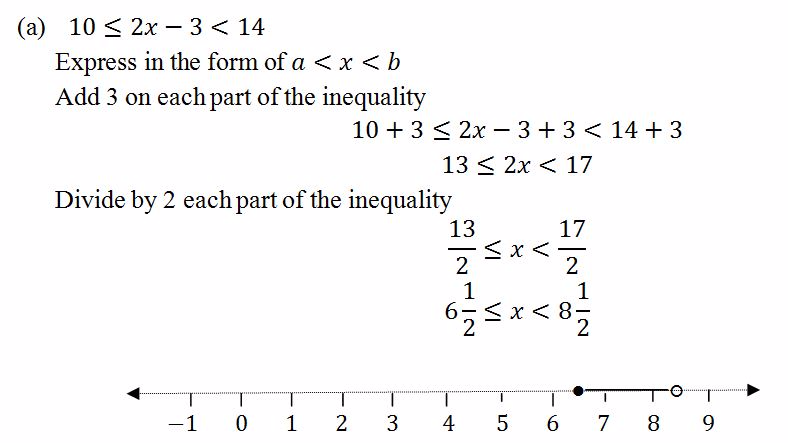
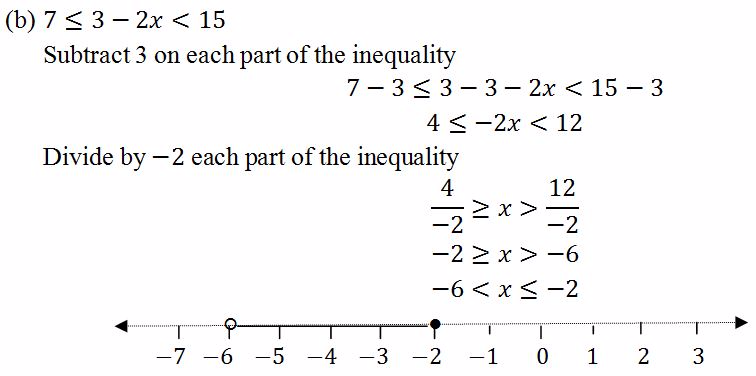
Solve the following compound inequalities and represent the answer on the number line
Solution
TOPIC 8: NUMBERS
A Rational Number
Define a rational number
ARational Numberis a real number that can be written as a simple fraction (i.e. as aratio). Most numbers we use in everyday life are Rational Numbers.
| Number | As a Fraction | Rational? |
|---|---|---|
| 5 | 5/1 | Yes |
| 1.75 | 7/4 | Yes |
| .001 | 1/1000 | Yes |
| -0.1 | -1/10 | Yes |
| 0.111... | 1/9 | Yes |
| √2(square root of 2) | ? | NO ! |
The square root of 2 cannot be written as a simple fraction! And there are many more such numbers, and because they arenot rationalthey are calledIrrational.
The Basic Operations on Rational Numbers
Perform the basic operations on rational numbers
Addition of Rational Numbers:
To
add two or morerational numbers, the denominator of all the rational
numbers should be the same. If the denominators of all rational numbers
are same, then you can simply add all the numerators and the denominator
value will the same. If all the denominator values are not the same,
then you have to make the denominator value as same, by multiplying the
numerator and denominator value by a common factor.
Example 1
1⁄3+4⁄3=5⁄3
1⁄3 +1⁄5=5⁄15 +3⁄15 =8⁄15
Subtraction of Rational Numbers:
To
subtract two or more rational numbers, the denominator of all the
rational numbers should be the same. If the denominators of all rational
numbers are same, then you can simply subtract the numerators and the
denominator value will the same. If all the denominator values are not
the same, then you have to make the denominator value as same by
multiplying the numerator and denominator value by a common factor.
Example 2
4⁄3 -2⁄3 =2⁄3
1⁄3-1⁄5=5⁄15-3⁄15=2⁄15
Multiplication of Rational Numbers:
Multiplication
of rational numbers is very easy. You should simply multiply all the
numerators and it will be the resulting numerator and multiply all the
denominators and it will be the resulting denominator.
Example 3
4⁄3x2⁄3=8⁄9
Division of Rational Numbers:
Division
of rational numbers requires multiplication of rational numbers. If you
are dividing two rational numbers, then take the reciprocal of the
second rational number and multiply it with the first rational number.
Example 4
4⁄3÷2⁄5=4⁄3x5⁄2=20⁄6=10⁄3
Real Numbers
Real Numbers
Define real numbers
he
type of number we normally use, such as 1, 15.82, −0.1, 3/4,
etc.Positive or negative, large or small, whole numbers or decimal
numbers are all Real Numbers.
They are called "Real Numbers" because they are not Imaginary Numbers.
Absolute Value of Real Numbers
Find absolute value of real numbers
The
absolute value of a number is the magnitude of the number without
regard to its sign. For example, the absolute value of 𝑥 𝑜𝑟 𝑥
written as 𝑥 . The sign before 𝑥 is ignored. This is because the
distance represented is the same whether positive or negative. For
example, a student walking 5 steps forward or 5 steps backwards will be
considered to have moved the same distance from where she originally
was, regardless of the direction.
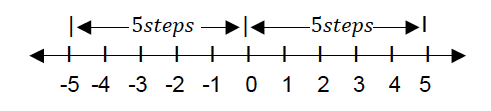
The 5 steps forward (+5) and 5 steps backward (-5) have an absolute value of 5
Thus |𝑥| = 𝑥 when 𝑥 is positive (𝑥 ≥ 0), but |𝑥| = −𝑥 when 𝑥 is negative (𝑥 ≤ 0).
For example, |3| = 3 since 3 is positive (3 ≥ 0) And −3 = (−3) =3 since −3 is negative (3 ≤ 0)
Related Practical Problems
Solve related practical problems
Example 5
Solve for 𝑥 𝑖𝑓 |𝑥| = 5
Solution
For any number 𝑥, |𝑥| = 5, there are two possible values. Either 𝑥,= +5 𝑜𝑟 𝑥 = 5
Example 6
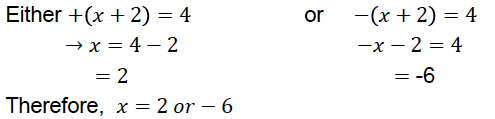
Solve for 𝑥, given that |𝑥 + 2| =4
Solution
TOPIC 9: RATIO, PROFIT AND LOSS.
Ratio
A ratio – is a way of comparing quantities measured in the same units
Examples of ratios
- A class has 45 girls and 40 boys. The ratio of number of boys to the number of girls = 40: 45
- A football ground 100 𝑚 long and 50 𝑚 wide. The ratio of length to the width = 100: 50
NOTE: Ratios can be simplified like fractions
- 40: 45 = 8: 9
- 100: 50 = 2: 1
A Ratio in its Simplest Form
Express a ratio in its simplest form
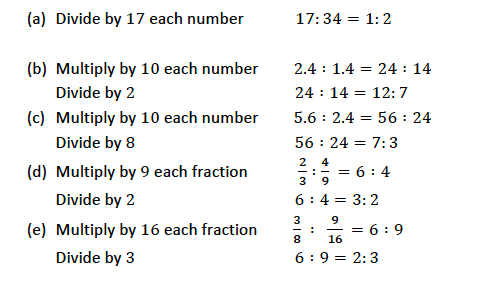
Example 1
Simplify the following ratios, giving answers as whole numbers
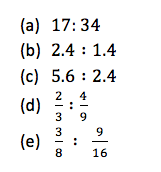
Solution
A Given Quantity into Proportional Parts
Divide a given quantity into proportional parts
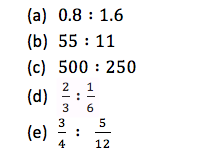
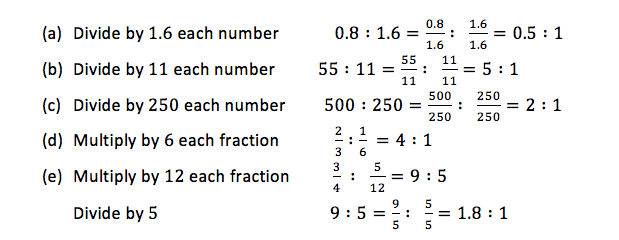
Example 2
Express the following ratios in the form of
Solution
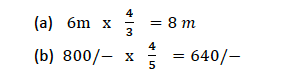
To increase or decrease a certain quantity in a given ratio, multiply the quantity with that ratio
Example 3
- Increase 6 𝑚 in the ratio 4 ∶ 3
- Decrease 800 /− in the ratio 4 ∶ 5
Solution
Profits and Loss
Profit or Loss
Find profit or loss
If
you buy something and then sell it at a higher price, then you have a
profit which is given by: Profit = selling price − buying price
If
you buy something and then sell it at a lower price, then you have a
loss which is given by: Loss = buying price − selling price
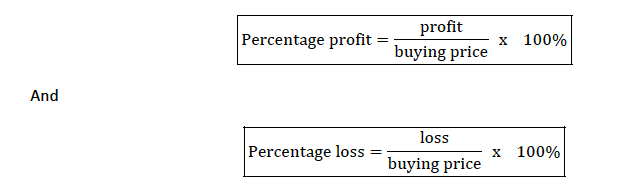
The profit or loss can also be expressed as a percentage of buying price as follows:
Percentage Profit and Percentage Loss
Calculate percentage profit and percentage profit and percentage loss
Example 4
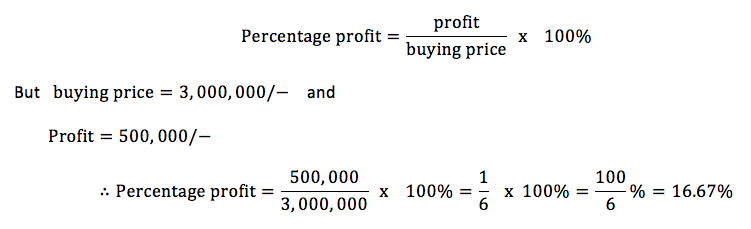
Mr. Richard bought a car for 3, 000, 000/− and sold for 3, 500, 000/−. What is the profit and percentage profit obtained?
Solution
Profit= selling price − buying price = 3,500,000-3,000,000=500,000
Therefore the profit obtained is 500,000/-
Example 5
Eradia bought a laptop for
Solution
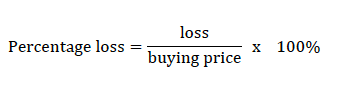
But buying price = 780, 000/− and loss = buying price − selling price = 780, 000 − 720, 000 = 60, 000/−

Simple Interest
Calculate simple interest
The amount of money charged when a person borrows money e. g from a bank is called interest (I)
The amount of money borrowed is called principle (P)
To calculate interest, we use interest rate (R) given as a percentage and is usually taken per year or per annum (p.a)

Example 6
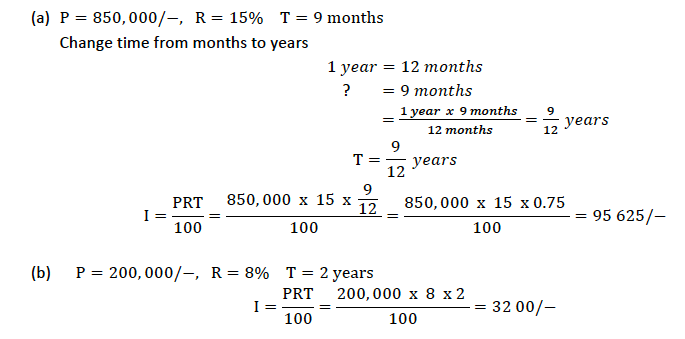
Calculate the simple interest charged on the following
- 850, 000/− at 15% per annum for 9 months
- 200, 000/− at 8% per annum for 2 years
Solution
Real Life Problems Related to Simple Interest
Solve real life problems related to simple interest
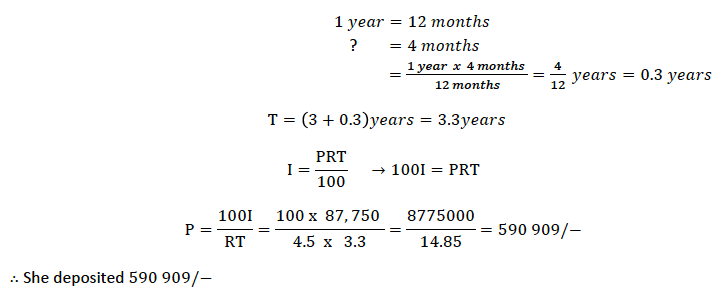
Example 7
Mrs.
Mihambo deposited money in CRDB bank for 3 years and 4 months. A t the
end of this time she earned a simple interest of 87, 750/− at 4.5% per
annum. How much had she deposited in the bank?
Solution
Given I = 87, 750/− R = 4.5% % T = 3 years and 4 months
Change months to years
FORM ONE MATHEMATICS TOPIC 1-3.
FORM ONE MATHEMATICS STUDY NOTES TOPIC 4-6.
FORM ONE MATHEMATICS STUDY NOTES TOPIC 7-9.
FORM ONE MATHEMATICS STUDY NOTES TOPIC 10-11.
O'LEVEL MATHEMATICS NOTES
FORM ONE MATHEMATICS STUDY NOTES
FORM TWO MATHEMATICS STUDY NOTES
FORM THREE MATHEMATICS STUDY NOTES
FORM FOUR MATHEMATICS STUDY NOTES


No comments