
FORM TWO MATHEMATICS STUDY NOTES TOPIC 3-4

Solving
quadratic equations can be difficult, but luckily there are several
different methods that we can use depending on what type of quadratic
that we are trying to solve. The four methods of solving a quadratic
equation are factoring, using the square roots, completing the square
and the quadratic formula.
The standard form of a Quadratic equation is ax2 + bx + c =0whereby a, b, c are known values and ‘a’ can’t be 0. ‘x’ is a variable (we don’t know it yet). a is the coefficient of x2 , b is the coefficient of x and c is a constant term. Quadratic equation is also called an equation of degree 2 (because of the 2 on x). There are several methods which are used to find the value of x. These methods are:
- by Factorization
- by completing the square
- by using quadratic formula
The Solution of a Quadratic Equation by Factorization
Determine the solution of a quadratic equation by factorization
We
can use any of the methods of factorization we learnt in previous
chapter. But for simplest we will factorize by splitting the middle
term. For Example: solve for x, x2 + 4x = 0
solution
Since the constant term is 0 we can take out x as a common factor.
So, x2 + 4x = x(x + 4) = 0. This means the product of x and (x + 4) is 0. Then, either x = 0 or x + 4 = 0. If x + 4 = 0 that is x = -4. Therefore the solution is x = 0 or x = -4.
Example 1
Solve the equation: 3x2 =- 6x – 3.
first rearrange the equation in its usual form.
that is:
3x2 = - 6x – 3
3x2 + 6x + 3 = 0
now, factorize the equation by splitting the middle term. Let us find two numbers whose product is 9
and their sum is 6. The numbers are 3 and 3. Hence the equation 3x2 + 6x + 3 = 0 can be written as:
3x2 + 3x + 3x + 3 = 0
3x(x + 1) + 3(x + 1) = 0
(3x + 3)(x + 1) (take out common factor which is (x + 1))
either (3x + 3) = 0 or (x + 1) = 0
therefore 3x = -3 or x = -1
x = -1 (divide by 3 both sides) or x = -1
Therefore, since the values of x are identical then x = -1.
Example 2
solve the equation 10 – 3y - 1 = 0 by factorization.
Solution
Two numbers whose product is -10 and their sum is -3 are 2 and -5.
Then, we can write the equation 10y2 – 3y - 1 = 0 as:
2y(5y + 1) – 1(5y + 1) = 0
(2y – 1)(5y + 1) = 0
Therefore, either 2y – 1 = 0 or 5y + 1 = 0

Example 3
solve the following quadratic equation by factorization: 4x2 - 20x + 25 = 0.
Solution
We need to split the middle term by the two numbers whose product is 100 and their sum is -20. The numbers are -10 and -10.
The equation can be written as:
4x2 -10x - 10x + 25 = 0
2x(2x - 5) – 5(2x -5) = 0
(2x – 5)(2x - 5) (take out common factor. The resulting factors are identical. This is a perfect square)
since it is a perfect square, then we take one factor and equate it to 0. That is:
2x – 5 = 0
2x = 5 then, divide by 2 both sides.
Therefore

Example 4
solve the equation x2 - 16 = 0.
Solution
We can write the equation as x2 - 42 = 0. This is a difference of two squares. The difference of two squares is an identity of the form:
a2 - b2 = (a - b)(a + b).
So, x2 - 42 = (x - 4)(x + 4) = 0
Now, either x- 4 = 0 or x + 4 = 0
Therefore x = 4 or x = -4
The Solution of a Quadratic Equation by Completing the Square
Find the solution of a quadratic equation by completing the square
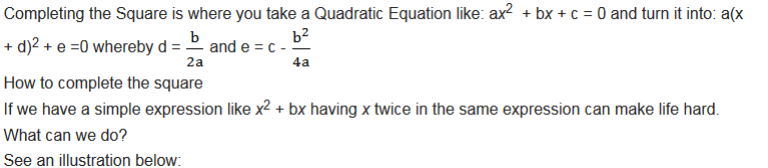
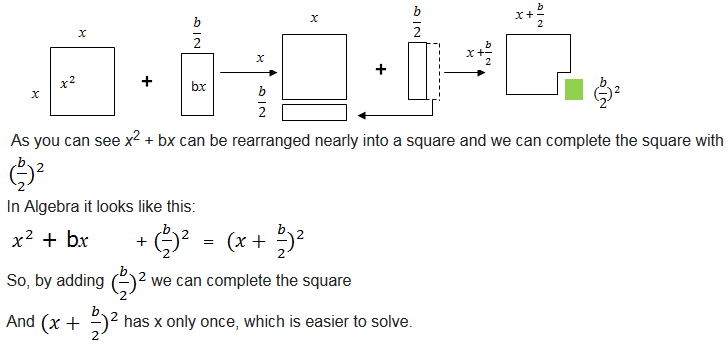
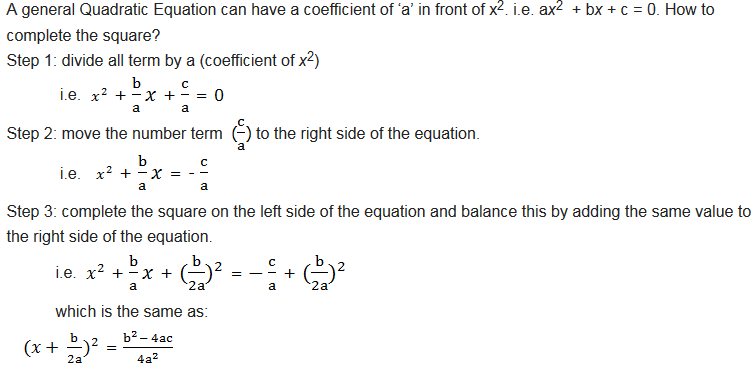
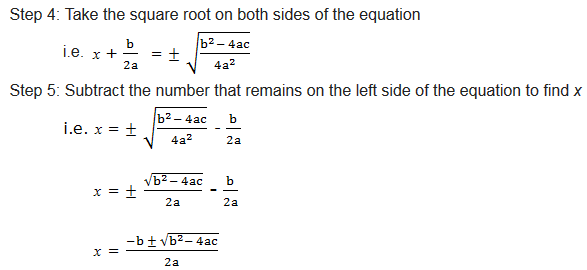
Completing the square.
Example 5
Add a term that will make the following expression a perfect square: x2 - 8x
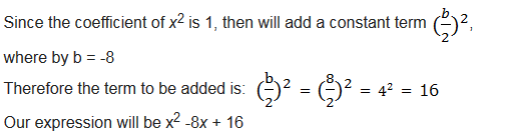
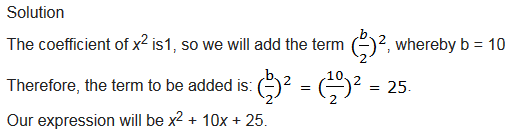
find a term that must be added to make the following expression a perfect square: x2 + 10x
Example 6
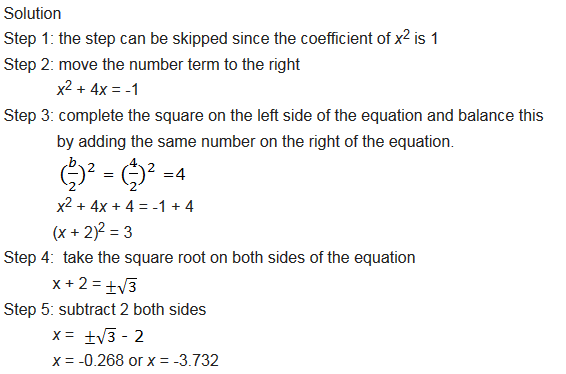
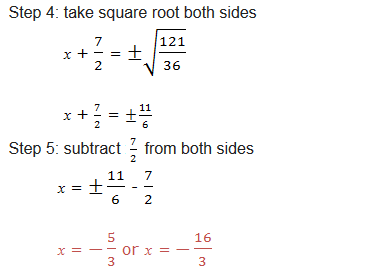
solve the following quadratic equation by completing the square: x2 + 4x + 1 = 0
Example 7
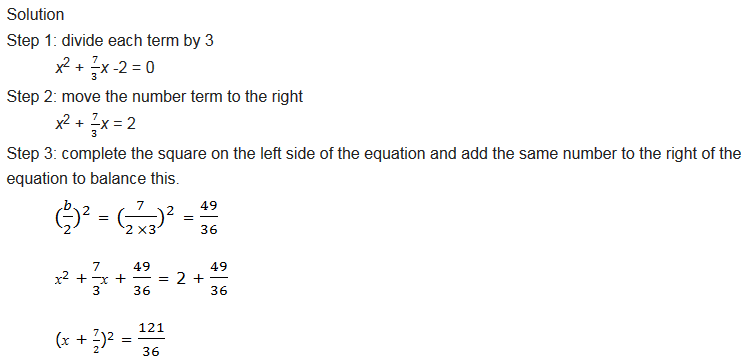
solve by completing the square: 3x2 + 7x – 6 = 0
General Solution of Quadratic Equations
The Quadratic Formula
Derive the quadratic formula
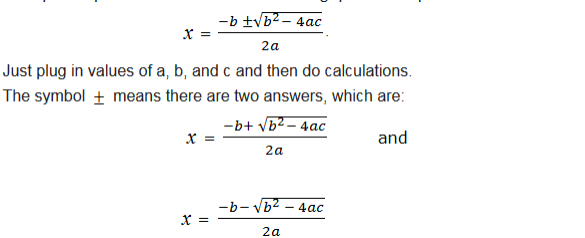
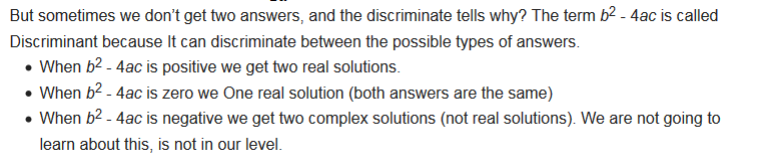
The special quadratic formula used for solving quadratic equation is:
Quadratic Equations using Quadratic Formula
Solve quadratic equations using quadratic formula
Example 8
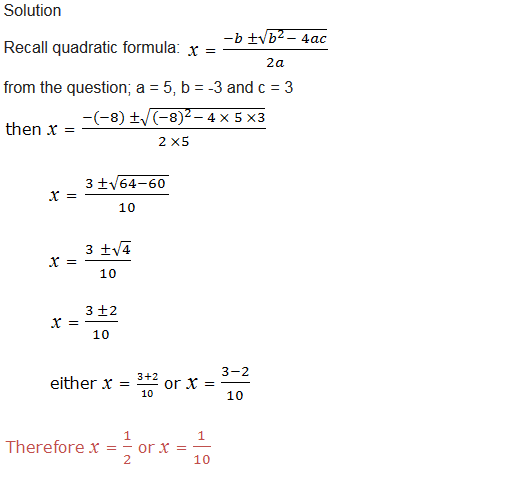
solve 5x2 – 8x + 3 = 0 by using quadratic formula.
Example 9
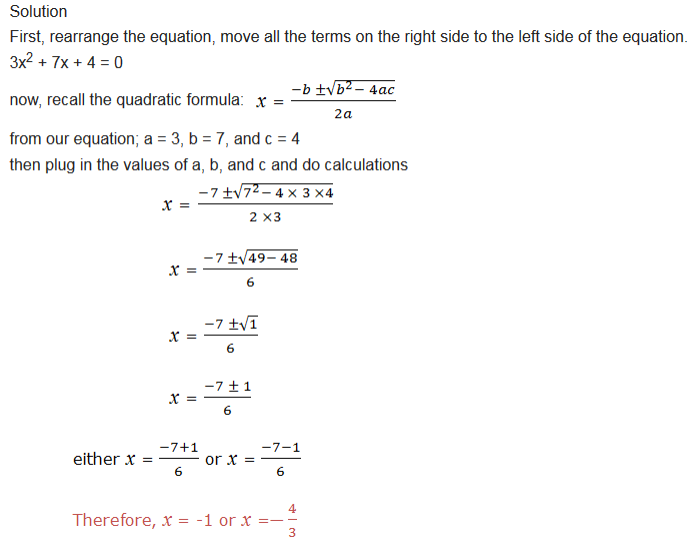
solve this quadratic equation by using quadratic formula: 3x2 = - 7x - 4
Word problems leading to quadratic equations
Given a word problem; the following steps are to be used to recognize the type of equation.
Step1: choose the variables to represent the information
Step 2: formulate the equation according to the information given
Step 3: solve the equation by using any of the method you know
In order to be sure with your answers, check if the solution you obtained is correct.
Example 10
the length of a rectangular plot is 8 centimeters more than the width. If the area of a plot is 240cm2, find the dimensions of length and width.
Solution
Let the width be x
The length of a plot is 8 more than the width, so the length of a plot be x + 8
We are given the area of a plot = 240cm2 and the area of a rectangle is given by length ×width
then (x + 8) × x = 240
x2 + 8x = 240
rearrange the equation
x2 + 8x – 240 = 0
then solve the equation to find the value of x
Solving by splitting the middle term, two numbers whose product is -240 and their sum is 8, the number
are -12 and 20
our equation becomes; x2 + 20x – 12x – 240 = 0
x(x + 20) – 12(x + 20) = 0
either (x - 12) = 0 or (x + 20) = 0
x = 12 or x = -20
since we don’t have negative dimensions, then the width is 12cm and the length is 12 + 8 = 20cm
Therefore the rectangular plot has the length of 20cm and the width of 12cm.
Example 11
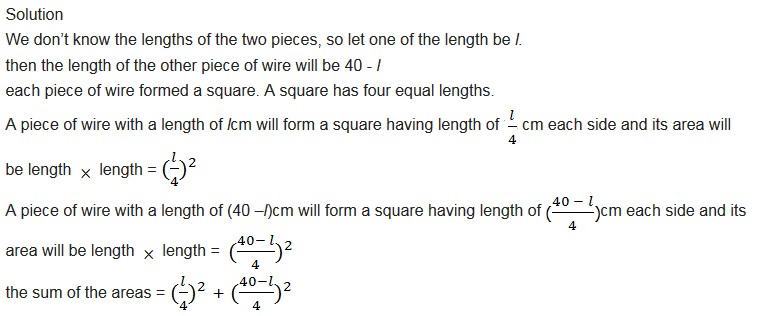
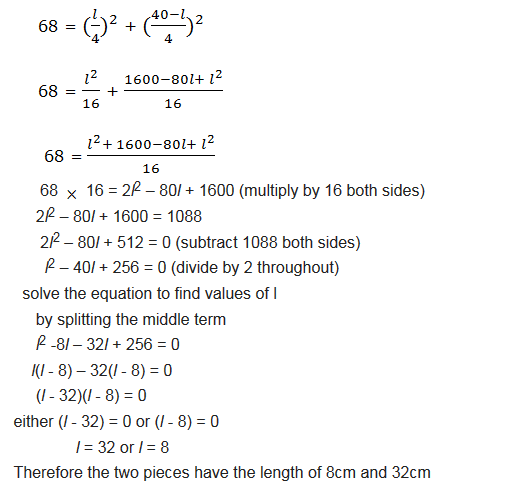
A
piece of wire 40cm long is cut into two parts and each part is then
bent into a square. If the sum of the areas of these squares is 68
square centimeters, find the lengths of the two pieces of wire.
Exercise 1
1. Solve each of the following quadratic equations by using factorization method:
- -6x2+ 23x – 20 = 0
- X2– x -12 = 0
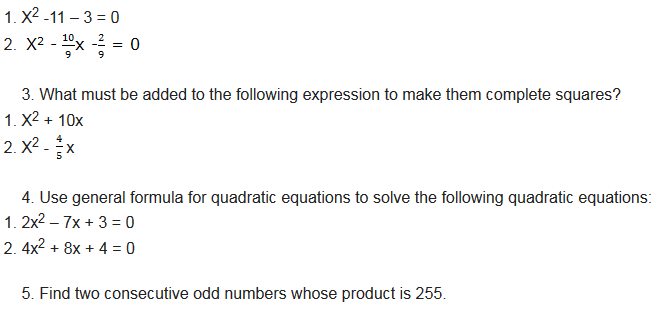
2. Solve these equations by completing the square:
We
always ask ourselves, how many of one number do we multiply to get
another number? For example; how many 3s do we multiply to get 81? All
these kind of questions will be answered in this unit. Make sure you
understand. Start reading now……!
Standard Form is also called Scientific Notation. It is a way of writing a number into two parts. For example
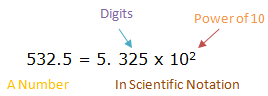
- Thedigits(with the decimal point placed after the first digit) followed by
- X 10 to a powerthat puts a decimal point where it should be (i.e. it shows how many places to move the decimal point).
Numbers in Standard Form
Write numbers in standard form
How to write a number in standard form?
To figure out the power of 10, think of how many decimal places to move:
- When the number is 10 or greater, the decimal place has to move to the left and the power of 10 will be positive. For example; 47 055 = 4. 7055 x 104
- When the number is smaller than 1, the decimal point has to move to the right and the power of 10 will be negative. For example;
0.00025 will be written as 2.5 x 10⁻⁴
For example; 4.5 would be written as 4.5 x100 we didn’t have to move the decimal point, so the power is 100. But now it is in standard form.
Note
that: After putting the number in scientific notation make sure that
the digits part is between 1 and 10 (it can be 1 but never 10). And the
power part shows exactly how many places to move the decimal point.
Computations which Involved Multiplication and Division of Numbers Expressed in Standard Form
Perform computations which involved multiplication and division of numbers expressed in standard form
Definition of a logarithm
A
logarithm answers the question: How many of one number do we multiply
to get another number. For example; how many of 2s do we multiply to get
16? Answer: 2 x 2 x 2 x 2= 16 so we needed to multiply 4 of the 2s to
get 16. So the logarithm is 4.
How to write it?
We would write the number of 2s we need to multiply to get 16 is 4 as:
The two things are the same:

The
number we are multiplying is called the base. So we can say ‘the
logarithm of 16 with base 2 is 4’ or ‘log base 2 of 16 is 4’ or 'the
base-2 log of 16 is 4’.
Not that we are dealing with 3 numbers:
- The base (the number we are multiplying in our example it is 2)
- How many times to use it in multiplication (in our example it is 4 times, which is the logarithm)
- The number we want to get (in our example it is 16)
There
is a relationship between the exponents and logarithms. The exponent
says how many times to use the number in a multiplication and logarithm
tells you what the exponent is. See the illustration below:
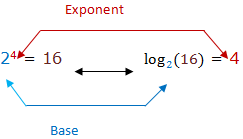
Generally: ax = y in logarithmic form is: LogaY = X
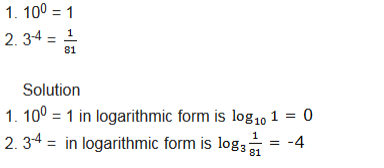
Example 1
write the following statements in logarithmic form:
The Laws of Logarithms
State the laws of logarithms
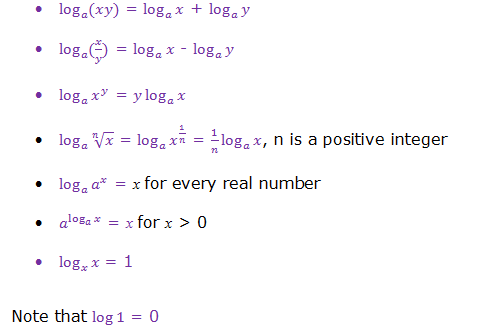
There
are several laws of logarithms which help in evaluating them. These
laws are valid for only positive real numbers. The laws are as follows:
Verification of the Laws of Logarithms Using the Knowledge of Exponents
Verify the laws of logarithms using the knowledge of exponents
Activity 1
Verify the laws of logarithms using the knowledge of exponents
The Laws of Logarithms to Simplify Logarithmic Expressions
Use the laws of Logarithms to simplify logarithmic expressions
Example 2
Use the laws of logarithms to evaluate the following:
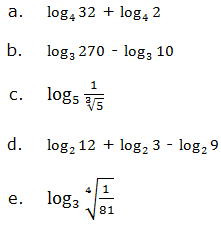
Solution
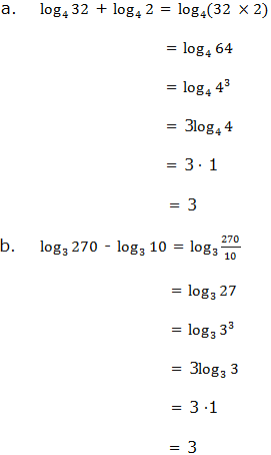
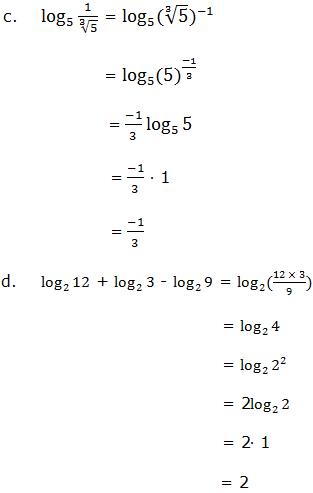
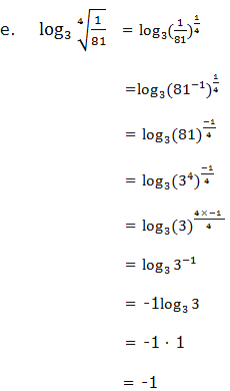
Change of base
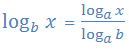
This is a formula for change of base. For any positive a, b (a, b ≠0) we have
Given,
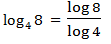
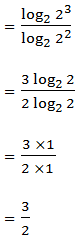
then find a number which is a common base to both 8 and 4
Example 3
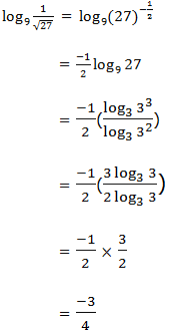
Solve.
Logarithms to Base 10
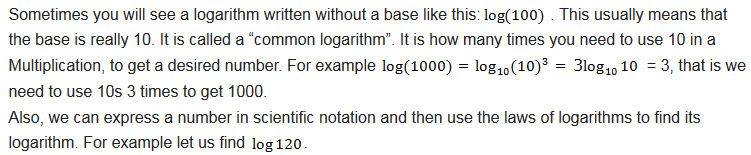
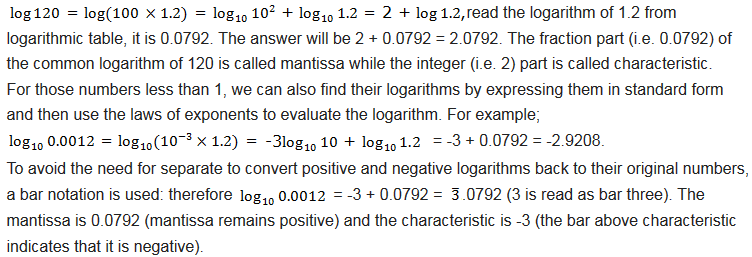
Logarithmic Equation
Solve logarithmic equation
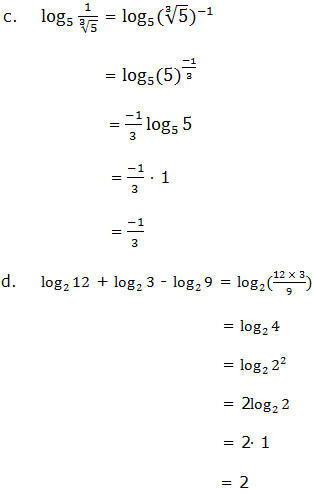
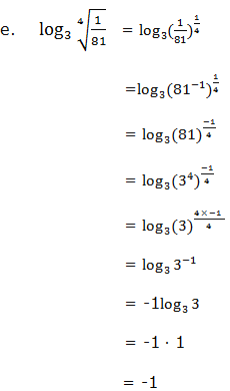
Use the laws of logarithms to evaluate the following:
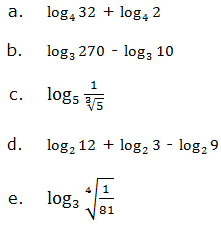
Solution
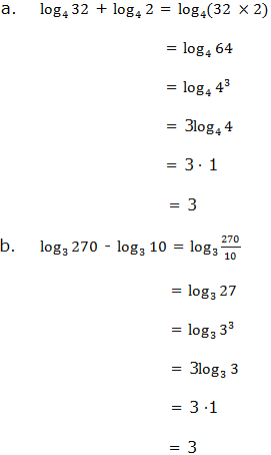
Laws of Logarithms to Find Products, Quotients, Roots and Powers of Numbers
Apply laws of logarithms to find products, quotients, roots and powers of numbers
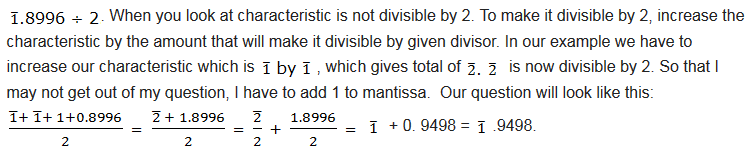
Here
we deal with all 4 operations which are addition, subtraction,
multiplication and division. All operations are just as usual operations
except division when we are given a negative characteristic. For
example;
Example 4
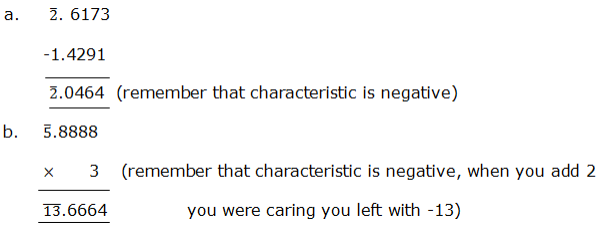
evaluate the following:
Logarithmic Tables to Find Products and Quotients of Numbers Computation
Apply logarithmic tables to find products and quotients of numbers computation
Most
of the logarithmic tables are of base 10 (common logarithms). When we
want to read a logarithm of a number from logarithmic table, we first
check if the number is between 0 and 10 (but not 0 or 10) because the
table consists only of logarithms of numbers between 0 and 1.
For
example; what is the logarithm of 5.25 from the table. Our number is
between 0 and 1. We look at the most left column and find where 52 is
(we ignore the decimal point). Then slide your finger along this row to
the right to find column of the next digit in our example is 5. Read the
number where the row of 52 meets the column of 5. The logarithm of 5.25
is 0.7202.
If
the number has 4 digits like 15.27, we do the following. First of all,
checking our number we see that it is greater than 10. The number is
between 10 and 100. And we know that the logarithm of 10 is 1 and
logarithm of 100 is 2. So logarithm of 15.27 is between 1 and 2,
normally less than 2 but greater than 1, hence 1.something. That
something we need to find it in a logarithm table. Look at the most left
column the row labeled 15, then, slide your finger to the right to find
the column labeled 2. Read the number where the row of 15 meets the
column of 2, the number is 0.1818. We are remaining with one digit which
is 7. If your log table has a part with mean difference table, slide
your finger over to the column in that table marked with the next digit
of the number you are looking up, in our example it is 7. Slide over to
row 15 and mean difference 7. The row of 15 meets mean difference column
7 at number 20. Add the two numbers obtained (the mean difference
number is added to the last digits of our first number we obtained) i.e.
0.1818 + 20 = 1838. Now add characteristic which is 1 since 15.27 is
between 10 and 100. We get 1 +0.1838 = 1.1838. Therefore Log 15.27= 1.1838.
Note
that if you are given a number with more than 4 digits, first round off
the number to 4 digits and then go on with similar procedures as
explained in examples above.
To
find the number whose logarithm is known, we can call it ant-logarithm
the same logarithmic table can be used. For example to find the number
whose logarithm is 0.7597, look at the central part of the log table
find the number (mantissa) 7597. This is in the intersection of the row
labeled 57 and column 5. So the number is 575. But in order to get
correct answer we have to consider characteristic of our logarithm which
is 0. This means our number is between 0 and 10 because the numbers
whose logarithms are 0.something are between 0 and 10. Hence, we need to
place one decimal point from left to our number to make it be between 0
and 10. Therefore the number will be 5.75 i.e. log 5.75 = 0.7597, thus
antilog 0.7597= 5.75.
How to find the ant-log
Step1:
Understand the ant-log table. Use it when you have log of a number but
not the number itself. the ant-log is also known as the inverse log.
Step 2:
Write down the characteristic. This is the number before decimal point.
If you are looking up the ant-log of 2.8699, the characteristic is 2.
Remove it from the number you are looking up. But never forget it
because it will be used later. So it is better if you write it
somewhere.
Step 3:
Find the row in the most left column that matches the first two numbers
of the mantissa. Our mantissa is 8699. So run your finger down that
column until you find .86.
Step 4:
Slide your finger over to the column marked with the next digit of the
mantissa. For 2.8699, slide your finger along the row marked .86 to find
the intersection with column 9. This reads 7396. Write this down.
Step 5:
If your ant-log table has a table of mean difference, slide your finger
over to the column in that table marked with the next digit of the
mantissa. Make sure to keep your finger in the same row. Considering our
example, slide your finger over the to the last column in the table,
column 9. The intersection of row .86 and mean difference column 9 is
15. Write it down.
Step 6:
Add the two numbers obtained from the two previous steps. In our
example, these are 7396 and 15. Adding them i.e. 7396 + 15 = 7411.
Step 7:
Use characteristic to place decimal point. Our characteristic is 2,
which means our answer is between 100 and 1000 because log 100 = 2 and
log 1000 = 3. For the number 7411 to fall between 100 and 1000, the
decimal point should be placed after 3 digits. So, the final answer is
741.1 therefore the ant-log of 2.8699 is 741.1.
Example 5
Find the product of 25.75 ×450.
Solution;
From
Logarithmic laws we saw that multiplication of two numbers is the same
as addition of two the same two numbers. How to do it?
Let x = 25.75 ×450
log x = log (25.75 ×450)
which is the same as
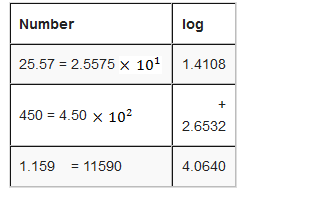
now, you can read log of your numbers from the logarithmic table as we learnt in the previous lesson, you will find:
log 25.75 = 1.4108 and log 450 = 2.6532
thus, log x = 1.4108 + 2.6532
log x = 4.0640
in order to obtain the value of x we have to find the inverse log of 4.0640 or ant-log of 4.0640
so, x = ant-log 4.0640
x = 11590
therefore, 25.75 ×450 = 11590
always the logarithmic calculations are set out in tabular form to make the solution not too long as above.
If we set our example in tabular form it will look like this:
Logarithmic Tables to Find Roots and Power of Numbers
Apply logarithmic tables to find roots and power of numbers
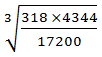
Example 6
Calculate using logarithms
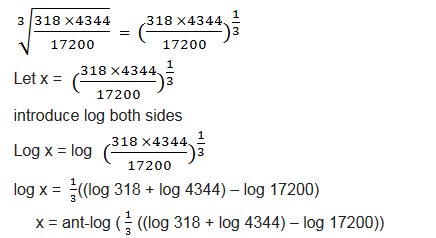
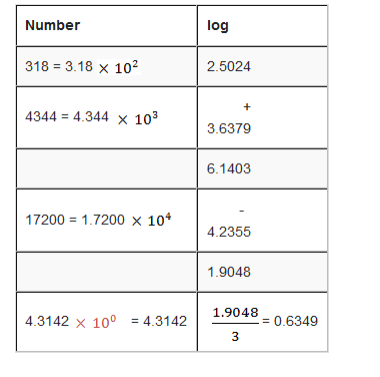
Solution
Exercise 1
1. Write each of the following in standard form:
- 167200
- 0.00235
- 245.750
- 45075
2. Write each of the following in decimal numerals:

FORM TWO MATHEMATICS STUDY NOTES TOPIC 1-2.
FORM TWO MATHEMATICS STUDY NOTES TOPIC 3-4
FORM TWO MATHEMATICS STUDY NOTES TOPIC 5-7
FORM TWO MATHEMATICS STUDY NOTES TOPIC 8-9.
FORM TWO MATHEMATICS STUDY NOTES TOPIC 10-11.


No comments