
CHEMISTRY FORM ONE STUDY NOTES TOPIC 3: HEAT SOURCES AND FLAMES, & TOPIC 4: SCIENTIFIC PROCEDURES.

TOPIC 3: HEAT SOURCES AND FLAMES
Heat sources
Most
chemical reactions require heat to proceed. It is therefore important
to have sources of heat in a laboratory for heating various reacting
substances. Sources of heat in a chemistry laboratory may include Bunsen
burner, candle, spirit burner, kerosene burner (stove), tin lamp (kibatari) and charcoal burner. These are burners commonly used in most school laboratories.
Different Heat Sources which can be Used in a Chemistry Laboratory
Name different heat sources which can be used in a chemistry laboratory
The
Bunsen burner is the best of all burners because it is convenient to
handle. Another advantage of the Bunsen burner is that it produces a hot
flame whose temperature is approximately 1000°C. The temperature can be
adjusted easily to produce a non-luminous flame, which does not produce
much soot.
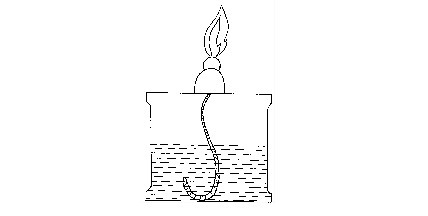
Spirit burner
The
spirit burner can also produce a soot-free flame. But the flame is not
hot enough to effect (produce) some chemical reactions. Apart from that,
the burner is filled with spirit, a substance that is highly flammable.
Spirit lamp
A candle
A
candle can only be used where a chemical reaction does not require much
heat. Its disadvantage is that it produces a lot of soot. The other
burners, though not commonly used, are an electric heater and a gas
burner.
The
electric heater uses electricity. The gas burner uses a liquefied gas.
The disadvantage of an electric burner is that it cannot be used in
rural areas where there is no electricity.
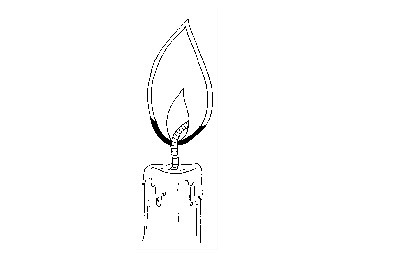
Candle
A kerosene burner
A kerosene burner (stove), also called jiko la mchina
in Swahili, if well adjusted can produce a flame hot enough to heat
many substances in the laboratory. It is fulled with kerosene, a fuel
that is convenient to carry and store. This fuel does not catch fire
easily as compared to spirit and it is affordable
It
can conveniently be used by schools in the most remote areas where
there is no electricity. If too much heating is required, wire gauze
should be placed on top of the burner. This will enable reduce soot and
increase the heating temperatures to about 1000°C or more.

Kerosene burner (stove)
A charcoal burner
A
charcoal burner can also be used in remove areas. In case the kerosene
burner is not available, for one reason or another, a charcoal burner
can be the best alternative.
The red-hot charcoal on the burner is almost soot-free. It can produce high temperature sufficient to carry out many reactions.

Charcoal burner
A tin lamp
A tin lamp (kibatari), though it produces a lot of soot, can also be used as a burner in a laboratory, especially in remote areas.
However, the heat it produces is not hot enough to initiate some reactions.
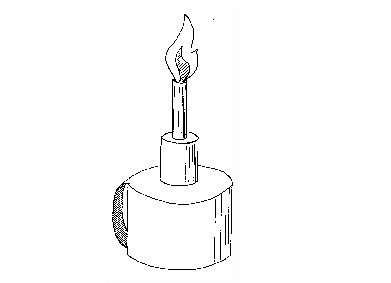
Tin lamp
The Functioning of a Bunsen Burner
Explain the functioning of a bunsen burner
Of
all the burners we have discussed so far, a Bunsen burner is the mostly
used. Therefore, we are going to discuss about the functioning of the
Bunsen burner in more detail. As the name suggests, this burner was
invented by a German scientist called Robert Bunsen, so it was named
after his name as a Bunsen burner. The burner uses coal gas, which burns
with a hot and non-luminous flame when the air holes are open. This is a
kind of flame we normally use in the laboratory.
Functions of different parts of the Bunsen burner
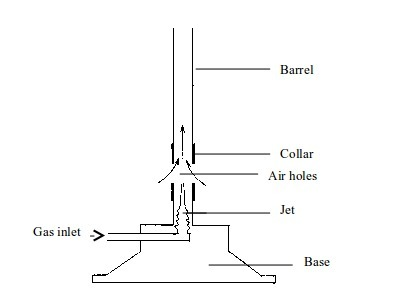
Base: Supports the burner. It makes the burner stable, due to its heavy weight, when placed on a bench.
Gas inlet: Lets the gas in from the gas supply.
Jet: Directs the gas to the barrel
Collar:
Regulates the amount of air entering the burner. It has air holes that
can be turned open or closed depending on the kind of flame, and hence
amount of heating required.
Air holes: These small holes on the collar allow air to enter in the burner.
Barrel: This is a part of the burner where air (from outside), and gas (from gas supply) mix up and burn.
How to light a Bunsen burner
After
knowing the different parts of the Bunsen burner, it is important that
you also learn how to light it. This is because careless use of the
burner may lead to accident or wastage of the gas. The following is a
correct sequence of steps on how to light the Bunsen burner:
- Connect the Bunsen burner by a rubber tube to the gas supply.
- Close the air holes.
- Turn the gas tap on to let in sufficient gas.
- Quickly bring a flame at the top of the barrel. You may use a matchstick, a lighter or wooden splint as a source of flame.
- Turn the collar to adjust the air holes until you get the type of flame you want. You may have the holes completely open.
- Adjust the gas tap until the gas supply is enough to produce a non-luminous flame.
To
put off the flame of the burner after you finish heating a substance,
turn the gas tap off in order to cut off the gas supply to the burner.
Disconnect the burner from the gas mains by removing the rubber tube
connecting the two. Then close the air holes. Pay attention not to touch
the hot collar with your fingers or else wait until it is cool enough.
Take the Bunsen burner and keep it at the appropriate place
Types of flame
Flames
are formed by burning gases or vapours. During burning, heat and light
are given out. For any solid or liquid to burn with a flame, it must
first turn into inflammable vapours (gaseous state).
Luminous and Non-luminous Flames from Different Types of Flames
Produce luminous and non-luminous flames from different types of flames
A
flame can be luminous or non-luminous. Flames of a candle and any oil
are usually smoky and luminous. Flames of such kind are normally of
little laboratory use. This is because they are not hot enough and would
deposit soot on laboratory apparatus. Coal gas also burns with a smoky
and luminous flame. With a Bunsen burner, one can produce two types of
flames namely, the luminous and non-luminous flames.
Luminous flame
This
is a type of flame produced when the air holes of a Bunsen burner are
closed. When the air holes are closed very little air enters the barrel
of the burner. In this case, the flame will be large, unsteady and
bright
The flame will have four main zones each having a distinct colour.
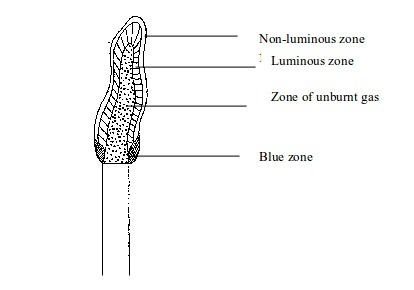
Luminous flame
- The inner dark zone - This is dark, cool and contains unburnt gas
- Luminous yellow zone - The gas burns in this zone but because the air is not enough the burning is incomplete. This leads to formation of tiny carbon particles from the gas. When these particles are white-hot, they result in formation of light (the yellow colour we see). If a cold evaporating dish, porcelain crucible, or glass is placed in this zone, it will blacken due to deposition of carbon particles (soot) on it.
- Outer zone - This is a non-luminous zone where the burning of the gas is complete due to presence of enough air. Because of the absence of carbon particles, this zone does not give out light. Consequently, the zone cannot be seen easily.
- Blue zone – Due to rising convectional current, there is sufficient supply of air for complete burning at this zone.
Non-luminous flame
When
air holes are fully opened, sufficient air enters the Bunsen burner
barrel and mixes well with the coal gas. Hence, the burning of the gas
is much quicker and complete. The flame is smaller and hotter.
Due
to absence of white-hot carbon, no light appears. The flame is
therefore non-luminous. The flame has three district zones each with a
different colour.
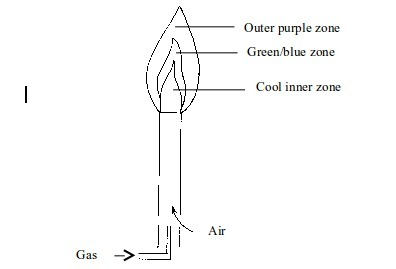
Non–luminous flame
- Cool inner zone – this is a zone of unburnt gas.
- Green/blue zone - part of the gas burns in this zone because there is not enough air to burn all the gas completely. However, no carbon is formed. The hottest part of the flame is at the tip of this zone.
- Outer purple zone – Burning of the gas in this zone is complete.
Major differences between luminous and non-luminous flames
| Non luminous flame | Luminous flame | |
| 1. | Formed when air holes are open | Formed when air holes are closed |
| 2. | Very noisy | Silent or calm |
| 3. | Comprises of three zones | Comprises of four zones |
| 4. | Forms no smoke or soot on apparatus | Forms a lot of smoke or soot on apparatus |
| 5. | Blue and almost invisible | Bright yellow and clearly visible |
| 6. | Very hot flame | Not a hot flame |
| 7. | Not bright | Very bright |
| 8. | Triangular flame | Wave-like flame |
Investigation of different parts of a flame
We can easily find out whether or not the inside of a flame is cool. Two experiments can prove this:
- (a) When a piece of cardboard is held horizontally over a non-luminous flame, we notice a burn mark as shown below:
When
held vertically over the flame, the burn mark is as shown in above.
Note that when performing this experiment, the cardboard should be
withdrawn from the flame just before it catches fire. We find that the
middle part of the cardboard does not get burned. This is the part in
the zone containing unburnt gas.
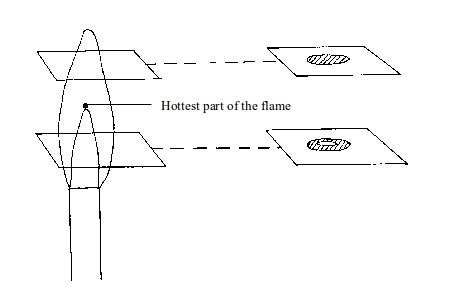
Burn mark on cardboard when held horizontally
(b)
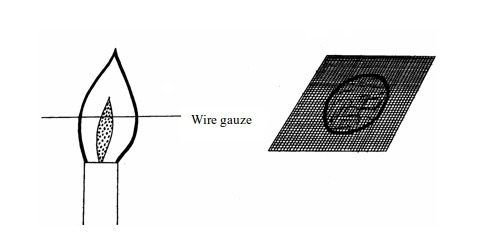
If the above experiment is repeated using a wire gauze, we notice that
the part in the middle will not become red hot except when the gauze is
held in the flame for a long time.
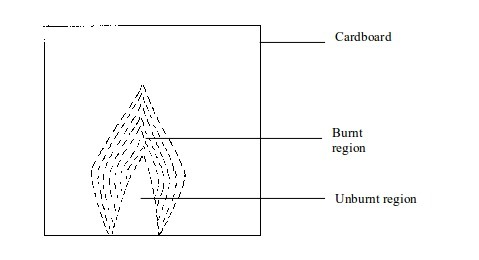
Burn mark on cardboard when held vertically
We
can prove the presence of unburnt gas in the Bunsen flame. This can be
done by inserting a glass tube into the flame as shown in figure bellow
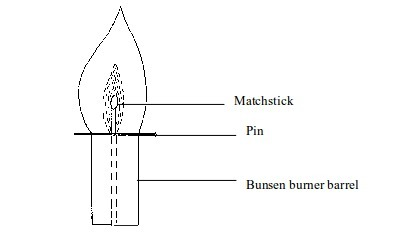
The
unburnt gas can be shown to have risen up the tube by putting a light
at the top of the tube. The flame will form. This indicates the escape
of unburnt gas through the tube.
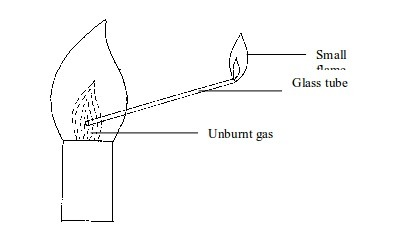
To indicate the presence of unburnt gas in a Bunsen burner flame
Uses of flames
Flames are used for different purposes. Some uses of the flames include the following:
- Production of heat for heating substances in the laboratory: In this case, a non-luminous flame, which produces much heat, is used. However, for reactions that require little heat, a luminous flame, which is not very hot, can be used.
- Flame tests for elements: In chemical analysis of some elements, a flame test is one of the preliminary tests normally used to identify an element. When some elements are strongly heated, they produce characteristic flame colours that distinguish them from one another. A non-luminous flame is often used.
- Production of light: Flames produce light that can be used to light a dark room. Therefore, an experiment that involves heating can even be conducted in the dark. The same flame is used to give heat as well as light. Here, a luminous flame is used. Examples of heat sources, which produce flames that may be used for lighting, are hurricane lamp, tin lamp, spirit lamp and candle.
- Cooking: Since it gives a hot flame and produces no soot, a non-luminous flame can be used for cooking food. Gas cookers, gas stoves and kerosene stoves usually produce such flames.
- Welding: A non-luminous flame is suitable for welding because it is very hot. In most welding operations, an oxyacetylene gas, a mixture of oxygen and ethyne, is used. When burned, the gas produces a flame hot enough to cut or melt the metal.
Significance of scientific procedure
The main steps of the scientific procedure
Each Step of the Scientific Procedure
Describe each step of the scientific procedure
Observation (identification) or statement of the problem
The
first step of the scientific procedure is to identify a researchable
problem. A problem is an obstacle that makes it difficult to achieve a
desired goal, objective or purpose. It refers to a situation, condition
or issue that is unresolved. Observation refers to identification of a
chemical phenomenon. This may include observing the colour, smell,
texture of a substance, and so on. Observing involves the use of senses
to obtain information. Observation is more than the bare fact of
observing. It is determined by use of five senses namely, smell, touch,
taste, vision and hearing. For example, to identify the colour of a
substance you have to see it with your eyes. The same case applies to
detection of the smell of a substance or gas produced by reacting
substances in a laboratory. To be able to detect the smell of a gas you
have to use your nose to smell it.
Observation
helps a scientist to identify a problem. Observation may involve making
measurements and collecting data. The data may be descriptive
(qualitative) or numerical (quantitative) in nature. Numerical
information such as the fact that a sample of sulphur powder measures
50g is quantitative. Non-numerical information, such as the fact that
the colour of anhydrous copper (II) sulphate is white, is qualitative.
Once
you identify a problem, it becomes easy to state it scientifically. For
example, you can observe that when you put a given volume of water in a
narrow container and expose it to open air, it takes much longer to
evaporate and decrease in volume. However, when you put the same amount
of water in a wide container, it takes a much shorter time to do so.
This phenomenon can be investigated scientifically.
Hypothesis formulation
After
identifying and stating the problem, you can formulate a testable
hypothesis for that problem. A hypothesis is a statement. It is a
prediction or proposed solution to a problem based on prior knowledge or
known information about a chemical phenomenon. It is a logical guess
about the outcome of the experiment. A hypothesis must be able to be
tested. Therefore, a hypothesis can be described as a tentative
explanation for an observation, phenomenon, or scientific problem that
can be tested by further investigation. It can be rejected, modified, or
accepted only after conducting an experiment to prove or disprove it.
Let
us take an example of water at the previous stage. It was observed that
the water held in a wide container evaporated faster than that in a
narrow container. Based on what we know about evaporation (prior
knowledge) we can formulate a hypothesis pertaining to this phenomenon.
It is well known that one of the factors affecting the rate of
evaporation is the surface area. From this fact, we can formulate a
testable hypothesis which states that “evaporation of water increases with increase in surface area of the container in which that water is placed”.
This is just a statement. It can be proved wrong or correct by setting
up and doing an experiment. Remember that this is just an example,
though not very much related to chemistry. We can turn to another
relevant example as well.
Now,
let us look at an example of anhydrous copper (II) sulphate. The
anhydrous salt is in powder form. When you expose this salt to open air,
it changes its colour and shape, from its original white powder to blue
crystals. Why does this happen? From our knowledge of the properties of
this salt (prior knowledge or information gathered) when it is placed
in open air, it absorbs water vapour from the air. It is this water
vapour which it absorbs that turns it blue. We can go as far as
formulating a hypothesis, which states that "When white anhydrous
copper (II) sulphate powder is exposed to open air, it absorbs water
vapour from the air and turns into blue crystals".
We still have a doubt about this hypothesis. How do we know that the
liquid absorbed by the salt is really water? To accept or reject this
hypothesis, we must conduct an experiment.
Experimentation
After
making a hypothesis, the next step is to plan and conduct an
experiment. Planning an experiment involves writing down steps for an
experiment that will answer the question. It should be remembered that
experimental plan should include short and clear steps. It should also
include the materials and methods that will be used in the experiment.
These may include safety gears such as goggles, gumboots, gloves, etc.
It must also state all expected hazards to be accompanied with the
reacting substances or chemical phenomena being experimented. This could
either occur as a result of mishandling chemicals or apparatus,
improper experimental procedure or even testing the products obtained
from the experiment.
In
the scientific method, an experiment is a set of observations
(qualitative or quantitative) made in the context of solving a
particular problem or question. An experiment is conducted in order to
retain or falsify a hypothesis concerning a particular phenomenon. The
experiment is a basis in the practical approach to acquiring deeper
knowledge about the chemical world.
Experimenting
involves carrying out a procedure under controlled conditions in order
to make observations and collect data. To learn more about matter,
chemists study systems. A system is a specific portion of matter in a
given region or space that has been selected for study during an
experiment or observation. When you observe a reaction in a test tube,
the test tube and its contents form a system.
Your
experiment tests whether your hypothesis is true or false. It is
important for your experiment to be a fair test. You conduct a fair test
by making sure that you change only one factor at a time while keeping
all other conditions the same (constant). These factors are also called
variables. They are the factors that affect the problem you want to
investigate. They can change or be changed during the experiment. Such
factors include temperature, volume, speed, light, concentration, light,
etc.
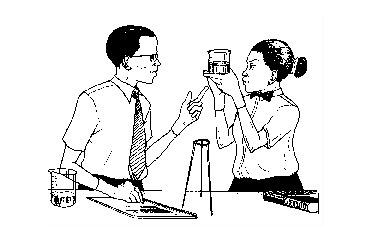
Students conducting an experiment
There are three types of variables. These are:
- Dependent variable: This is the factor that changes its value when the values of the other variables change. It is the value being measured.
- Independent variable: This is the factor that is manipulated so as to obtain different values.
- Controlled (or constant) variable: This is the factor that does not change, or is kept constant all the time. It does not affect the result of the experiment.
For
example, you might be interested to carry out an experiment to
determine the influence of the concentration of phosphorus fertilizer on
maize growth. To get the best results, you grow maize in similar
conditions of soil and atmospheric environment (controlled variable) but vary the quantity of fertilizer in each test (independent variable). Then you measure the height of maize plants (dependent valuable)
after a certain interval of time as shown in figure below. The value of
the height you will obtain will obviously depend on the amount
(concentration) of the fertilizer applied. This is a typical fair test.
However, most chemistry experiments do not involve fair tests.
Now,
let us turn back to our experiment. In the example of determining
whether the surface area increases the rate of evaporation or not, we
can design an experiment to prove or disprove this phenomenon. This is
conducted by filling a basin (with large surface area) and a bucket
(with small surface area) with 10 litres of water each. Then the two
containers are placed in open air for 3 days. Here, care must be taken
to place both containers under similar environmental conditions.
Containers must be of the same type, that is, both must be plastics,
metals, etc. In addition, the water used must be obtained from the same
source.
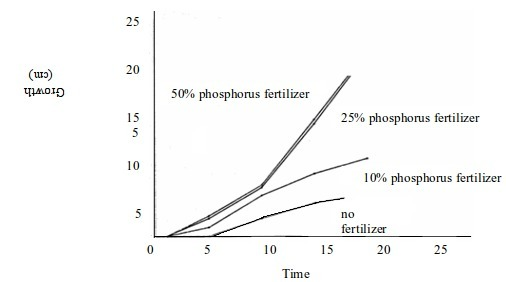
The effect of fertilizer on plant growth
The
only variable to be kept constant is the volume of water, which is set
to the volume of 10 litres. You should repeat your experiment several
times to make sure that the first results were not just an accident.

Determination of the effect of surface area on the rate of evaporation of water
Observation and collection of data
Observation
and recording of data must be done from the beginning to the end of the
experiment. Data is the information gathered during the experiment.
This can include descriptive (qualitative) and numerical (quantitative)
data. Numerical data is that which can be measured, for example, 10
litres of water, 5g of copper, a five centimetre long ribbon of
magnesium, etc. Qualitative data include information that cannot be
measured, e.g. colour, shape or appearance, smell, feel, etc. Recording
data is an important part of the scientific method because it helps
scientists organize their ideas and observations. Charts, graphs, lists,
diagrams, tables and even sketches are all the ways of recording data
during experiments. Records appearing in the form of tables are easy to
read, understand and interpret.
Continuing
with our hypothetical experiment for determining the effect of surface
area on the rate of evaporation, we expect that at the end of the
experiment the volume of water in each container will have dropped to a
certain extent.
We
also expect that the volume of water lost from the basin will be bigger
than that lost from the bucket. This means that more water will
evaporate from the basin than from the bucket. Considering that
scenario, we can then predict what the data can be like. Let us take
this model as a real experiment and assume the kind of results that
could be observed and collected during the experiment.
After
3 days of the experiment, water from each container was measured. The
results obtained were summarized in the following table.
Source: hypothetical
Data collected from evaporation experiment after 3 days
| Amount of water | Type of container | |
| Basin | Bucket | |
| Initial volume Final volume | 10 litres 7.0 litres | 10 litres 8.5 litres |
| Amount of water lost (evaporated off) | 3.0 litres | 1.5 litres |
Data analysis and interpretation
Once
your experiment is complete and after you have collected data, you
analyse your data to see if your hypothesis is true or false. In table
4.1, we find that, at the end of the experiment, 3 litres of water had
evaporated off from the basin as compared to 1.5 litres from the bucket.
What does this data tell us? What is it trying to reveal? This means
that from the basin (with large surface area) water evaporated faster
than that from the bucket (with small surface area). The data reveals
the fact that surface area plays a major role in evaporation of water
and many other liquid substances.
However,
you may sometimes get unexpected results. You may find that your
hypothesis was false. In such a case, you will construct a new
hypothesis and start the entire process of the scientific method over
again. Even if you find that your hypothesis was true, you may want to
test it again in a new way.
Conclusion
The
last stage (at this level of study) of the scientific method is to make
inferences and draw a conclusion. Scientists look at the information
they gathered and observed. Then they make connections to draw a
conclusion. These conclusions may be or may not be in agreement with
their predictions. Scientists make incorrect predictions all the time.
An important part of the scientific process is to understand why
predictions were incorrect. Many scientists will repeat an experiment
several times to see if they can replicate the results before
concluding. This ensures that they have conducted the experiment the
same way each time and make sure no introduced errors or outside factors
affected the experiment's outcome.
Based
on data in a hypothetical experiment above, we found that 3.0 litres of
water evaporated from the basin (a container with wide mouth and hence a
large surface area). At the same time, 1.5 litres of water evaporated
from a bucket (a container with a narrow mouth and hence a small surface
area). From this result, of course, we can conclude that evaporation of water increases with increase in surface area of the container in which that water is kept.
Therefore, our hypothesis is proved true and correct. Remember always
to base your conclusion on the collected and analysed data, though it
may deviate, to some extent, from the reality for one reason or another.
ADDITIONAL NOTES ON SCIENTIFIC PROCEDURE
In
advanced study, the last step of the scientific method is to share what
you have learned. Scientists share information so that others can use
the findings to create different questions and conduct different
experiments. Sharing information is an important part of working
together. Professional scientists will publish their final reports in
scientific journals, magazines, books, or even present their results at
scientific conferences. For the purpose of study at this level, the last
step is conclusion.
Even
though we show the scientific procedure as a series of steps, keep in
mind that new information or thinking might cause a scientist to back up
and repeat steps at any point during the process. A process like the
scientific method that involves such backing up and repeating is called
an iterative process. Therefore, the scientific process is an iterative process.


No comments