
FORM TWO MATHEMATICS STUDY NOTES TOPIC 8-9.

Pythagoras Theorem
Triangle
with a Right angle i.e. 90° has an amazing property. Do you want to
know what property is that? Go on, read our notes to see the amazing
property of a right angled triangle.
Pythagoras Theorem deals only with problems involving any Triangle having one of its Angles with 900. This kind of a Triangle is called Right angled triangle.
When triangle is a right angled triangle, squares can be made on each of the three sides. See illustration below:
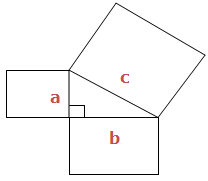
The
Area of the biggest square is exact the same as the sum of the other
two squares put together. This is what is called Pythagoras theorem and
it is written as:
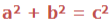
that is:
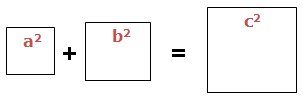
‘c’ is the Longest side of the Triangle, is called Hypogenous and is the one that forms the biggest square. a and b are the two smaller sides.
The Pythagoras Theorem
Prove the pythagoras theorem
Pythagoras
theorem states that: In a Right Angled Triangle, the sum of squares of
smaller sides is exactly equal to the square of Hypotenuse side (large
side). i.e. a2 + b2 = c2
Take a look on how to show that a2 + b2 = c2
See the figure below:
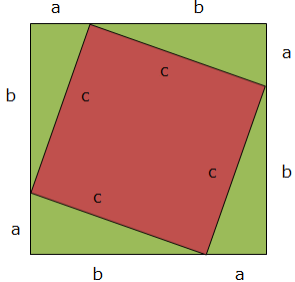
The area of a whole square (big square)
A big square is the one with sides a + b each. Its area will be:
(a + b) ×(a + b)
Area of the other pieces
First, area of a smaller square (tilted) = c2
Second, area of the equal triangles each with bases a and height b:

But there are 4 triangles and they are equal, so total area =
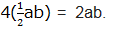
Both areas must be equal, the area of a big square must be equal to the area of a tilted square plus the area of 4 triangles
That is:
(a + b)(a + b) = c2 + 2ab
Expand (a +b)(a + b): a2 +2ab + b2 = c2 + 2ab
Subtract 2ab from both sides: a2 + b2 = c2 Hence the result!
Note: We can use Pythagoras theorem to solve any problem that can be converted into right Angled Triangle.
Exercise 1
1. In a right triangle with given hypotenuse c and legs a and b, find:
- c if a = 5 and b = 12
- a if b = 8 and c = 12
- b if a = 9 and c = 11
2. A rectangle has base 6 and height 10. What is the length of the diagonal?
3. A square has a diagonal with length 6. What is the length of the sides of the square?
4. The diagonals of a rhombus have lengths 6 and 8. Find the length of one side of the rhombus.
5.
A ladder leans against a wall. If the ladder reaches 8m up the wall and
its foot is 6m from the base of the wall. Find the length of the
ladder.
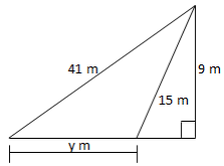
6. Find the value of the marked side.
The Pythagoras Theorem
Prove the pythagoras theorem
Pythagoras
theorem states that: In a Right Angled Triangle, the sum of squares of
smaller sides is exactly equal to the square of Hypotenuse side (large
side). i.e. a2 + b2 = c2
Take a look on how to show that a2 + b2 = c2
See the figure below:
The area of a whole square (big square)
A big square is the one with sides a + b each. Its area will be:
(a + b) ×(a + b)
Area of the other pieces
First, area of a smaller square (tilted) = c2
Second, area of the equal triangles each with bases a and height b:
But there are 4 triangles and they are equal, so total area =
Both areas must be equal, the area of a big square must be equal to the area of a tilted square plus the area of 4 triangles
That is:
(a + b)(a + b) = c2 + 2ab
Expand (a +b)(a + b): a2 +2ab + b2 = c2 + 2ab
Subtract 2ab from both sides: a2 + b2 = c2 Hence the result!
Note: We can use Pythagoras theorem to solve any problem that can be converted into right Angled Triangle.
Exercise 1
1. In a right triangle with given hypotenuse c and legs a and b, find:
- c if a = 5 and b = 12
- a if b = 8 and c = 12
- b if a = 9 and c = 11
2. A rectangle has base 6 and height 10. What is the length of the diagonal?
Application of Pythagoras Theorem
The Pythagoras Theorem to Solve Daily Life Problems
Apply the pythagoras theorem to solve daily life problems
You
may have heard about Pythagoras's theorem (or the Pythagorean Theorem)
in your math class, but what you may fail to realize is that
Pythagoras's theorem is used often in real life situations. For example,
calculating the distance of a road, television or smart phone screen
size (usually measured diagonally).
Activity 1
Apply the pythagoras theorem to solve daily life problems
TOPIC 9: TRIGONOMETRY
Do
you want to learn the relationships involving lengths and Angles of
right-angled triangle? Here, is where you can learn.
Trigonometry
is all about Triangles. In this chapter we are going to deal with Right
Angled Triangle. Consider the Right Angled triangle below:
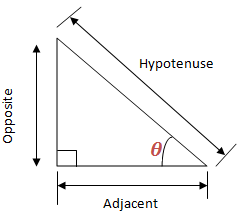
The sides are given names according to their properties relating to the Angle .
Adjacent side is adjacent (next to) to the Angle
Opposite side is opposite the Angle
Hypotenuse side is the longest side
Sine, Cosine and Tangent of an Angle using a Right Angled Triangle
Define sine, cosine and tangent of an angle using a right angled triangle
Trigonometry
is good at finding the missing side or Angle of a right angled
triangle. The special functions, sine, cosine and tangent help us. They
are simply one of a triangle divide by another. See similar triangles
below:
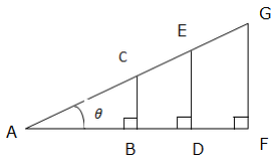
The ratios of the corresponding sides are:
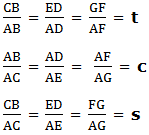
Where by t, c and s are constant ratios called tangent (t), cosine (c) and sine (s) of Angle respectively.
The right-angled triangle can be used to define trigonometrical ratios as follows:
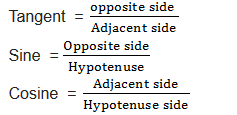
The short form of Tangent is tan, that of sine is sin and that of Cosine is cos.
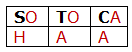
The simple way to remember the definition of sine, cosine and tangent is the word SOHCAHTOA. This means sine is Opposite (O) over Hypotenuse (H); cosine is Adjacent (A) over Hypotenuse (H); and tangent is Opposite (O) over Adjacent (A). Or
Example 1
Given a triangle below, find sine, cosine and Tangent of an angle indicated.
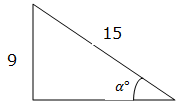
Solution
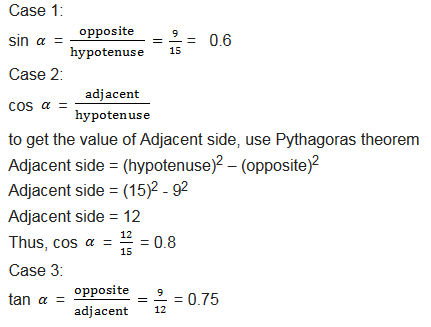
Example 2
Given that

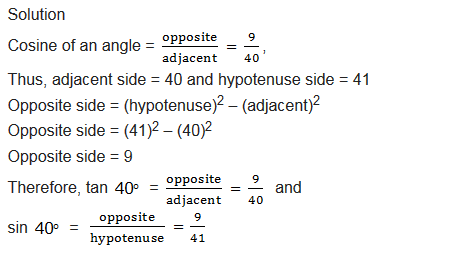
Trigonometric Ratios of Special Angles
Determination of the Sine, Cosine and Tangent of 30°, 45° and 60° without using Mathematical Tables
Determine the sine, cosine and tangent of 30°, 45° and 60° without using mathematical tables
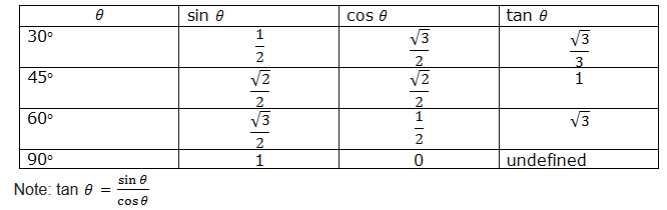
The special Angles we are going to deal with are 300, 450, 600, 900. Let us see how to get the Tangent, Sine and Cosine of each angle as follows:
First, consider an equilateral triangle ABC below, the altitude from C bisects at D.
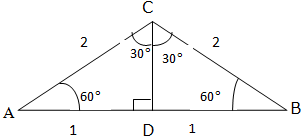
AD = BD = 1 (bisection)
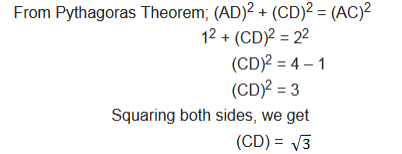
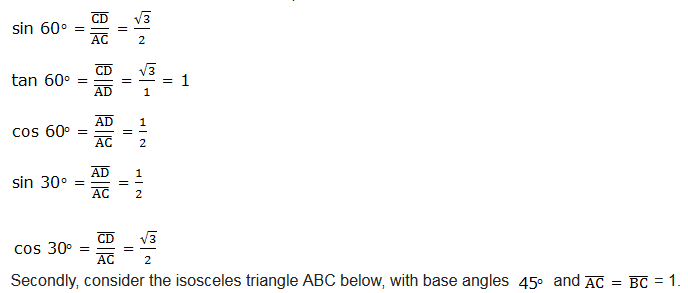
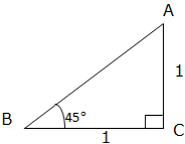
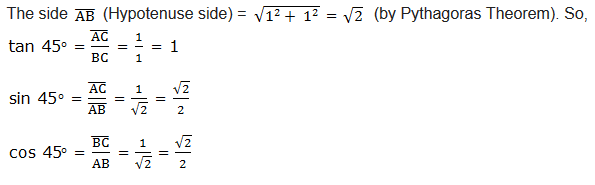
The results above can be summarized in table as here below:
Simple Trigonometric Problems Related to Special Angles
Solve simple trigonometric problems related to special angles
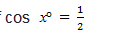
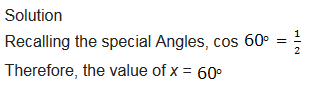
Example 3
Find the value of x if
Angles of Elevation and Angles of Depression
Demonstrate angles of elevation and angles of depression
Angle of Elevation
of an Object as seen by an Observer is the angle between the horizontal
and the line from the Object to the Observer’s aye (the line of sight).
See the figure below for better understanding
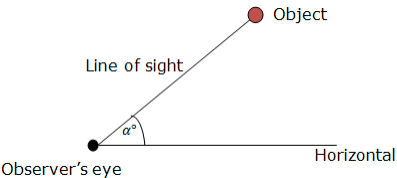
The angle of Elevation of the Object from the Observer is α0.
Angle of depression of
an Object which is below the level of Observer is the angle between the
horizontal and the Observer’s line of sight. To have the angle of
depression, an Object must be below the Observer’s level. Consider an
illustration below:
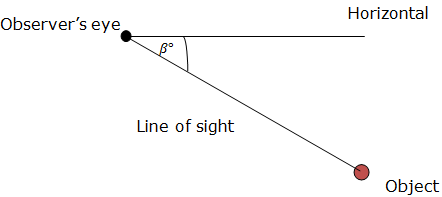
The angle of depression of the Object from the Object is β0
Problems involving Angles of Elevation and Angles of Depression
Solve Problems involving angles of elevation and angles of depression
Example 5
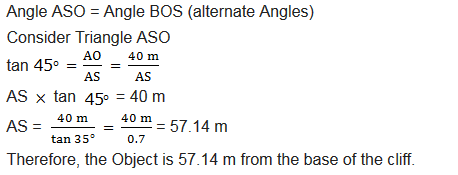
From the top of a vertical cliff 40 m high, the angle of a depression of an object that is level with the base of the cliff is350. How far is the Object from the base of the cliff?
Solution
We can represent the given information in diagram as here below:
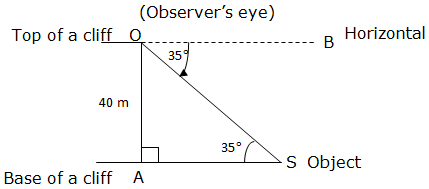
Angle of depression = 350
Exercise 1
1. Use trigonometric tables to find the following:
- cos 38.250
- sin 56.50
- tan 750
2. Use trigonometrical tables to find the value of x in the following problems.
- sin x0 = 0.9107
- tan x0 = 0.4621
3. Find the height of the tower if it casts a shadow of 30 m long when the angle of elevation of the sun is380.
4. The Angle of elevation of the top of a tree of one point from east of it and 56 m away from its base is250. From another point on west of the tree the Angle of elevation of the top is500. Find the distance of the latter point from the base of the tree.
5. A ladder of a length 15m leans against a wall and make an angle of300with a wall. How far up the wall does it reach?
FORM TWO MATHEMATICS STUDY NOTES TOPIC 1-2.
FORM TWO MATHEMATICS STUDY NOTES TOPIC 3-4
FORM TWO MATHEMATICS STUDY NOTES TOPIC 5-7
FORM TWO MATHEMATICS STUDY NOTES TOPIC 8-9.
FORM TWO MATHEMATICS STUDY NOTES TOPIC 10-11.
O'LEVEL MATHEMATICS NOTES
FORM ONE MATHEMATICS STUDY NOTES
FORM TWO MATHEMATICS STUDY NOTES
FORM THREE MATHEMATICS STUDY NOTES
FORM FOUR MATHEMATICS STUDY NOTES


No comments