
FORM TWO MATHEMATICS STUDY NOTES TOPIC 10-11.

Sets
Forget
everything you know about number and forget that you even know what a
number is. This is where mathematics starts. Instead of mathematics with
numbers we will think about mathematics with things.
The
word set means collection of related things or objects. Or, things
grouped together with a certain property in common. For example, the
items you wear: shoes, socks, hat, shirt, pants and so on. This is
called a set. A set notation is simple, we just list each element or
member (element and member are the same thing), separated by comma, and
then put some curly brackets around the whole thing. See an example
below:
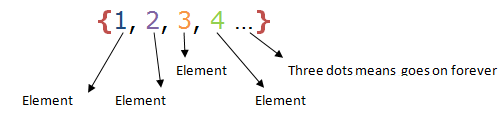
The Curly brackets are sometimes called “set brackets” or “Braces”.
Sets are named by capital letters. For example; A = {1, 2, 3, 4 …} and not a = {1, 2, 3, 4, …}.
To show that a certain item belongs to a certain set we use the symbol ∈.
For example if set A = {1, 2, 3, 4} and we want to show that 1 belongs to set A (is an element of set A) we write 1∈A.
To
show the total number of elements that are in a given set, say set A,
we use the symbol n(A). Using our example A = {1, 2, 3, 4}, then, the
total number of elements of set A is 4. Symbolically , we write n(A) = 4
Types of Sets
A Universal Set and an Empty Set
Define a universal set and an empty set
Universal set
This is a set that contains everything that we are interested in. The symbol for universal set is μor
U. for example, the set of Integers contains all the elements of sets
such as odd numbers, prime numbers, even numbers, counting numbers and
whole numbers. In this example the set of integers is the Universal set.
Another
example of a Universal set is a Set of all English Alphabets which
contains all elements of a set of vowels and set of Consonants.
Empty set or Null set: is a set with no elements. There aren’t any elements in it. Not one. Zero elements. For example; A set of Countries South of the South Pole.
It is represented by Øor {}.
The Difference Between Finite and Infinite Sets
Distinguish between finite and infinite sets
Finite sets: is a set which its elements can be counted.
We can say how many members are there. For example; a set B is a set of
numbers between 1 and 7. When we list the elements, then set B =
{2,3,4,5,6}. So, there 5 elements. This set is called finite set.
Infinite set:
this is a set whereby we cannot count the number of elements of the
set. We cannot tell how many members are there in a set. For example; A
is a set of all real numbers. Real numbers are all positive and negative
numbers including fractions. We cannot count the members of a set of
real numbers. Another example; B = {1,2,3,…}. Three dots means go on or
infinite, we will go on with no end. This types of sets are called
infinite sets.
The Difference Between Equivalent and Equal Sets
Distinguish between equivalent and equal sets
Equivalent sets:
Two sets are said to be equivalent if their members match exactly. For
example; if A = {a, b, c, d} and B = {w, x, y, z} the two sets match
like this:
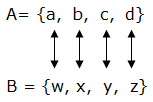
Generally, two sets are equivalent if n(A) = n(B). Symbolically we write A ≡B which means A is equivalent to B.
Equal sets:
If two sets are equivalent and their members are alike, then the two
sets are said to be equal. For example; if A = {a, b, c, d} and B = {c,
a, b, d} then the two sets are equal since a is in set A and in set B, b
is in set A and in set B, c is in set A and in set B and d is in set A
and in B. Also, numbers of elements of the both sets are equal.
Therefore A = B (set A is equal to set B)
Subsets
A Subset
Define a subset
When we define a set, if we take piece of that set, we can form what is called a subset. For
example; if we have a set {a, b, c, d, e}, a subset of this is {b, c,
d}. Another subset is {a, b} or even another subset is {e} or {d} and so
on. However {a, f} is not a subset since it contains an element (f)
which it is not in the parent set.
Generally, A is a subset of B if and only if every element of A is in B. symbolically we write A⊂B (means A is a subset of B).
Subsets of a Given Set
List subsets of a given set
For
example; if A = {1, 2, 3, 4}, B = {1, 2, 3} and C = {1, 2, 3, 4} then, B
is a proper subset of A i. e. B⊂A and C is an improper subset of A i.e.
C⊆A.
Important note: an Empty set is a subset of any set.
The Difference between Proper and Improper Subsets
Distinguish between proper and improper subsets
If every element in A is also in B, and there exist at least one element in B that is not in A, we say that A is Proper subset of B.
And if every element in A is in B, and there is no element in B that is not in A, we say that A is an improper subset of B and we write A = B or symbolically we write A⊆B or B⊆A.
The Number of Subsets in a Set
Calculate the number of subsets in a set
Consider an example below:
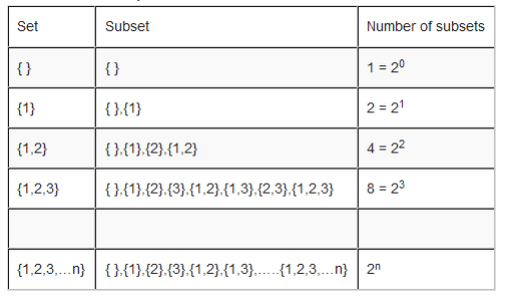
When
you look at the table, you will see that the number of subsets can be
obtained by 2 raised to the number of elements of the set under
consideration. Therefore, the formula for finding the number of subsets
of a set with n elements is given by 2n, n is a number of elements of a set.
Example: How many subsets are there in set A = {Red, White, Yellow}. List them.
Solution: case 1, number of subsets
Set A has 3 elements. But
Number of subsets = 2n, so number of subsets of set A = 23 = 8
Therefore set A has 8 subsets
Case 2: list of subsets.
The subsets of set A are: { },{Red},{White},{Yellow},{Red,White},{Red,Yellow},{White,Yellow}, {Red,White,Yellow}.
Reprsenting Sets by using Venn Diagrams
Represent a sets by using venn diagrams
The
diagrams are oval shaped. They we named after John venn, an English
Mathematician who introduced them. For example A = {1,2,3} in venn
diagram can be represented as follows:
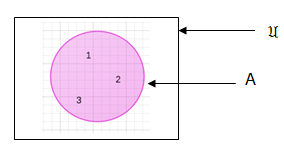
is a universal set which can be a set of counting numbers and A is a subset of it.
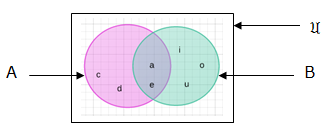
If
we have two sets, say Set A and B and these sets have some elements in
common and we are supposed to represent them in venn diagrams, their
ovals will overlap. For example if A = {a,b,c,d,e,} and B = {a,e,i,o,u}
in venn diagrams they will look like this:
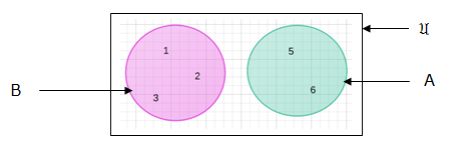
If
the two sets have no elements in common, then the ovals will be
separate. For example; if A = {1,2,3} and B = {5,6}. In venn diagram
they will appear like here below:
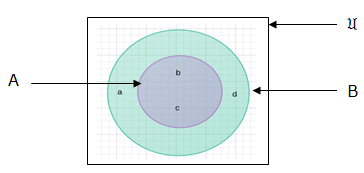
If
we have two sets, A and B and set A is a subset of set B then the oval
for set A will be inside the oval of set B. for example; if A = {b,c}
and B = {a,b,c,d} then in venn diagram it will look like this:
If
we have to represent the union or intersection of two or more sets
using venn diagrams, the appearance of the venn diagrams will depend on
whether the sets under consideration have some elements in common or
not.
Information from Venn Diagrams
Interpret information from venn diagrams
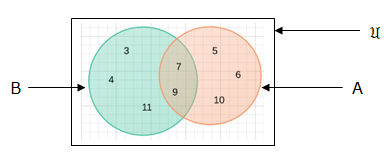
Case 1: sets with elements in common.
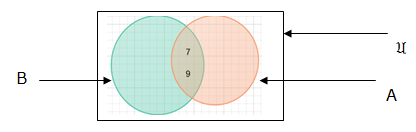
Example 1: If A = {5,6,7,9,10} and B = {3,4,7,9,11} represent A union B and A intersection B in venn diagrams.
Solution
Case 1: A union B
Case 2: A intersection B
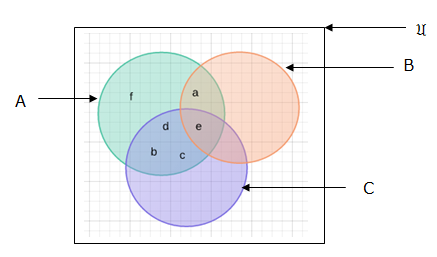
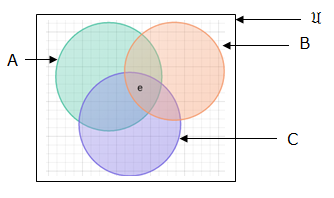
Example 2: A = {a,b,c,d,e,f}, B = {a,e} and C = {b,c,e,d}. Represent in venn diagrams A∪B∪C and A∩B ∩C.
Solution: case 1. A∪B∪C
Case 2: A ∩B∩C
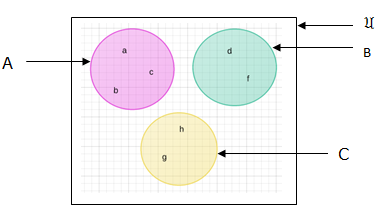
Case 2: sets with no elements in common:
For example; A = {a,b,c,}, B = {d,f}, C = {h,g} on venn diagram will appear like this:
Number of elements in two sets say set A and B i.e. n(A∪B) is given by: n(A∪B) = n(A) + n(B) – n(A ∩B)
proof: consider the venn diagram below:
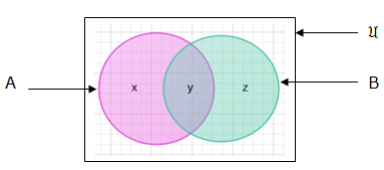
From our venn diagram:
n(A) = x + y, n(B) = y + z, n(A∩B) = y and n(A∪B) = x + y + z thus;
n(A) + n(B) = (x + y) + (y + z)
= (x + y + z) + y
but x + y + z = n(A ∪B) and n(A∩B) = y
so,
n(A) + n(B) = n(A∪B) + n(A∩B)
make n(A∪B) be the subject of the formula
For example; if n(A) = 15, n(A∩B) = 3 and n(A∪B) = 24. Find n(B)
Soln;
Recall that: n(A∪B) = n(A) + n(B) – n(A∩B)
n(B) = n(A∪B) + n(A∩B) – n(A)
= 24 + 3 – 15
n(B) = 12
Therefore, n(B) = 12
Word problems
For
example; at Mtakuja primary school there are 180 pupils. If 120 pupils
like one of the sports, either netball or football and 50 pupils likes
netball while 30 pupils likes both netball and football. How many pupils
- likes football.
- Likes neither of the sport
Solutions.
Let be the universal set
N be the set of pupils who likes netball
F be the set of pupils who likes football
Thus,
n(F) = ?
n(N∩F) = 30
n(N∪F) = 120
n(μ) = 180
But we know that n(N∪F) = n(N) + n(F) – n(N∩F)
Thus, n(F) = n(N∪F) + n(N∩F) – n(N)
= 120 + 30 – 50
n(F) = 100
Therefore there are 100 pupils who likes football.
2. We have a total of 180 pupils at Mtakuja primary school
But only 120 pupils likes one of either the sport. so, those who likes neither of the sport will be 180 – 120 = 50
Therefore 50 pupils likes neither of the sport.
Alternatively: by using venn diagram
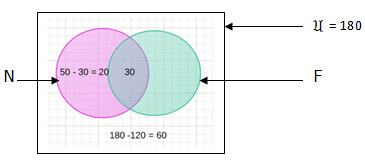
n(F) only = 120 – 30 -20 = 70
n(F) = those who likes both netball and football + those who likes football only
n(F) = 30 + 70 = 100
Therefore, there 100 pupils who likes football.
Exercise 1
1. If A = {Red,White,Blue} show by using symbol that Red, White and Blue are members of set A.
2. List the elements of set B if B is a set of counting numbers.
3. Which of the following sets are finite, infinite or empty sets.
- A = {y:y is an odd number}
- B = {1,3,7,…35}
- C = { }
- D = {Maths,Biology,Physics,Chemistry}
- E = {Prime numbers between 31 and 37}
- F = {….-2,-1,0,1,2,…}
4. If A = {1,4,9,16,25,36}, B = {1,4,9} and C = {1,3,4}, which of the following statement is true:
- A⊂B
- B⊂A
- A⊆C
- C⊆B
5. How many subsets are there in set A = {f,g,I,k,m,n}? List them all.
6.If A = {all letters of English Alphabets} and B = {c,d,g,h}.List the elements of B′.
7. Let B be a set of whole numbers and C a set of prime numbers found in a set of whole numbers, using venn diagram show B∩C.
8. Draw a venn Diagram and show by shading the required region:

9. If n(A) = 90, n(B) = 120 and n(A∩B) = 45. Find:
- n(A∪ B)
- n(B) only.
- n(A) only.
10.
In a certain meeting 40 people drank juice, 25 drank soda and 20 drank
both juice and soda. How many people were in the meeting, assuming that
each person took juice or soda?
Statistics
is the study of the collection, analysis, interpretation, presentation
and organization of data. Statistics helps to present information using
picture or illustration. Illustration may be in the form of tables,
diagrams, charts or graphs.
Statistics
helps to present information using picture or illustration.
Illustration may be in the form of tables, diagrams, charts or graphs.
Information by Pictograms
Display Information by pictograms
This is a way of showing information using images. Each image stands for a certain number of things.
Interpretation of Pictograms
Interpret pictograms
For example here is a pictograph showing how many apples were sold over 4 months at a local shop.
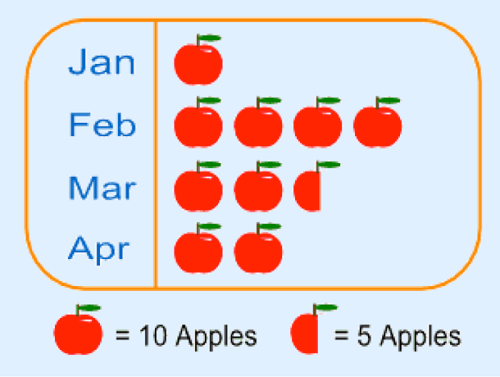
Each picture of 1 apple means 10 apples and the half-apple means 5 apples.
Note that:
- The method is not very accurate. For example in our example we can’t show just 1 apple or 2 apples.
- Pictures should be of the same size and same distance apart. This helps easy comparison.
- The scale depends on the amount of data you have. If the data is huge, then one image can stand for large number like 100, 1000, 10 000 and so on.
Bar Charts
They are also called bar graphs. Is a graphical display of information using bars of different heights.
Horizontal and Vertical Bar Charts
Draw horizontal and vertical bar charts
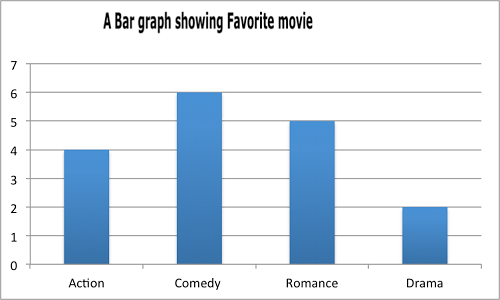
For example; imagine you just did a survey of your friends to find what kind of movie they liked best.
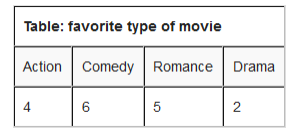
We can show that on a bar graph as here below:
Scale: vertical scale: 1cm represents 1 kind of movie
Horizontal scale: 1 cm represents 1 movie they watched.
Interpretation of Bar Chat
Interpret bar chart
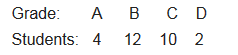
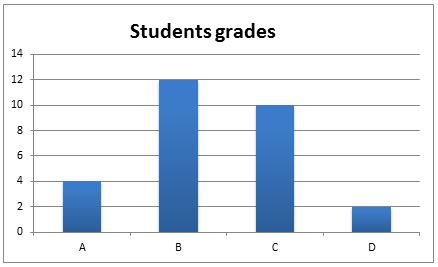
in a recent math test students got the following grades:
And this is a bar chart.
Scale: vertical scale: 1 cm represents 1 grade
Horizontal scale: 1 cm represents 2 students
Line Graphs
These are graphs showing information that is connected in some way. For example change over time.
Representing Data using Line Graphs
Represent data using line graphs
Example 1
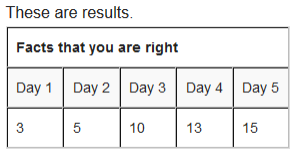
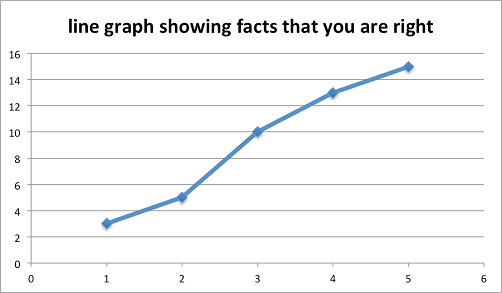
you are learning facts about mathematics and each day you do test to see how Good you are.
Solution
We need to have a scale that helps us to know how many Centimeter will represent how many facts that you were correct.
Vertical scale: 1 cm represents 2 facts that you were right
Horizontal scale: 2 cm represents 1 day.
Interpretation of Line Graphs
Interpret line graphs
Example 2
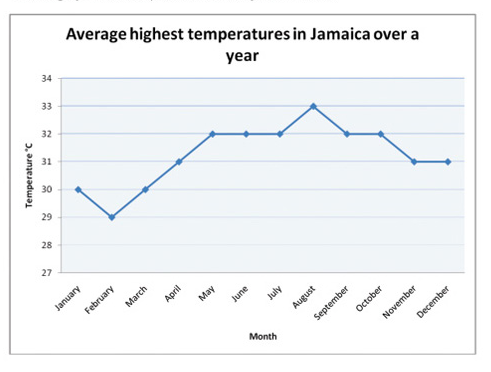
The graph below shows the temperature over the year:
From the graph we can get the following data:
- The month that had the highest temperature was August.
- The month with the lowest temperature was February.
- The difference in temperature between February and may is (320-290)=30C.
- The total number of months that had temperature more than 300C was 9.
Pie Chart
This is a special chart that uses “pie slices” to show relative size of data. It is also called Circle graph.
Data using Pie Charts
Display data using pie charts
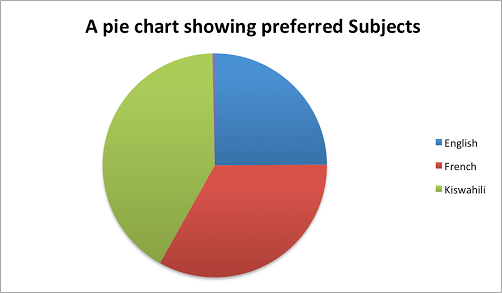
Example 3
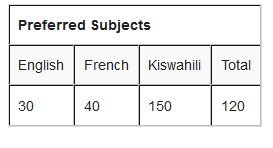
The
survey about pupils interests in subjects is as follows: 30 pupils
prefer English, 40 pupils refer French and 50 pupils prefer Kiswahili.
Show this information in a pie chart.
How to make them?
Step 1: put all you are data into a table and then add up to get a total.
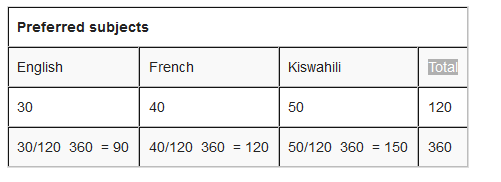
Step
2: divide each value by the total and then multiply by 360 degrees to
figure out how many degrees for each “pie slice” (we call pie slice a
sector) We multiply by 360 degrees because a full circle has a total of
360 degrees.
Step
3: draw a circle of a size that will be enough to show all information
required. Use a protractor to measure degrees of each sector. It will
look like the one here below:
Interpretation of Pie Charts
Interpret pie charts
Example 4
Interpreting the pie charts.
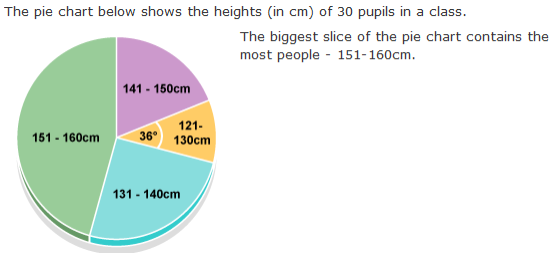
How many pupils are between 121-130cm tall?
The
angle of this section is 36 degrees. The question says there are 30
pupils in the class. So the number of pupils of height 121 - 130 cm is:
36/360 x 30 = 3
Frequency Distribution Tables
Frequency
is how often something occurs. For example; Amina plays netball twice
on Monday, once on Tuesday and thrice on Wednesday. Twice, once and
thrice are frequencies.
By counting frequencies we can make Frequency Distribution table.
Frequency Distribution Tables from Raw Data
Make frequency distribution tables from raw data
For example; Sam’s team has scored the following goals in recent games.
2, 3, 1, 2, 1, 3, 2, 3, 4, 5, 4, 2, 2, 3.
How to make a frequency distribution table?
•Put the number in order i.e. 1, 1, 2, 2, 2, 2, 2, 3, 3, 3, 3, 4, 4, 5
•Write how often a certain number occurs. This is called tallying
- how often 1 occurs? (2 times)
- how often 2 occurs? (5 times)
- how often 3 occurs? (4 times)
- how often 4 occurs? (2 times)
- how often 5 occurs? (1 times)
•Then, wrote them down on a table as a Frequency distribution table.
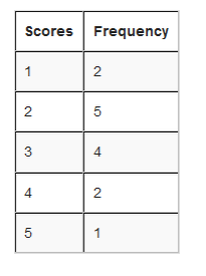
From the table we can see how many goals happen often, and how many goals they scored once and so on.
Interpretation of Frequency Distribution Table form Raw Data
Interpret frequency distribution table form raw data
Grouped Distribution Table
This
is very useful when the scores have many different values. For example;
Alex measured the lengths of leaves on the Oak tree (to the nearest cm)
9,
16, 13, 7, 8, 4, 18, 10, 17, 18, 9, 12, 5, 9, 9, 16, 1, 8, 17, 1, 10,
5, 9, 11, 15, 6, 14, 9, 1, 12, 5, 16, 4, 16, 8, 15, 14, 17.
How to make a grouped distribution table?
Step 1:
Put the numbers in order. 1, 1, 1, 4, 4, 5, 5, 5, 6, 7, 8, 8, 8, 9, 9,
9, 9, 9, 9, 10, 10, 11, 12, 12, 13, 14, 14, 15, 15, 16, 16, 16, 16,
17, 17, 17, 18, 18,
Step 2: Find the smallest and the largest values in your data and calculate the range.
The smallest (minimum) value is 1 cm
The largest (maximum) value is 18 cm
The range is 18 cm – 1 cm = 17 cm
Step 3:
Find the size of each group. Calculate an approximate size of the
group by dividing the range by how many groups you would like. then,
round that group size up to some simple value like 4 instead of 4.25
and so on.
Let us say we want 5 groups. Divide the range by 5 i.e. 17/5 = 3.4. then round up to 4
Step 4: Pick a Starting value
that is less than or equal to the smallest value. Try to make it a
multiple of a group size if you can. In our case a start value of 0 make the most sense.
Step 5: Calculate the list of groups (we must go up to or past the largest value).
In
our case, starting at 0 and with a group size of 4 we get 0, 4, 8, 12,
16. Write down the groups. Include the end value of each group. (must
be less than the next group):
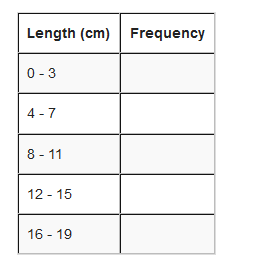
The largest group goes up to 19 which is greater than the maximum value. This is good.
Step 6: Tally to find the frequencies in each group and then do a total as well.
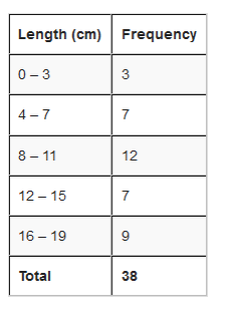
Done!
Upper and Lower values
Referring our example; even though Alex measured in whole numbers, the data is continuous.
For instance 3 cm means the actual value could have been any were
between 2.5 cm to 3.5 cm. Alex just rounded numbers to whole numbers.
And 0 means the actual value have been any where between -0.5 cm to 0.5
cm. but we can’t say length is negative. 3.5 cm is called upper real limit or upper boundary while –0.5 cm is called lower real limit or lower boundary. But since we don’t have negative length we will just use 0. So regarding our example the lower real limit is 0.
The limits that we used to group the data are called limits. For example; in a group of 0 – 3, 0 is called lower limit and 3 is called upper limit.
See an illustration below to differentiate between Real limits and limits.
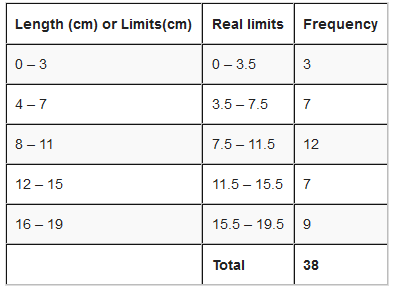
Class size is the difference between the upper real limit and lower real limit i.e. class size = upper real limit – lower real limit
We use the symbol N (capital N) to represent the total number of frequencies.
Class Mark of a class Interval
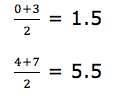
This
is a central (middle) value of a class interval. It is a value which is
half way between the class limits. It is sometimes called mid-point of a
class interval. Class mark is obtained by dividing the sum of the upper
and lower class limits by 2. i.e.
Class mark =

Referring to our example class marks for the class intervals are;
Interpretation of Frequency Distribution Tables
Interpret frequency distribution tables
Example 5
interpretation of frequency distribution data:
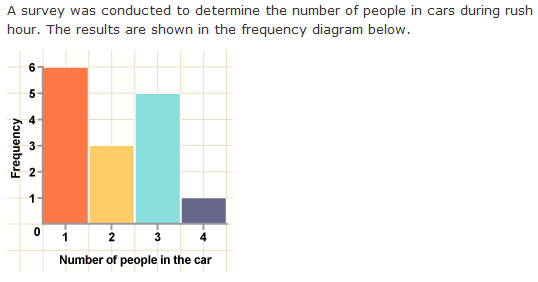
total number of cars in the survey:
6 + 3 + 5 + 1 = 15
There are 6 cars with one person in, 3 cars with two people, 5 cars with three people, and 1 car with four people.
the most likely number of people in a car:
Cars
in the survey are most likely to have 1 person in them as this is the
tallest bar - 6 of the cars in the survey had one occupant.
Frequency Polygons
This is a graph made by joining the middle-top points of the columns of a frequency Histogram
Drawing Frequency Polygons from Frequency Distribution Tables
Draw frequency polygons from frequency distribution tables
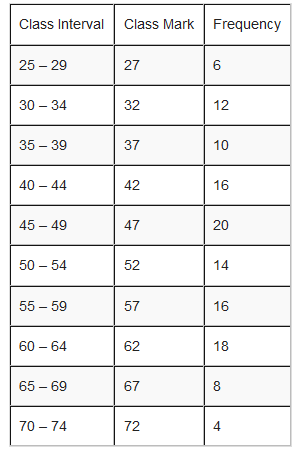
For example; use the frequency distribution table below to draw a frequency polygon.
Solution
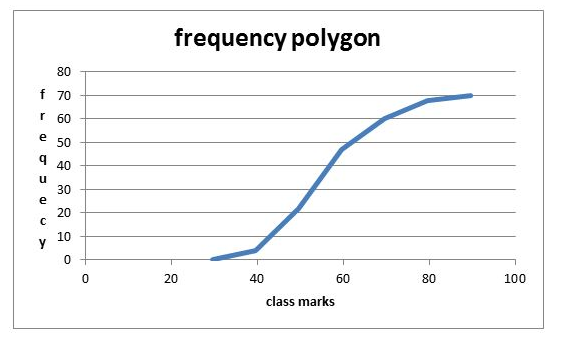
In
a frequency polygon, one interval is added below the lowest interval
and another interval is added above the highest interval and they are
both assigned zero frequency. The points showing the frequency of each
class mark are placed directly over the class marks of each class
interval. The points are then joined with straight lines.
Interpretation of Frequency Polygons
Interpret frequency polygons
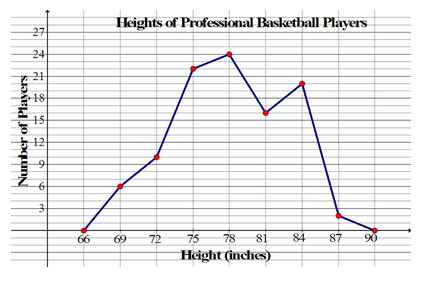
The frequency polygon below represents the heights, in inches, of a
group of professional basketball players. Use the frequency polygon to
answer the following questions:
Histograms
Is a graphical display of data using bars of different heights. It is similar to bar charts, but a Histogram groups numbers into ranges (intervals). And you decide what range to use.
Drawing Histograms from Frequency Distribution Table
Draw histograms from frequency distribution table
For
example; you measure the height of every tree in the orchard in
Centimeters (cm) and notice that, their height vary from 100 cm to 340
cm. And you decide to put the data into groups of 50 cm. the results
were like here below:
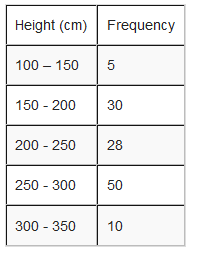
Represent the information above using a histogram.
Solution
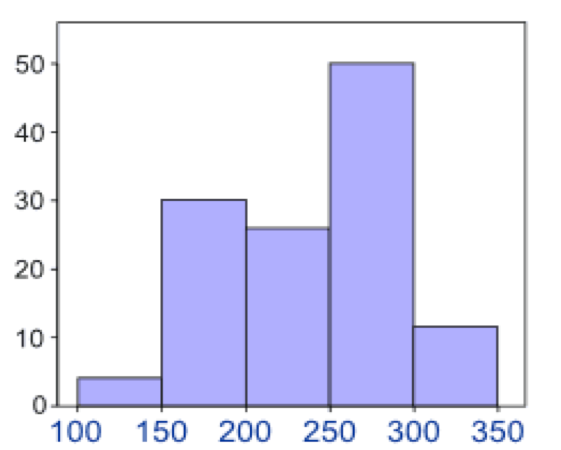
In order to draw histogram we need to calculate class marks. We will use class marks against frequencies.
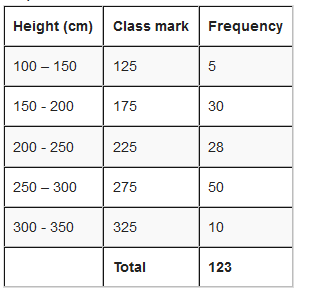
Scale: vertical scale: 1 cm represents 5 trees
horizontal scale: 1 cm represents 50 cm (range of trees heigths).
Interpretation of Histograms
Interpret histograms
The histogram below represents scores achieved by 250 job applicants on a personality profile.
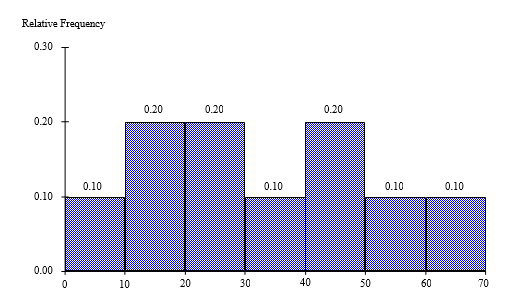
- Percentage of the job applicants scored between 30 and 40 is10%
- Percentage of the job applicants scored below 60 is90%
- Job applicants scored between 10 and 30 is100
Cumulative means “how much so far”. To get cumulative totals just add up as you go.
Drawing Cumulative Frequency Curves from a Cumulative Frequency Distribution Table
Draw cumulative frequency curves from a cumulative frequency distribution table
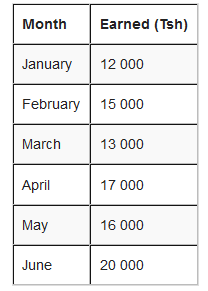
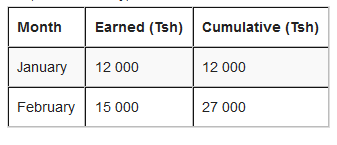
For example; Hamis has earned this much in the last 6 months.
How to get cumulative frequency?
The first line is easy, the total earned so far is the same as Hamis earned that month.
But, for February, the total earned so far is Tsh 12 000 + Tsh 15 000 = Tsh 27 000.
for
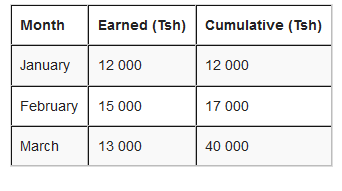
March, we continue to add up. The total earned so far is Tsh 12 000 +
Tsh 15 000 + Tsh 13 000 = 40 000 or simply take the cumulative of
February add that of March i.e. Tsh 27 000 + Tsh 13 000 = Tsh 40 000.
The rest of the months will be:
April: Tsh 40 000 + Tsh 17 000 = Tsh 57 000
May: Tsh 57 000 + Tsh 16 000 = Tsh 73 000
June: TSh 73 000 + Tsh 20 000 = Tsh 93 000
The results on a cumulative frequency table will be as here below:
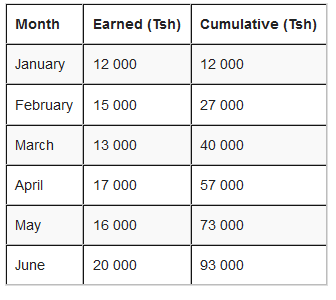
The last cumulative total should math the total of all earnings.
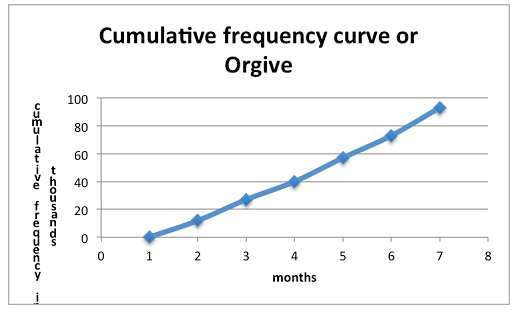
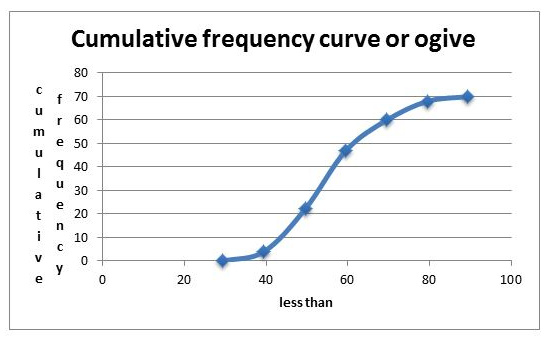
Graph for cumulative polygon is drawn with cumulative frequency on vertical axis and real upper limits on Horizontal axis.
Scale: Vertical scale: 1cm represents Tsh 20 000
Give number to months. i.e. January =2, February =3 and so on
Note: To draw an Orgive, plot the points vertically above the upper real limits of each interval and then join the points by a smooth curve. Add real limit to the lowest real limit and give it zero frequency.
Interpretation of a Cumulative Frequency Curve
Interpret a cumulative frequency curve
Interpretation:
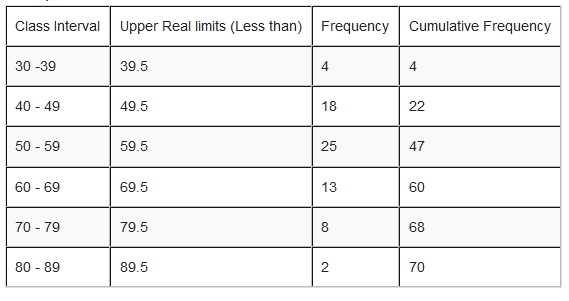
Its Cumulative Frequency Curve or Orgive will be:
Exercise 1
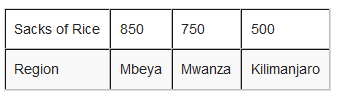
1. Represent the data in the table below using pictures (pictograms)
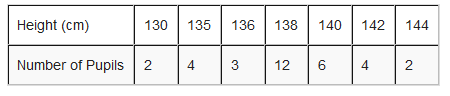
2. The following table represent the number of pupils with their corresponding height.
FORM TWO MATHEMATICS OTHER TOPICS
FORM TWO MATHEMATICS STUDY NOTES TOPIC 1-2.
FORM TWO MATHEMATICS STUDY NOTES TOPIC 3-4
FORM TWO MATHEMATICS STUDY NOTES TOPIC 5-7
FORM TWO MATHEMATICS STUDY NOTES TOPIC 8-9.
FORM TWO MATHEMATICS STUDY NOTES TOPIC 10-11.
O'LEVEL MATHEMATICS NOTES
FORM ONE MATHEMATICS STUDY NOTES
FORM TWO MATHEMATICS STUDY NOTES
FORM THREE MATHEMATICS STUDY NOTES
FORM FOUR MATHEMATICS STUDY NOTES


No comments