
FORM TWO PHYSICS STUDY NOTES TOPIC 3-4.

LINK OF OTHER SUBJECTS >>>>>
TOPIC 3: MAGNETISM
Concept of Magnetism
The Orign of Magnetism
Explain the origin of magnetism
Chinese were the first to use the metal magnetite called lodestone.
A Lodestone was capable of attracting small iron pieces and it was used
as a crude navigation compass by Greeks. Lodestones were the earliest
magnets.
Iron, nickel and cobalt
are the only naturally occurring magnetic materials. Magnet has two
ends known as magnetic poles in which the greatest attraction power is
concentrated.
Magnetic and Non-magnetic Materials/Substances
Identify magnetic and non-Magnetic material/substances
Magnetic substances
These are substances which have a property of being attracted by a magnet.E g; iron,steel,cobalt and nickel.
- Pole strength refers to the ability of a magnet to attract objects.
- Ferromagnetic substances have very high magnetic susceptibility (easily magnetized).Eg; iron, nickel and cobalt.
- Electromagnet is the substance which requires electric current to attain magnetism.
- Permanent magnet is a substance which is already a magnet and it doesn’t require electric current to attain magnetism.
Non-magnetic substances
These
are substances which are not attracted by a magnet.Eg; copper, brass,
aluminium,glass,plastic and wood.These substances have very weak
magnetic properties.
The Properties of Magnets
State the properties of magnets
Magnets have a tendency of attracting magnetic substances and have no action on non-magnetic materials.
Types of magnetic materials
There are three types of magnetic materials:
- Diagmatic materials: Are substances which have a tendency to repel from a stronger to weaker magnetic field. Eg; bismuth, water, gold,air,hydrogen,common salt,diamond,silver and copper.
- Paramagnetic materials: Are substances which become weakly magnetized when placed in magnetic field. Eg; aluminium,platinum,chromium,oxygen and manganese.
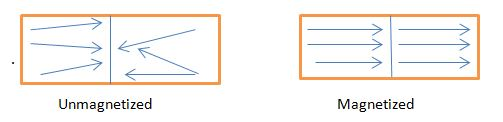
- Ferromagnetic materials: Are substances which becomes magnetized when placed in magnetic field. Their magnetic domain become aligned in one direction when they are placed in magnetic field. Eg; iron, cobalt and nickel.
Magnetic domain
refers to the molecular magnets lined up with each other which
constitute ferromagnetic materials.
The direction of magnetic poles varies from one domain to another if the magnet is unmagnified
Types of Magnets
Identify types of Magnets
Magnets may also be classified according to their shapes. This includes:
- Horse shoe magnet
- Rod magnet
- Field magnet
- Bar magnet
Application of Magnets
Identify application of magnets
Magnets are used in:
- women handbags closing
- picking up heavy loads
- electrical appliances like meter and receivers
- sound and video recording equipment
- computer memory and disks
- electrical trains
Magnetisation and Demagnetisation
The Concept of Magnetisation and Demagnetisation
Explain the concept of magnetisation and demagnetisation
Magnetisation:Is a process of making a magnet from a magnetic substance.
Demagnetisation:Is the process by which a magnet is made to lose its magnetism.
Demonstrating Magnetisation and Demagnetisation
Demonstrate magnetisation and demagnetisation
Methods of magnetisation
There are various ways, including;
- Induction
- Stroking
- Electrical method
Induction method.
This is done by placing a piece of unmagnetised steel bar near or in contact with a pole of a magnet and then removing it.
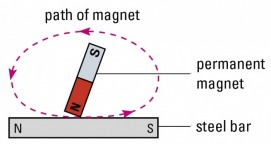
In this case an iron nail placed near a bar magnet will be induced with magnetism.
Stroking method
This is done by stroking a bar magnet into an unmagnetised steel bar.There are two stroking methods, namely;
- Single touch: A magnetised bar magnet is formed by a single stroke.-A steel bar is stroked repeatedly by a very strong bar magnetism the same direction with the north pole i.e from A to B. The bar magnet is lifted at B and then returned at A. After several strokes the steel bar will be magnetised with north pole at A and south pole at B.
- Double touch: Two bar magnets are used to magnetise a single steel bar. The steel bar is magnetised by two bar magnets from its center to its ends using left and right hands simultaneously for several times. Between each stroke the two bar magnets are lifted up high and returned to the center for another stroking.
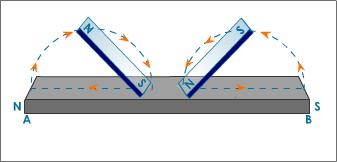
In this case the steel bar will be magnetized with south pole at A and north pole at B.
Note:
- In both single and double touch methods, the magnetising magnet none of their strengths.
- Between successive strokes, the pole is lifted high above bar, otherwise the magnetism already induced in it will tend to be weakened.3.Consequent poles will be formed at the center of the steel bar when the two bar magnets placed at the center are of like poles. Same poles will be obtained on both ends.
Electrical method
A
cylindrical coil wound with many of insulated copper wire is connected
in series with a battery. A steel bar is placed inside the solenoid and
the current switched on and off.When the steel bar is removed and
tested, it is found to be magnetised.
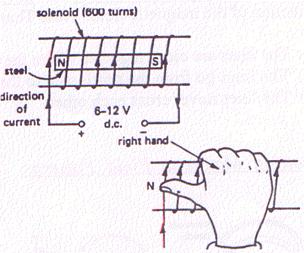
Note:If
the current is switched off for so long, the bar will not be
magnetized.The poles of the bar magnet depends on the direction of flow
of current. The end at which the direction of the current is in
clockwise direction will be south pole and if anticlockwise it will be
north pole.
Methods of demagnetization
Electrical method
The
magnet is placed inside a solenoid through which an a. c is flowing.The
magnet is withdrawn from the solenoid while the current is flowing
pointing in the W-E direction. When the magnet is held in W-E direction,
it doesn’t remain with residue magnetism due to induction from earths
magnetic field.
Other methods of demagnetisation include;
- Heating a magnet.
- Hammering while pointing E-W direction.
Methods of Storing Magnets
Design methods of storing magnets
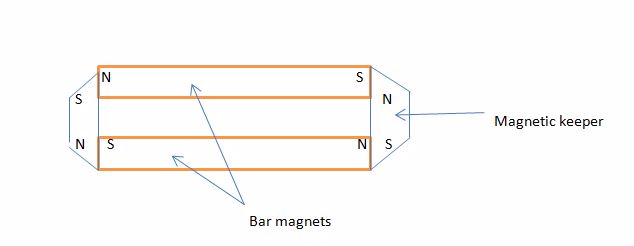
Magnets are stored in magnetic keepers.They
are stored in pairs,with unlike poles together and with pieces of
iron(magnetic keepers) across both ends.The keepers are magnetised by
induction.
Magnetic Fields of a Magnet
The Concept of Magnetic Fields of a Magnet
Explain the concept of magnetic fields of a magnet
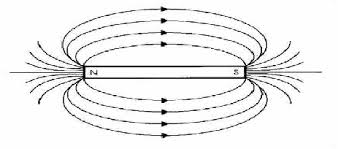
Magnetic field:Is
a space surrounding a magnet in which a magnetic force is exerted or
experienced. It consists of magnetic field lines which are imaginary
lines of force around a magnet from North Pole to South Pole.
The Magnetic Lines of Force around a Magnet using Iron Fillings or Compass Needle
Illustrate the magnetic lines of force around a magnet using iron fillings or compass needle
Experiment.
Aim:To study the properties of magnetic field lines around a bar magnet.
Materials: Iron fillings, bar magnets and a piece of paper.
Procedures
- Place a sheet of plane paper over a bar magnet.
- Sprinkle iron fillings on the sheet of paper.
- Gently tap the sheet of paper.
Observation
- Iron fillings will form a pattern which depends on the magnetic lines of force of the magnet.
- The lines of equal magnetic strength are seen flowing between magnetic poles .The lines are referred to as lines of magnetic flux or field lines. The pattern magnetic force is called a magnetic field.
- When investigating a magnetic field with iron fillings the field is strongest where the fillings are crowded.
- By investigating a magnetic field lines and a bar magnet using a small compass needle, the magnetic flux(lines) runs from north pole to south pole.
Neutral point is a point at which the resultant magnetic flux density is zero.
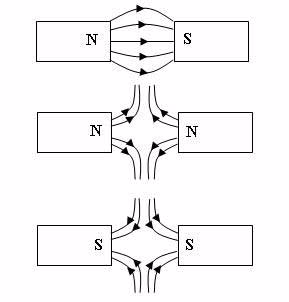
this
area, X, the two magnetic field s cancel or neutralize each other.It
happens when two like magnetic poles are brought together.
Therefore neutral point is;
- an area in a magnetic field where the resultant magnetic field strength is zero.
- a point which exists where two magnetic field neutralize each other.
The Methods of Magnetic Shielding
Explain the methods of magnetic shielding
Magnetic shielding:Is a screen made from high permeability material used to isolate any material from unwanted magnetic fields
Example;
The electron beam in the cathode ray tubes of TV sets, and very
delicate measuring instruments are shielded(protected)from magnetic
influence by placing them in soft iron cases with thick wells.
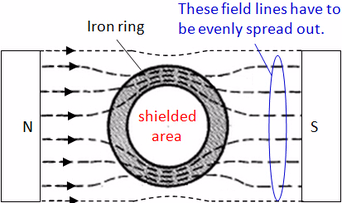
Here the object is shielded from the strong magnetic fields by a soft iron ring around it.
Earth's Magnetic Field
The Phenomenon of Earth's Magnetism
Explain the phenomenon of earth's magnetism
Earth
is imagined as a single big magnet, with its south seeking pole near
the geographic north called a north magnetic pole and the north seeking
pole is near geographic south pole called south magnetic pole.
The
earth behaves as if at its center there is a short piece of a bar
magnet inclined at a small angle to its rotation (spinning) axis. When a
bar magnet is hanged horizontally with a string, it will oscillates for
a short time and then comes to rest with its poles pointing in the N-S
direction due to the earth’s magnetic field.
This
gives a notion that the earths north pole is in the southern hemisphere
where any magnets north pole will always point.The two earth’s magnetic
poles are joined by a line called magnetic meridian.The geographic
meridian joins the true north and true south.
Direction of Earth's Magnetic Field
Determine direction of earth's magnetic field
Compass needle:Is
a thin magnet balanced on a point, usually at the center of gravity
used to identify N-S direction.Spinning a compass needle, it will
eventually come to rest with its poles pointing to the N-S
direction.This gives direction at any point on the earth’s surface.
The Earth's Magnetic Lines of Force about a Bar Magnet
Locate the earth' magnetic lines of force about a bar magnet
The
magnetic field lines around a bar magnet can be mapped with the help of
a magnetic compass. The magnetic field lines due to a bar magnet are
closed loops. They leave at the north pole and enter at the south pole.
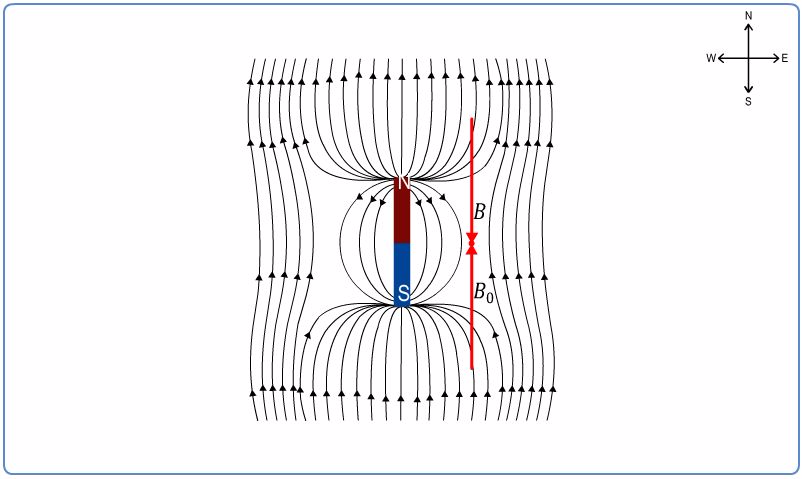
When you plot the magnetic field lines around a bar magnet, the
horizontal component of the earth’s magnetic field, B0,
influences the magnetic field induction, B, due to the bar magnet. At
points close to the bar magnet, magnetic induction B due to the bar
magnet is very high as compared to the horizontal component of the
earth’s magnetic field, B0. Thus, B0is negligible.
According
to the inverse square law of magnetism, magnetic field induction B due
to the bar magnet decreases as we move away from it. At certain points
around the bar magnet, B and B0are equal in magnitude and
opposite in direction. Therefore, they cancel each other out, and the
resultant magnetic field is zero.
Thus,
the point where magnetic field induction B due to a bar magnet is equal
in magnitude and opposite in direction to the horizontal component of
the earth’s magnetic field induction, B0, is called a neutral point.
The neutral points around a bar magnet can be located in two different cases
- When the north pole of the bar magnet points towards the earth’s north pole
- when the south pole of the bar magnet points towards the earth’s north pole.
When the north pole of a bar magnet points towards the north pole of the earth.
- Fix a sheet of white paper on a drawing board with brass pins.
- Take a compass needle, place it at the centre of the paper, and mark the north and south directions.
- Draw a straight line along the paper connecting the two points. This represents the magnetic meridian of the earth.
- Represent the geographical directions at the corner of the paper.
- Draw an arrow from the geographical south to the geographical north on the right side of the paper to indicate the direction of the horizontal component of the earth’s magnetic field, B0.
- Take a bar magnet and place it at the centre of the paper such that the north pole of the bar magnet points towards the north pole of the earth.
- Now place the compass needle at the north pole of the bar magnet and mark a point where the north pole of the compass needle is.
- Shift the compass such that the south pole of the compass needle is at the point you just marked.
- Mark another point at the north of the compass needle, and then shift the compass, as done earlier.Repeat the procedure till the compass needle reaches the other end of the bar magnet.
- Join all the points to get a continuous smooth curve, which represents a magnetic field line.
- Repeat the procedure from the north pole of the magnet, but from different points, and draw the magnetic field lines.
The
two points on either side of the bar magnet at equal distances from its
centre, where the compass needle does not show any specific direction.
At these points, the magnetic field induction B due to the bar magnet
and the horizontal component of the earth’s magnetic field induction, B0are
equal in magnitude and opposite in direction. The resultant magnetic
field is zero. These points represent the neutral points denoted by N1and N2. These two points fall on the equatorial line of the bar magnet.
Thus,
when the north pole of a bar magnet points towards the geographical
north pole of the earth, the two neutral points lie on the equatorial
line of the bar magnet such that they are equidistant from the centre of
the bar magnet.
The Angle of Inclination (dip) and Angles of Declination
Measure the angle of inclination (dip) and angles of declination
Angle of dip is the angle between the direction of the earth’s magnetic flux and the horizontal.
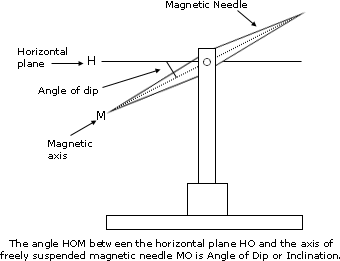
Measurement of angle of dip
The angle of dip is not constant over the earth’s surface; it varies from place to place.
This
difference is brought about by the earth’s magnetic field direction at a
point on the earth’s surface. The easiest way to measure the angle of
dip is using a thin iron rod.The rod is suspended by length of a thread
such that it balances horizontally.
Without
disturbing the position of attachment, the rod is magnetised by
bringing close a bar magnet and touching. On re-suspending the rod will
dip with its north pole pointing downwards as shown in the diagram
above. Using a protractor, the angle between the axis of the rod and the
horizontal can be measured.
Angle of declination
Is
the angle between the magnetic meridian and geographic meridian. The
angle of declination varies from place to place all over the world. Maps
shows declination at different points of the world.
Application of Earth's Magnetic Field
State the application of earth's magnetic field
The earth’s magnetic field is used to:
- indicate poles of unknown magnets.
- enables the use of magnetic needle.
Moment of a Force
The Effects of Turning Forces
Explain the effects of turning forces
A force
is a push or pull which when applied to a body it will change its state
either by stopping it if it was in motion or making it move if it was
at rest.
If
a body under the action of a net externalforceis allowed to rotate
about a pivot, the body will tend to turn in the direction of the
applied force.
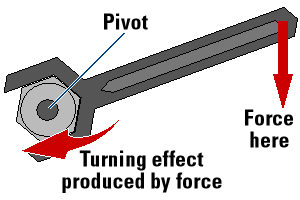
Examples of turning effect of force:
- A person pushing a swing will make the swing rotate about its pivot.
- A worker applies force to a spanner to rotate a nut.
- A person removes a bottle’s cork by pushing down the bottle opener’s lever.
- Force is applied to a door knob and the door swings open about its hinge.
- A driver can turn a steering wheel by applying force on its rim.
The Moment of Force
Determine the moment of force
Moment of forceabout
a point is the turning effect of the force about that point. The change
of state of a body can appear in several forms and the most common form
is the turning effect which is referred to as moment of a force.
The unit for a force isNewton, Nwhile that for moment of a force isNewton-meter, Nm.
Moment = Force, F x Perpendicular distance, x.
Moment = Fx
Consider the diagram below;
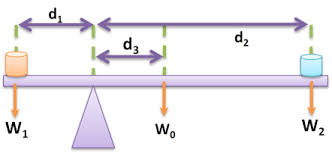
Moment of W₁ about the fulcrum. = W₁d₁
Moment of W₂ about fulcrum = W₂d₂
The Principle of Moments
State the principle of moments
The Principle of moments states that:”If
a body is in equilibrium under a force which lie in one plane, the sum
of the clockwise moments is equal to the sun of the anticlockwise
moments about any point in that plane.”
Activity 1
Experiment.
Aim: To determine the moment of a force.
Materials and apparatus:Meter rule, several different weights, inelastic cotton thread, knife edge and a marker pen.
Procedures
- Balance the meter rule horizontally on a knife edge.
- Mark a balance point as C. Use the marker pen to do that.
- Suspend a meter rule from a fixed axis through C. Suspend unequal weights W₁ and W₂ from the meter rule by using thin cotton threads.
- Adjust the distance d₁ and d₂ of the weights W₁ and W₂ from C until the meter rule balance.
- Repeat the experiment five times using different values of W₁ and W₂.Record the results on the table as shown below.
| W₁(g) | W₂(g) | d₁(cm) | d₂(cm) | W₁ d₁ (gcm) | W₂ d₂ (gcm) |
Observation:In each case it will be found that W₁ d₁ is equal to W₂ d₂.
The Principle of Moment in Daily Life
Apply the principle of moment in daily life
Moment of a force is used in the following:
- Is applied by a hand to unscrew a stopper on the bottle.
- Is applied by a spanner to unscrew a nut on a bottle.
- Turning a steering wheel of a car.
Centre of Gravity
Centre of Gravity
Explain centre of gravity
Center of gravity
of a body is the point at which the weight of a body appears to be
concentrated. OR center of gravity of a body is the point of application
of the resultant force due to the earth attraction on the body.The
center of gravity of a regular body is found to be at its geometrical
center.
Example 1
- Centre of gravity of a uniform meter rule is at the 50cm mark.
- Centre of gravity of a circular object is at its center.
The center of gravity of irregular bodies can be found experimentally.
Centre of Gravity of Regular Shaped Body
Determine centre of gravity of regular shaped body
Activity 2
Experiment.
Aim; To determine the center of gravity of a regular body (meter rule)
Materials and apparatus: Meter rule, a known weight and a spring balance.
Procedures
- Balance the meter rule on a fulcrum and mark the position where the meter rule balances horizontally by the letter G.
- Hang a known weight from one end of the meter rule and determine the position where the meter rule balances and mark it X.
- Measure the distance XC and XG(C is the point at the end of the meter rule where an object of known weight, w is attached).
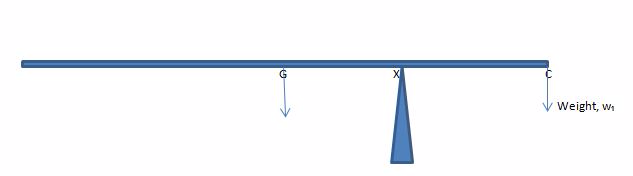
The weight, w of the meter rule always acts at G downwards. Thus it will create a moment to balance the moment due to w.
Results
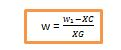
The mass of the meter rule, w is determined by using the principle of moments.Taking moments about X;
Clockwise moments = Anticlockwise moments
w₁ .XC =w. XG
Centre of Gravity of Irregular Shaped Body
Determine centre of gravity of irregular shaped body
Activity 3
Experiment
Aim: To determine the center of gravity of irregular plate.
Materials and apparatus:Card board, plumb line, inelastic cotton thread, clamp, clamp rod and a marker pen.
Procedures
- Make an irregular shaped piece of card board.
- Make three small holes well-spaced round the edge of the cardboard.
- Sus
Types of Equilibrium
The Condition for Equilibrium
Explain the condition for equilibrium
Equilibrium:A body is said to be balanced if its center of gravity is directly above the point of support.
Stable, Unstable and Neutral Equilibrium
Explain Stable, Unstable and Neutral equilibrium
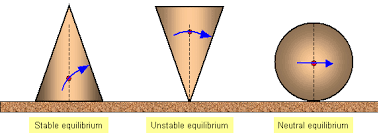
There are three types of equilibrium, namely:
- Stable equilibrium
- Unstable equilibrium
- Neutral equilibrium
Stable equilibrium:A
body is said to be in stable equilibrium if is given with small
displacement the center of gravity will be raised and the body returns
to its original position after displacement.
Unstable equilibrium:A
body is said to be in unstable equilibrium if when given a small
displacement the center of gravity will be lowered and the body doesn’t
returns to its original position after displacement.
Neutral equilibrium:A
body is said to be in neutral equilibrium when a small displacement
doesn’t alter the position of the center of gravity; the body is at rest
in whichever position it is placed, eg, rolling a sphere or a barrel.
Conditions of Stable, Unstable and Neutral Equilibrium in Daily Life
Apply conditions of stable, unstable and neutral equilibrium in daily life
Application of turning effect in daily life
- Is applied by a hand to unscrew a stopper on the bottle.
- Is applied by a spanner to unscrew a nut on a bottle.
- Turning a steering wheel of a car.
Exercise 1
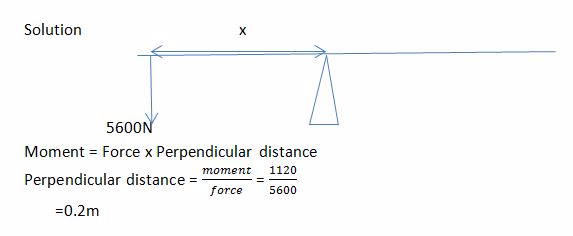
.The
moment of a force about a point is 1120 Nm.If the magnitude of the
force is 5600N,find the perpendicular distance between the point and the
line of action of the force
PHYSICS TOPIC 1-2.
PHYSICS TOPIC 3-4.
PHYSICS TOPIC 5: SIMPLE MACHINES
PHYSICS TOPIC 6: MOTION IN STRAIGHT LINE.
PHYSICS TOPIC 7 & 8:
PHYSICS TOPIC 9: SUSTAINABLE ENERGY RESOURCE
O'LEVEL PHYSICS
PHYSICS FORM FOUR
PHYSICS FORM THREE
PHYSICS FORM TWO
PHYSICS FORM ONE


No comments