
BIOLOGY FORM THREE TOPIC 1: CLASSIFICATION OF LIVING THINGS, TOPIC 2: MOVEMENT

Kingdom Plantae, Division Coniferophyta (Conifers )
General and Distinctive Features of the Division Angiospermophyta
Explain general and distinctive features of the division angiospermophyta
Angiosperms
are flowering plants under kingdom Plantae and division
Angiospermophyta. This group of plants is sometimes called
Magnoliophyta. Angiosperms are the most abundant land plants. Like
gymnosperms, angiosperms are seed-producing plants but they are
distinguished from gymnosperms by their characteristic of producing
flowers. These plants produce fruits that contain seeds instead of cones
like it is in gymnosperms. The term angiosperm means a plant that
produces seeds within fruits.
Angiosperms life cycle:The
ovary has ovules that contain mega-sporocyte. Mega-sporophyte has four
haploid megaspores; three megaspores disintegrate and the remaining one
divides by mitotic divisions to produce eight nuclei in an embryo sac.
The three nuclei are organized into the egg whereby one cell is the egg
cell; the two others are egg helpers. Although these three cells look
are similar, only the egg cell continues to develop to an embryo sac.
The embryo sac at this stage is the female gametophyte or
mega-gametophyte.
Pollination and fertilization:The
pollen from the anther is transported to the stigma of a flower. In the
stigma pollen tube emerges. The mature male gametophyte therefore is a
germinated pollen grain, pollen tube and three sperm nuclei. The pollen
tube grows downward toward the ovary through the style and penetrates
the embryo sac. After discharging its contents one of the sperm nuclei
fuses with the egg nucleus and form a zygote, the other sperm fuses with
the polar cell of the ovary, forming the endosperm nucleus. This is
what is known as double fertilization. Fertilization in angiosperms
begins very soon after pollination.
Note: In gymnosperms, fertilization can occur up to a year after pollination.
Double fertilization:Double
fertilization is a distinctive characteristic of the angiosperms and
results in a polyploid endosperm tissue. In double fertilization each
ovule receives a pollen tube that delivers two sperm cells to the embryo
sac. One sperm fertilizes the egg cell to form the diploid zygote,
while the other sperm fertilizes the central polar cell to form triploid
endosperm. After double fertilization, the ovule develops into a seed
and the ovary into a fruit.
General features of angiosperms
They
bear flowers which are reproductive structures. Fertilization takes
place between male and female flower by pollination that includes insect
pollination, wind pollination and animal pollination.
- Angiosperms have underground root as well as aerial shoot system.
- Angiosperms have very well-developed conducting tissues. These tissues include the xylem and the phloem arranged in form of vascular bundles.
- They have root that helps absorption of water and minerals from the soil.
- Most of them have leaves that carry out photosynthesis, so they are autotrophs.
- They have alternation of generation, Sporophyte generation alternate with gametophyte generation. The sporophyte is the dominant, diploid stage and is the more visible form of the plant, with the leaves, stems, roots, and flowers. Gametophyte generation is reduced and it is found within the ovary and anther.
Distinctive features of angiosperms
- The most obvious distinguishing feature of angiosperms is the possession of reproductive structures called flowers.
- They bear seeds enclosed in a carpel (the fruit). The seeds are the fertilized ovules.
- They have endosperm produced after fertilization and before the zygote undergo its first division. Endosperm has nourishing function, it nourishes the embryo.
- They have double fertilization whereby each ovule receives a pollen tube that delivers two sperm cells to the embryo sac. One sperm fertilizes the egg cell to form the diploid zygote, while the other sperm fertilizes the central polar cell to form triploid endosperm.
- Their haploid gametophyte is confined inside the ovary (female) or anther (male) of the flower, unlike the free- living gametophytes of most other plants.
- They have conducting tissues phloem and xylem. Unlike gymnosperms which have xylem tracheid angiosperms has xylem vessels.
The Classes of the Division Angiospermophyta and their Distinctive Features
Outline the classes of the division angiospermophyta and their distinctive features
Division
Angiosperms is divided into two classes which are Monocotyledonae and
Dicotyledonae. These two classes are distinguished from each other by
their morphology and anatomy.
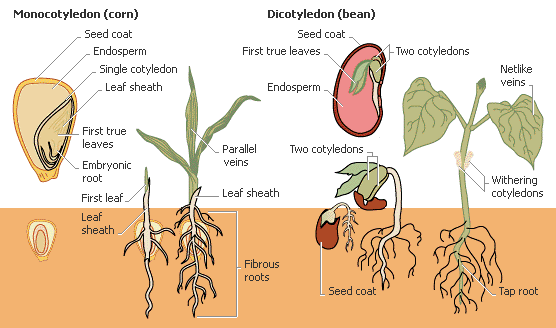
Features of Class Monocotyledonae
- Monocots have one cotyledon (or one seed leaf)
- Monocots have broad leaves with parallel venation.
- Monocots have fibrous root systems.
- The floral parts in monocots occur in threes, or multiple of three. PMonocots lack cambium secondary growth.
- Monocots have scattered vascular bundles in their stems.Typical example of monocot is a maize plant.
Features of Class Dicotyledonae
- Dicots have two cotyledons (or two seed leaves).
- Dicots have net venation.
- Dicots have tap root system
- Dicots floral parts occur in fours and fives and multiple of four or five.
- Dicots have cambium secondary growth.
- Dicots have vascular bundles arranged into a ring. A Typical example of dicot is a bean plant.
The Structure of Representative Plants Under Each Class (Monocotyledonae and Dicotyledonae)
Describe the structure of representative plants under each class (Monocotyledonae and Dicotyledonae)
Structure ofMonocotyledonae and Dicotyledonae plants
Advantages and Disadvantages of Division Angiospermophyta
Explain advantages and disadvantages of division dngiospermophyta
Advantages of Angiosperms
- Agriculture. Agriculture depends on angiosperms. Angiosperms provide human food. Example; plants belonging to grass family (grains), are the most important food stocks. They include rice, maize, wheat, barley, millet, sugar cane and sorghum. Legume provides beans, several varieties of nuts and soy. Also of potatoes, tomatoes, and peppers, pumpkins, melons and varieties of vegetables to include cabbage and lettuce. Many fruits oranges, lemons and grapefruits are angiosperms.
- Livestock. Plants belonging to grass family are the world number one feeds of livestock. Many types of grassland in Africa are either grazed by cattle or wild animals. Also almost all feeds consumed by human are also used by domestic animals as food.
- Wood. Angiosperms provide different varieties of wood for furniture, paper and building materials. Carpentry and masonry depends largely on angiosperms for both soft and hard wood.
- Textile. Different varieties of fibers including cotton, flax, and hemp are important raw materials for textile industry. Cotton is the word first class material for clothes.
- Medicine. Many organic drugs are coming from angiosperm herbs. They are either industrial made or can be utilized in its raw form. Today it is believed that herbs form the best medicine when used in their fresh form than when industrial made.
- Floriculture. Flowers from angiosperms have great social significance as they are used in different kinds of ceremony. Roses for instance are the most sold flowers and they are highly purchased and used in wedding and burial ceremonies.
- Forestry. Forestry is the field of study whose base depends on both angiosperms and gymnosperms. Many forests form green belts that habit different varieties of plants.
- Ecology. Angiosperms provide a wide range of habitats for different species of organisms. They also serve as primary producers of energy.
- Climate. Angiosperms are used to modify climate. Green belts are established in order to absorb carbon and reduce global warming.
- Tourism. Many sites of tourism are plants oriented. Ecotourism for instance depends largely on different plant species that host different kinds of land animals.
Disadvantages of Angiosperms
- Toxins. Some plants are poisonous when eaten by human and other animals. They cause death to human and other living organisms. Some cassava varieties are a good example. They have cyanide acid that inhibits cellular respiration.
- Drugs. Some angiosperm varieties are drugs that can be abused when taken. Examples are marijuana, cocaine, tobacco and some caffeine varieties.
- Weeds. Some angiosperm varieties are bad weeds; they reduce crop yields. Some weeds are parasites. Example, Cuscuta kilimanjari is parasitic to coffee plantations.
Concept of Movement and Locomotion
The Concept of Movement and Locomotion
Explain the concept of movement and locomotion
Movement
refers to change of position and posture. Therefore the change of
position of body parts such as limbs and other body parts.
Locomotion is the movement or change of position of the whole organism from one place to another.
But normally organisms have different kinds of movement. Plants show movement but do not show locomotion.
Since
locomotion involves coordination between nervous muscular and skeletal
system and all these system enable the organism to locomote.
The Importance of Movement in Animals and Plants
Explain the importance of movement in animals and plants
Animals and plants move about to:
- Find a mate and to reproduce
- Escape danger
- Seek and capture food
- To seek shelter, a suitable habitat/climate
- To avoid competition for food/water, living space etc
- Find water/soil nutrients, and hold leaves to get maximum sunlight
- Seek and capture food
- Obtain support
- Protect themselves from damage from: touch/pressure, pain or sudden temperature change
- Disperse seeds
Movement and Locomotion Actions
Demonstrate movement and locomotion actions
Demonstration of movement and locomotion
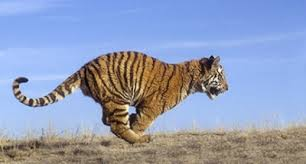
Movement action
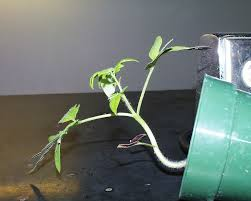
Locomotion action
Movement of the Human Body, the Human Skeletal System
The Structures of Human Skeleton
Describe the structures of human skeleton
The
contraction and relaxation of muscles cause muscular movement in
vertebrate organisms such as man. The muscles work together with
skeletal system to support or allow movement to occur.BONES, CARTILAGE, JOINTS AND MUSCLES
The Functions of the Major Components of the Human Skeleton and their Adaptations
Explain the functions of the major components of the human skeleton and their adaptations
Major Components of the Human Skeleton includeBones, Cartilage, Joints and Muscles
Bones
Bones
consist of living cells embedded in a hard substance made mainly: The
bones are attached together at the joints by tough flexible fibers known
as ligaments
Bones are classified in to long, short, irregular bones and flat.
- Short bones these are short bones, which support weight allowing for many smaller movements. Example bones on the human feet.
- Long bones these are strong, hollow and light containing spongy bone at the end. And spongy bone has open space and holes, which contain red marrow, which is where red cells are made. Example bones on the legs and arms.
- Flat bones these are bones, which support and protect body organs, these comprises ribs, breastbone, shoulder bones etc.
- Irregular bones these bones are for support and such bones are vertebrae also human ear has three tiny irregular bones, which conduct sound.
Cartilage
Besides
bones, the skeletal system has tissue called cartilage. It's the strong
flexible tissue that gives shape to some parts of the body
The cartilage keeps bones from grinding against each other, between vertebrae cartilage disks act as shock absorbers
Before birth bones are made mostly of cartilage whose cells absorb calcium after birth to produce bones
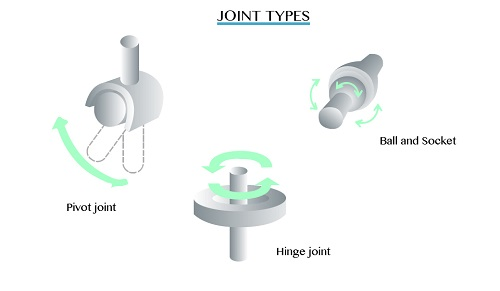
Joints
The human skeleton has about seventy movable joints.
Pivot Joint:This is the type of joint, which allows one bone to twist against another
NB. Joint is the point where two or more bones meet
Pivot joint allows movement in several directions
Hinge joint is the joint which allows movement in one direction Example elbow
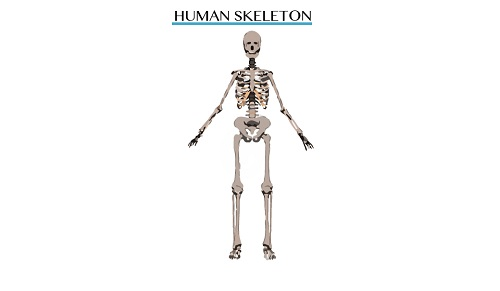
Functions of Skeleton include:
- The human skeleton provides mechanical support for the body
- Protection for internal organs e.g. skeleton of head protects the brain while chest bones protect soft organs such as the heart
- Skeleton functions as framework for anchoring the muscles
- Skeleton, together with muscles, function to bring about movement in an organism
Muscles and Movement
The Concept of Muscles
Explain the concept of muscles
A
muscle is a tissue consisting of cells that have the capacity to
contract and exert a pull. Muscles are made up of specialized tissues,
which are known as contractile tissues. When these tissues contract they
become shorter and tighter, as a result they cause movement. All
muscles are made up of elongated cells called muscle fibers.
Types of Muscles
Mention types of muscles
There
are three kinds of muscles in the body of a mammal. These muscles are
skeletal muscles (voluntary), smooth (involuntary) muscles and cardiac
muscles.
How Muscles Facilitate Movement
Demonstrate how muscles facilitate movement
Muscles are attached to bones at two points:
- At one point a muscle is usually attached to an immovable bone and other end to a movable bone.
- Muscles may be attached directly or indirectly by means of tendons. Tendons are tough whitish cords of fibrous materials which connect a bone and a muscle
- Muscles can contract and relax, but not expand when muscle contracts it becomes shorter and thicker and hence, exerts a pulling force on bone to which it is attached at a point of insertion.
- When a muscle relaxes, it lengthens and becomes thinner
- Most muscles act in pairs in such a manner that when one member of the pair contracts the other member relaxes. This means that they never contract or relax at the same time
- Muscles acting in pairs in this manner are known as antagonistic muscles. One member of the pair is called extensor while the other member is the flexor
The
figure below shows how the two muscles of the upper arms that is the
biceps and triceps muscles bringing about the bending and straightening
of the limb.
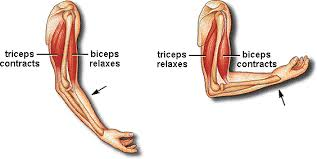
When
the triceps (extensor) muscle contracts the limb is straightened. The
contraction of the triceps is accompanied by the relaxation of the
biceps (flexor). When the biceps muscle contracts the arm bends.
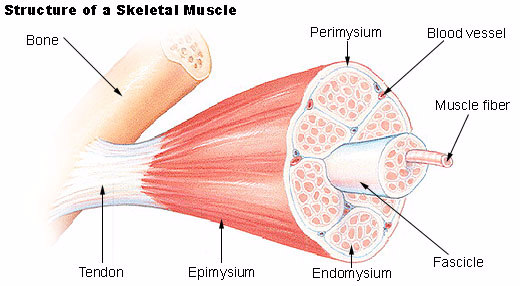
The Structure of Muscles
Describe the structure of muscles
Structure of mucles
Adaptations of Different Types of Muscles to their Roles
Explain adaptations of different types of muscles to their roles
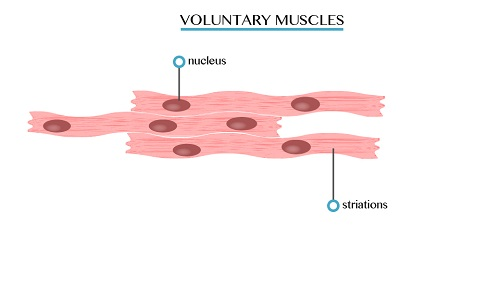
Skeletal Muscles
- These are the muscles, which are attached to bones of the skeleton
- The skeletal muscles contract powerfully and fatigue quickly
- Their contractions are controlled by the brain for this reason they are called voluntary muscles
Function of Skeletal Muscles
- Skeletal muscles are concerned with the movement of the limbs and parts of the skeleton
Smooth Muscles
Smooth (involuntary) muscles are found on the walls of internal organs such as alimentary canal, blood vessels and bladder.
- These muscles are made up of cells which taper at both ends (spindle shaped)
- Smooth muscles contract slowly
- The contraction of the smooth muscle is involuntary (it is not controlled by the brain)
Function of Smooth Muscles
The
smooth muscles, which are formed in different organs contract and relax
to cause movements of materials through them. Example: peristalsis in
alimentary canal causes movements of the materials through the canal
with the help of smooth muscles.

Cardiac Muscles
This
is the type of muscle, which is found only in the heart. These muscles
are made up of muscle fibers which branch and connect to each other like
a network.
Function
- Contraction of cardiac muscles causes the heart to keep on pumping (i.e. heart beat)
Causes, Effects and Preventive Measures of Muscles Cramps
Explain causes effects and preventive measures of m cramps
A
muscle cramp is an involuntary and forcibly contracted muscle that does
not relax. The cramp may involve a part of muscle, the entire muscle or
several muscles that usually act together. Any of the muscles that are
not at our voluntary control can cramp.
Sometimes
it occurs when the body lacks salt especially for those people who work
hard in hot weather they sweat a lot and get painful cramps in their
legs, arms or stomach.
Causes Muscle Cramps
There are basically two major causes of muscle cramps that are:
- Lack of water or salt in the body
- Lack of oxygen in the muscles (inadequate oxygenation of muscles)
Prevention of Muscle Crampa
- Cramps from poor breathing (lack of oxygen) can be improved by rapid breathing as well as stretching the muscles
- A muscle cramp from lack of water or salt can be treated by stretching the muscles and drinking many glasses of water, which contain salt so as to replace the amount of salt lost in the body
Treatment of Muscle Cramps
Applying
a soft massage on the cramped muscle, stretching the muscle and
applying oil ointment on the affected area, can treat a muscle cramp.
The Concept of Movement in Plants (Movement of Curvature)
Explain the concept of movement in plants (movement of curvature)
Generally
plants do not show locomotion (movement of the entire organism).
However, movement of individual plant organs is possible and modified by
sensitivity of the plant to external stimuli.
Plant movements in response to internal stimuli are known as spontaneous movement.
Examples of these movements are metabolic conditions, disease
conditions, vex ages and parental influence Those movements shown by
plants in response to external stimuli are known as induced or irritablemovements.
Types of Movement Exhibited by Plants
Mention types of movement exhibited by plants
Normally there are two types of plant movements, which are:
- Spontaneous movement
- Induced (irritable) movement
Spontaneous Movement
is plant movement in response to internal stimuli. Example of these
movements are metabolic conditions, disease conditions, vex ages and
parental influences
Induced or Irritable Movement
is the type of plant movement shown by plants in response to external
stimuli. Light, temperature, gravity, touch, water and chemical
substances are examples of induced movement.
Induced movements include nastic movement, tactic movement and tropic movement.
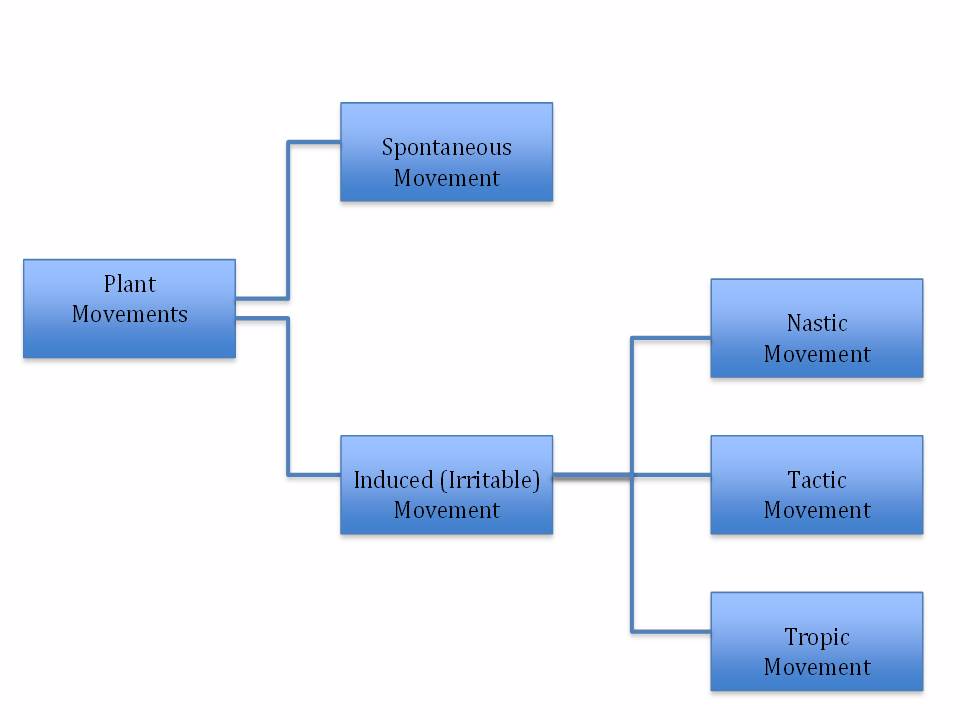
A summary of the types of movements shown by plants in response to stimuli.
STIMULI
- Light
- Chemicals
- Water
- Temperature
- Contact
- Gravity
- Gravitactic or Gravitaxis
Tropic Movements in Plants
Tropic
movements are the growth movements shown by a fixed part of a
stationary plant towards or away from a stimulus coming from one
direction. Tropic movements are also known as tropism movements.
Tropic
(tropism) is growth movements, which take place at a very slow pace.
The growth movement is caused by an increased or decreased rate of
growth on the side of the organ, which is under the influence of the
stimulus, with respect to the opposite side. This results in growth in
curvature.
There are various types of tropic movements, these types are:
- Phototropism or phototropic which is a growth movement shown by part of a fixed plant in response to light
- Hydrotropism (Hydrotropic) which is growth movement in a response to water
- Thigmotropism (Thigmotropic) which is the growth movement in response to touch
- Chemotropism (Chemotropic) which is a growth movement made by plants towards chemicals
- Thermotropism (Thermotropic), a growth movement shown in plants in response to heat.
Experiments to Investigate Movement in Plants
Carry out experiments to investigate movement in plants
An experiment to investigate movement in plants
BIOLOGY FORM THREE OTHER TOPICS
TOPIC 1: CLASSIFICATION OF LIVING THINGS, TOPIC 2: MOVEMENT
TOPIC 3: COORDINATION
TOPIC 4: EXCRETION
TOPIC 5: REGULATION
TOPIC 6: REPRODUCTION


No comments