
BIOLOGY FORM THREE TOPIC 3: COORDINATION,

In
this topic you will learn about concept of coordination, nervous
coordination inhumans, sense organs, drugs and drug abuse in relation to
nervous coordination, andcoordination in plants.
The Structure of Motor Sensory and Relay Neurons
Describe the structure of motor sensory and relay neurons
Neurones
Neurones
are nerve cells. They carry information as tiny electrical signals. A
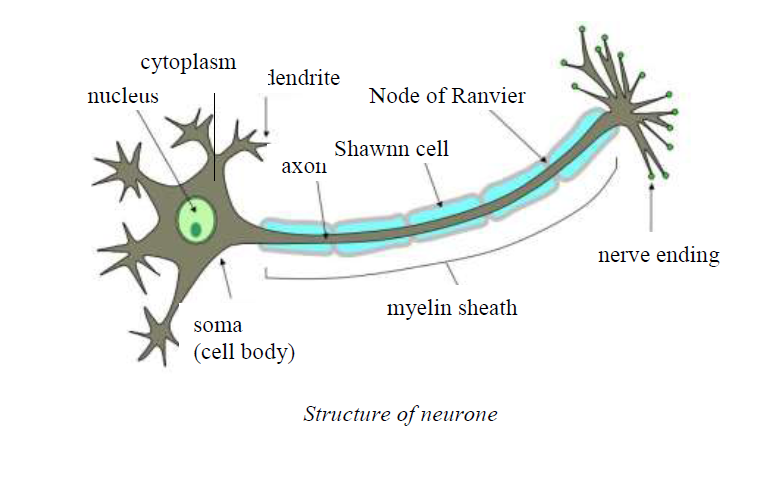
neuroneconsists of a cell body (with a nucleus and cytoplasm), dendrites
that carry electricalimpulses to the cell, and a long axon that carries
the impulses away from the cell. Theaxon of one neurone and the
dendrites of the next neurone do not actually touch eachother. The gap
between neurones is called the synapse
Structure and functions of neurones
The
diagram below shows a typical neurone: in this case, a motor neurone.
It has tinybranches at each end (dendrites) and a long fibre (axon) that
carries the signals or nervousimpulses. The axon is surrounded by a
fatty layer known as the myelin sheath. Thishelps to protect the neurone
and allow impulses to travel faster. The sheath is produces bySchawnn
cells. The myelin sheath has nodes (Nodes of Ranvier) that speed
uptransmission of nervous impulses. The cell body consists of cytoplasm
enclosing thenucleus. There are also other organelles in the cytoplasm
such as mitochondria thatsupply energy to for metabolic functions.
Synapses
Where
two neurones meet, there is a tiny gap called a synapse. Signals cross
this gapusing chemicals (neurotransmitters) released by a neurone. When
the chemical diffusesacross the gap it makes the next neurone transmit
an electrical signal. The transmission ofnervous impulses across
synapses occurs thus:
- An electrical impulse travels along an axon.
- This triggers the nerve-ending of a neuron to release chemical messengers calledneurotransmitters.
- These chemicals diffuse across the synapse (the gap) and bind with receptormolecules on the membrane of the next neuron.
- The receptor molecules on the second neuron bind only to the specific chemicalsreleased from the first neuron. This stimulates the second neuron to transmit theelectrical impulse.
Types of neurones
There
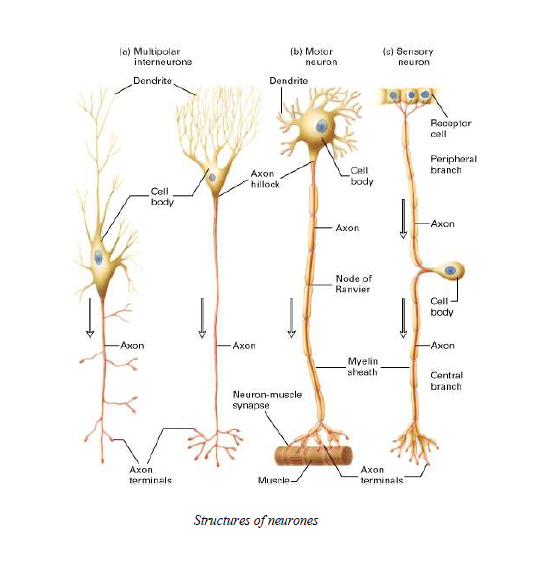
are three types of neurones namely motor neurone, sensory neurone and
relay(or intermediate) neurone. Each of these neurones has a different
structure and performsdifferent functions.
Motor neurone
A
motor neurone is a nerve cell that transmits impulses from the central
nervous system(CNS) to the effector organs such as muscles or glands
where response is made. The cellbody of a motor neurone is at one end of
the neurone and lies entirely within the centralnervous system (see the
diagram above).
Sensory neurone
A
sensory neurone is a nerve cell that transmits impulses from the
receptors to the CNS.Sensory neurones have their cell bodies off the
axon and outside the central nervoussystem.
Relay (intermediate or inter) neurone
A
relay neurone conveys messages between neurones in the CNS. Relay
neurones arelocated in the CNS between the sensory and the motor
neurones.
Central Nervous System (CNS)
The Meaning of Central Nervous System
Give the meaning of central nervous system
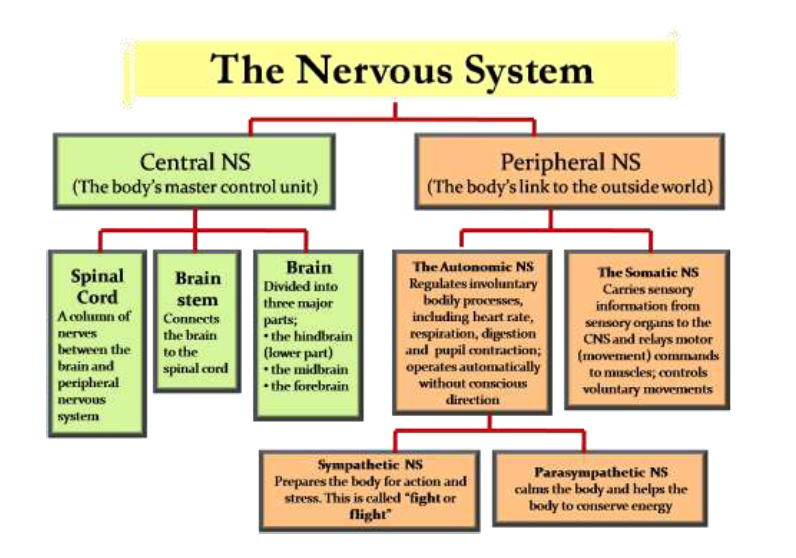
The
CNS is the part of the nervous system consisting of the brain and
spinal cord. Itcoordinates all the neural functions. The chart below
shows subdivisions of the nervoussystem.
The brain
The
human brain is a specialized organ that is ultimately responsible for
all thought andmovement that the body produces. This allows humans to
successfully interact with theirenvironment, by communicating with
others and interacting with inanimate objects neartheir surroundings. If
the brain is not functioning properly, the ability to move,
generateaccurate sensory information or speak and understand language
can be damaged as well.
The
brain has many different parts. Each part has a unique function that
allows humansobserve and interact with their environment effectively.
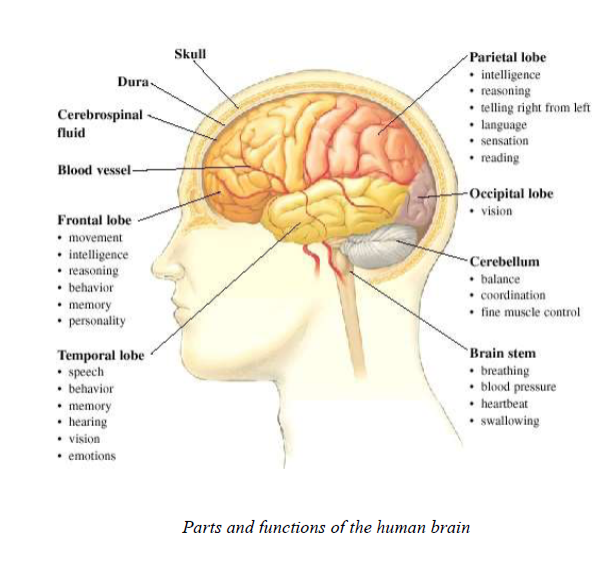
The following are parts of thehuman brain and their functions:
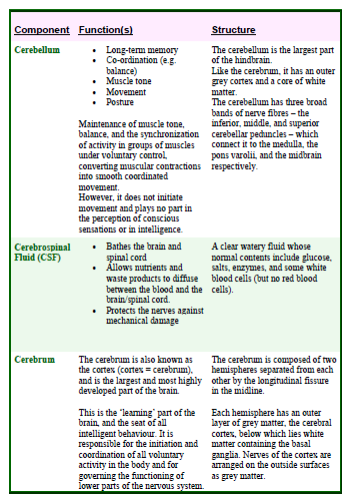
Cerebrum
The
cerebrum is the largest portion of the brain, and contains tools which
are responsiblefor most of the brain's function. It is divided into four
sections: the temporal lobe, theoccipital lobe, parietal lobe and
frontal lobe.
Parietal
Lobe: Located in the cerebral hemisphere, this lobe focuses on
comprehension.Visual functions, language, reading, internal stimuli,
tactile sensation and sensorycomprehension are monitored here.
Temporal
Lobe: The temporal lobe controls visual and auditory memories. It
includesareas that help manage some speech and hearing capabilities,
behavioural elements, andlanguage. It is located in the cerebral
hemisphere.
Occipital Lobe: the occipital lobe is located in the cerebral hemisphere in the back of thehead. It helps to control vision.
Cerebellum
This
is commonly referred to as "the little brain‖. The cerebellum controls
essential bodyfunctions such as balance, posture and coordination,
allowing humans to move properlyand maintain their posture.
Limbic system
The
limbic system contains glands which help relay emotions. Many hormonal
responsesthat the body generates are initiated in this area. The limbic
system includes theamygdala, hippocampus, hypothalamus and thalamus.
Amygdala: The amygdala helps the body responds to emotions, memories and fear.
Hippocampus:
This portion of the brain is used for learning memory,
specificallyconverting temporary memories into permanent memories which
can be stored within thebrain.
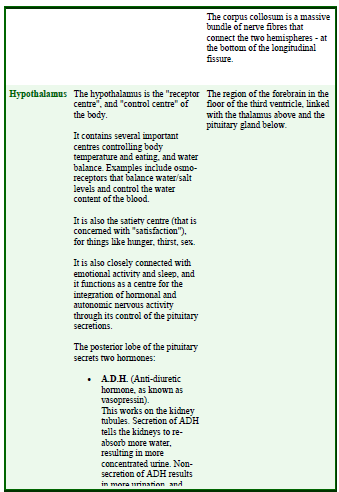
Hypothalamus:
The hypothalamus region of the brain controls mood, thirst, hunger
andtemperature. It also contains glands which control the hormonal
processes throughout thebody.
Thalamus:
The thalamus is located in the centre of the brain. It helps to control
theattention span, sensing pain and monitors input that moves in and
out of the brain to keeptrack of the sensations the body is feeling.
Brain stem
All
basic life functions originate in the brain stem, including heartbeat,
blood pressureand breathing. In humans, this area contains the medulla,
midbrain and pons.
Midbrain: This part of the brain helps regulate body movement, vision and hearing.
Pons:
The pons interprets information that is used in sensory analysis or
motor control.The pons also creates the level of consciousness necessary
for sleep.
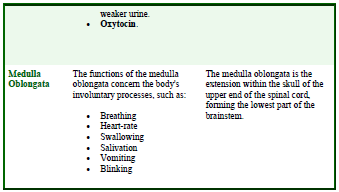
Medulla:
The medulla or medulla oblongata is an essential portion of the brain
stemwhich maintains vital body functions such as the heart rate and
breathing.
The diagram below shows and summarizes the basic functions of different parts of thebrain.
The Components of the Central Nervous System and their Functions
Identify the components of the central nervous system and their functions
The table below summarizes the structure and functions of the major components of thebrain.
The Structure of the Spinal Cord and Brain
Describe the structure of the spinal cord and brain
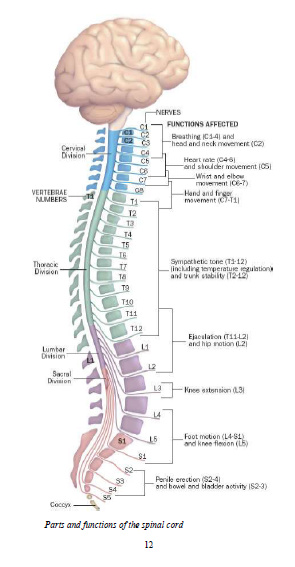
Spinal cord
The
spinal cord functions primarily in the transmission of neural signals
between thebrain and the rest of the body but also contains neural
circuits that can independentlycontrol numerous reflexes and central
pattern generators. It carries out two mainfunctions:
- It connects a large part of the peripheral nervous system to the brain. Information(nerve impulses) reaching the spinal cord through sensory neurons is transmitted upinto the brain. Signals arising in the motor areas of the brain travel back down thecord and leave in the motor neurones.
- The spinal cord also acts as a minor coordinating centre responsible for some simplereflexes like the withdrawal reflex.
The intermediate neurones carrying impulses to and from specific receptors and effectorsare grouped together in spinal tracts.
The diagram shows various sections of the spinal cord and the functions of each section.
Reflex Action
The Meaning of Reflex Action
Give the meaning of reflex action
When
a receptor is stimulated, it sends a signal to the central nervous
system, where thebrain co-ordinates the response. But sometimes a very
quick response is needed, one thatdoes not need the involvement of the
brain. This is a reflex action.
The
reflex action is a rapid, involuntary response to a certain stimulus.
The route that isfollowed by impulses during a reflex action is called a
reflex arc.
Reflex
actions are rapid and happen without us thinking. For example, you
would pullyour hand away from a hot flame without thinking about it. The
diagram below shows asimplified reflex arc.

This is what happens:
- receptor detects a stimulus - change in the environment
- sensory neurone sends signal to relay neurone
- motor neurone sends signal to effector
- effector produces a response
The above process appears to be a long one but, in reality, the process takes a very shorttime. It happens within seconds.
The
way the iris in our eye adjusts the size of the pupil in response to
bright or dim lightis also a reflex action. It happens without our
thinking and beyond our control.
The Neuronic Path of a Reflex Action
Describe the neuronic path of a reflex action
A reflex action can either be simple or conditioned reflex.
Simple reflex action
An
example of a simple reflex found in humans is the pupil reflex, where
the pupil of theeye gets larger in dim light and smaller in bright
light.The eye needs to control the amount of light entering it in
different light conditions. Indim conditions, more light is allowed to
enter so that a clear image can be formed on theretina. In bright
conditions, less light is allowed to enter so that the retina is not
damaged.
Conditioned reflex action
A conditioned reflex is some action or feeling that is learned in response to a specificsituation or stimulus.
A
Russian scientist called Pavlov trained dogs to expect food whenever he
rang a bell.The dogs eventually produced saliva when they heard the
bell ring. The dog salivatesnaturally when given food. Pavlov rung a
bell every time the dogs were to be given food.After much repetition the
dogs salivated when they heard the bell ringing, even whenthere was no
food. This is an example of a conditioned reflex.
The
dogs were conditioned to salivate when the bell rang. A ringing bell
does notnormally cause salivation in dogs. However, when the ringing
bell becomes a secondarystimulus, it does cause salivation, even though
the dog will not be able to eat the bell asfood.
This
is now called a conditioned reflex. In a conditioned reflex the final
response(salivation) has no direct connection with the stimulus (ringing
bell).
vAnother
example of a conditioned (learned) reflex is when the driver comes
across ahurdle on the road such as a ditch or a pedestrian. In such
circumstances, the first thingthe driver will do is to move his leg
towards the brake pedal to apply the brakes. He haslearned to do this
action for so long that he finds himself applying the brake in any
ofsuch circumstances.
The Difference between Simple Reflex and Conditioned Reflex Action
Distinguish simple reflex from conditioned reflex action
Differences between conditioned reflex action and simple reflex action
| Conditioned reflex | Simple reflex | |
| 1 | It involves more than one stimuli | Requires only one stimulus |
| 2 | Involves the brain | Mostly involve the spinal cord |
| 3 | It is an immediate action (no time to learn) | It is an immediate action (no time to learn) |
| 4 | It is acquired in one‘s life | It is inborn |
Modifying a reflex response
In
some circumstances the brain can modify a reflex response. It does this
by sending animpulse along a motor neuron of the reflex arc. This
enables us, for example, to hold ahot dinner plate when normally we
would drop it.
Sense Organs
The Meaning of a Sense Organ
Explain the meaning of a sense organ
Sense organs are organs of the body that detect and respond to changes in theenvironment (stimuli) so as to survive.
Types of Sense Organs and Their Relative Position
Identify types of Sense organs and their relative position
There
are five sense organs in our body: eyes,ears, nose, tongue and skin. We
receive a variety of information from the environmentaround us through
the sense organs. The sense organs contain receptors. A receptor is
acell (or a group of cells) in a sense organ which is sensitive to a
particular type ofstimulus (or a particular type of change in the
environment) such as light, sound, smell,taste, heat, pressure, etc. The
different sense organs contain receptors for detectingdifferent
stimuli.
The
eyes have light receptors (which can detect light), ears have sound
receptors (whichcan detect sound), nose has smell receptors (which can
detect smell), tongue has tastereceptors (which can detect taste)
whereas skin has receptors for detecting touch,pressure, heat (or cold)
and pain, etc.
The Structure of Each Sense Organ
Describe the structure of each sense organ
The human eye
The
eye is the organ for vision. The eye is one of the most complex parts
of the body.The different parts of the eye allow the eye to take in
light and perceive objects around usin the proper colour, detail and
depth. This allows people to make more informeddecisions about their
environment. If a portion of the eye becomes damaged, you may notbe able
to see effectively. You may even lose your vision completely.Parts of
the eye and their functionsThere are several physical and chemical
elements that make up the eye. The table belowshows different parts of
the human eye and their functions.Eye part Description and
function(s)Cornea The cornea is the outer, transparent covering of the
eye. This layerprotects the eye from elements that could cause damage to
the innerparts of the eye. The cornea also helps to focus light on the
retina at theback of the eye.Sclera The sclera is commonly referred to
as the "white" of the eye. It protectsthe eye and maintains the shape of
the eye ball.Pupil The pupil appears as a black dot in the middle of
the eye. This blackarea is actually a hole that takes in light to enable
the eye focus on theobjects in front of it. The pupil, thus, controls
the amount of light thatenters the eye.Iris The iris contains the
pigment which gives the eye its colour. It has radialInternal structure
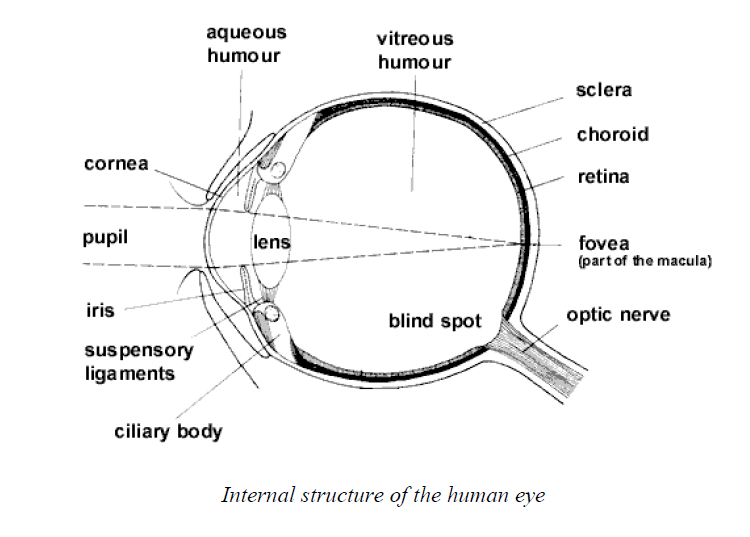
Parts of the eye and their functions
There
are several physical and chemical elements that make up the eye. The
table belowshows different parts of the human eye and their functions.
| Eye part | Description and function(s) |
| Cornea | The cornea is the outer, transparent covering of the eye. This layer protects the eye from elements that could cause damage to the inner parts of the eye. The cornea also helps to focus light on the retina at the back of the eye. |
| Sclera | The sclera is commonly referred to as the "white" of the eye. It protects the eye and maintains the shape of the eye ball. |
| Pupil | The pupil appears as a black dot in the middle of the eye. This black area is actually a hole that takes in light to enable the eye focus on the objects in front of it. The pupil, thus, controls the amount of light that enters the eye. |
| Iris | The iris contains the pigment which gives the eye its colour. It has radial and circular muscles that control the size of the pupil by dilation and contraction. This allows the eye to take in more or less light depending on how bright it is around. The iris allows more light into the eye when the environment is dark and allows less light into the eye when the environment is bright. |
| Conjunctiva | This is a membrane that covers the cornea. It is thin and transparent so as to allow light to enter the eye. It is tough and protects the eye from mechanical damage. |
| Lacrimal glands | These glands are located on the outer corner of each eye. They produce tears which help moisten the eye when it becomes dry, and flush out particles which irritate the eye. As tears flush out potentially dangerous irritants, it becomes easier to focus properly. |
| Lens | This is a transparent structure filled with a jelly-like substance. The lens focuses light into the retina. It is held in place by the suspensory ligaments attached to the ciliary muscles, which allow the lens to change shape depending on the amount of light entering the eye. Through the ciliary muscles, the lens becomes thicker to focus on nearby objects and thinner to focus on distant objects. |
| Retina | Retina is the sensory tissue that lines the inner layer of the eye. It is the layer of the eye where images are formed, and it is connected to the optic nerve that transmits the images to the brain to be interpreted. The retina is made up millions of photoreceptors known as rods and cones. |
| Ciliary body | Ciliary body, also called ciliary muscles, is a ring-shaped tissue which holds and controls the movement of the eye lens, and thus, it helps to control the shape of the lens. The ciliary body contains glandular cells which secrete the aqueous humour. |
| Suspensory ligaments | The suspensory ligaments attach the lens to the ciliary muscles. When the ciliary muscles contract, they pull the suspensory ligaments and the lens gets long and thin to accommodate rays of light from distant objects. When the ciliary muscles relax, there is less tension on the suspensory ligaments and the lens becomes more spherical in shape. This enables the accommodation of light rays from near objects. |
| Choroid | The choroid lies between the retina and the sclera, which provides blood supply to the eye. Just like any other portion of the body, the blood supply gives nutrition to the various parts of the eye. |
| Vitreous humour | The vitreous humour is the gel located in the back of the eye which helps it hold its shape. This gel takes in nutrients from the ciliary body, aqueous humour and the retinal vessels so the eye can remain healthy. The gel in the vitreous humour is transparent to allow light to get to the retina and also helps maintain the shape of the eyeball. |
| Aqueous Humor | The aqueous humour is a watery substance that fills the eye. The aqueous humour gives the front of the eye its shape as well as nourishes the cornea and lens. This liquid is drained through the Schlemm canal so that any build-up in the eye can be removed. If the person’s aqueous humour is not draining properly, s/he can develop glaucoma. |
| Optic nerve | Optic nerve is a cranial nerve which contains sensory neurones. The neurones transmit impulses from the rods and cones of the retina to the brain for interpretation. The optic nerve exits the eye at the blind spot. |
| Blind spot | It is located at the point where the optic nerve leaves the eye. The blind spot is not sensitive to light because it has no rods or cones. |
| Fovea | The fovea is the centremost part of the macula*. This tiny area is responsible for our central, sharpest vision. A healthy fovea is important for reading, watching television, driving, and other activities that require the ability to see detail.*Small and highly sensitive part of the retina responsible for detailed central vision. The retina is the very centre of the macula. |
Adaptations of the eye to its functions
The eye is adapted to its functions by possessing the following features:
- Conjunctiva, cornea and lens are transparent to allow light to pass through them.
- Sclerotic layer is made up of (collagen) fibres; it maintains shape of eyeball/protectsthe eye from mechanical damage.
- Cornea is transparent and curved thus refracts light rays and allows light to passthrough.
- Choroid (a layer of a tissue) has black or dark pigments that prevent internalreflections of light in the eye.
- The eye contains blood vessels in the choroids layer that supply oxygen and nutrientsto the eye, giving the eye energy to perform its function, and removes the metabolicwastes from the eye.
- Retina is made of photoreceptors known as rods and cones, which trap light rays toenable the eye to do its function of vision.
- Yellow spot (fovea) has the highest concentration of cones for accurate and sharp,central vision.
- Optic nerve has sensory neurones for transmission of nerve impulses to the brain (forinterpretation).
- Lens is biconvex and made up of elastic, transparent material which adjusts to focusfar or near objects and allows light rays to pass through.
- Suspensory ligaments are fibrous to hold the lens in place.
- . The ciliary body contains ciliary muscles which are contractile to for controlling thecurvature and hence focal length of the lens. It also contains glands that secrete theaqueous and vitreous humours.
- The iris is opaque and contractile for controlling the amount of light entering the eye(by adjusting the size of the pupil).
- Ocular muscles coordinate eye movement so that both eyes can follow a movingobject together.
- The eyelid covers an eye and prevents it from mechanical damage and invasion byforeign bodies.
- Eye lashes help to prevent dust and small insects or particles from entering the eyeby trapping them on their hairs.
- The presence of aqueous and vitreous humours helps the eye to bend light raystoward retina to process the signal and send impulse to the brain.
The Functions of Sense Organs and their Adaptive Features
Explain the functions of sense organs and their adaptive features
Adaptations of the eye to its functions
The eye is adapted to its functions by possessing the following features:
- Conjunctiva, cornea and lens are transparent to allow light to pass through them.
- Sclerotic layer is made up of (collagen) fibres; it maintains shape of eyeball/protectsthe eye from mechanical damage.
- Cornea is transparent and curved thus refracts light rays and allows light to passthrough.
- Choroid (a layer of a tissue) has black or dark pigments that prevent internalreflections of light in the eye.
- The eye contains blood vessels in the choroids layer that supply oxygen and nutrientsto the eye, giving the eye energy to perform its function, and removes the metabolicwastes from the eye.
- Retina is made of photoreceptors known as rods and cones, which trap light rays toenable the eye to do its function of vision.
- Yellow spot (fovea) has the highest concentration of cones for accurate and sharp,central vision.
- Optic nerve has sensory neurones for transmission of nerve impulses to the brain (forinterpretation).
- Lens is biconvex and made up of elastic, transparent material which adjusts to focusfar or near objects and allows light rays to pass through.
- Suspensory ligaments are fibrous to hold the lens in place.
- . The ciliary body contains ciliary muscles which are contractile to for controlling thecurvature and hence focal length of the lens. It also contains glands that secrete theaqueous and vitreous humours.
- The iris is opaque and contractile for controlling the amount of light entering the eye(by adjusting the size of the pupil).
- Ocular muscles coordinate eye movement so that both eyes can follow a movingobject together.
- The eyelid covers an eye and prevents it from mechanical damage and invasion byforeign bodies.
- Eye lashes help to prevent dust and small insects or particles from entering the eyeby trapping them on their hairs.
- The presence of aqueous and vitreous humours helps the eye to bend light raystoward retina to process the signal and send impulse to the brain.
The human ear
The
ear is the organ of hearing and maintaining balance and posture. The
outer earprotrudes away from the head and is shaped like a cup to direct
sound waves toward thetympanic membrane, which transmits vibrations to
the inner ear through a series of smallbones (ossicles) in the middle
ear called the malleus, incus and stapes. The inner ear, orcochlea, is a
spiral-shaped chamber covered internally by nerve fibres that react to
thevibrations and transmit impulses to the brain via the auditory nerve.
The brain combinesthe input of our two ears to determine the direction
and distance of sounds.
The
inner ear has a vestibular system formed by three semicircular canals
that areapproximately at right angles to each other and which are
responsible for the sense ofbalance and spatial orientation. The inner
ear has chambers filled with a viscous fluid andsmall particles
(otoliths) containing calcium carbonate. The movement of these
particlesover small hair cells in the inner ear sends signals to the
brain that are interpreted asmotion and acceleration. The figure below
shows the internal structure of themammalian ear.
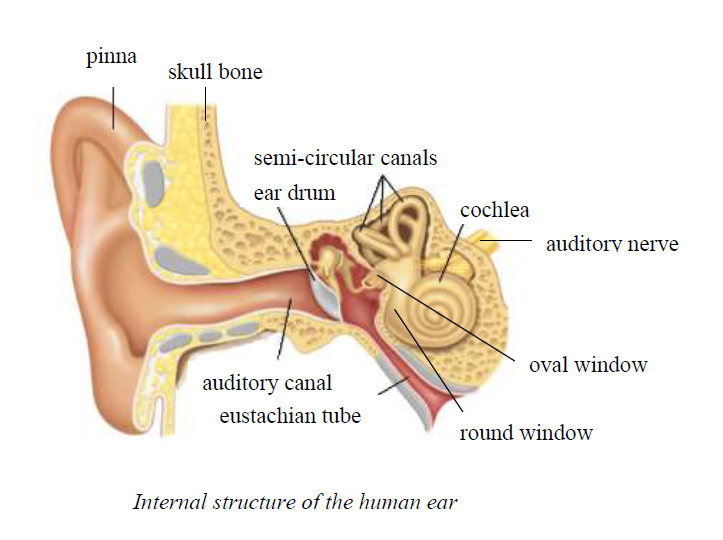
Adaptations of the mammalian ear to its functions
The ear is adapted to its functions by possessing the following features:
- The outer ear (pinna) is a flap of tissue which collects sound waves and directs theminto the inner ear via the auditory canal.
- The lining of auditory canal contains wax-secreting cells which produce wax. Thewax in the canal traps dust particles and other foreign bodies and hence protects theinner delicate parts of an ear from mechanical damage or microbial infections.
- The ear drum is thin and membranous, a fact that enables it to vibrate when soundwaves hit it before converting the waves into vibrations and passing them on to theear ossicles in the middle ear.
- The ear ossicles (malleus, incus and stapes) act as a lever system which can moveforward and backward to amplify and transmit vibrations to the oval window.
- The Eustachian tube is hollow, a fact which allows air in and out of the middle ear toequalize the pressure between the inside and outside of the ear drum—whichimproves the drum‘s ability to vibrate
- The cochlea is coiled to increase the surface area for sound reception. It also cariesauditory nerves which transmit sound impulses to the brain for interpretation.pinnaear drumskull bonesemi-circular canalsauditory canaleustachian tuberound windowcochleaauditory nerveInternal structure of the human earoval window
- The presence of fluid-filled vestibular apparatus (semi-circular canals, sacculus, andutriculus) in the inner ear facilitates balancing of sound when the fluid is displaced.
The tongue
The
tongue is an organ responsible for taste. It is the primary organ of
taste (gustation), asmuch of its upper surface is covered in taste buds.
The tongue's upper surface is alsocovered with numerous lingual
papillae. The tongue is sensitive and kept moist by saliva,and is richly
supplied with nerves and blood vessels.
The
receptors for taste, called taste buds, are situated chiefly in the
tongue, but they arealso located in the roof of the mouth near the
pharynx. They are able to detect four basictastes: salty, sweet, bitter,
and sour.
Generally,
the taste buds close to the tip of the tongue are sensitive to sweet
and saltytastes, whereas those in the back of the tongue are sensitive
to bitter tastes. The taste budsin the sides of the tongue are sensitive
to sour tastes. At the base of each taste bud there isa nerve that
sends the sensations to the brain. The sense of taste functions in
coordinationwith the sense of smell.
The
number of taste buds varies substantially from individual to
individual, but greaternumbers increase sensitivity. Women, in general,
have a greater number of taste budsthan men. As in the case of colour
blindness, some people are insensitive to some tastes.
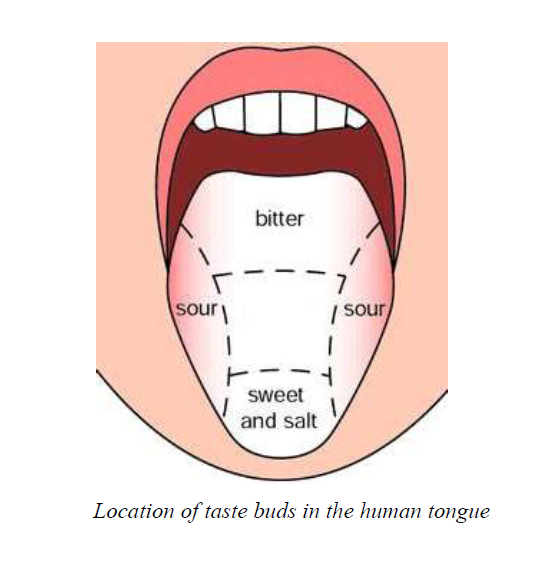
Adaptation of the tongue to its functions (as a sense organ)
The tongue is adapted to its functions by possessing the following features:
- The tongue has taste buds which help it to respond the stimuli such as sweet, bitter,sour and salty.
- At the base of each taste bud there is a nerve that sends the sensations to the brain.
The human nose
The
nose is the organ responsible for the sense of smell. The cavity of the
nose is linedwith mucous membranes that have smell receptors connected
to the olfactory nerve. Thesmells themselves consist of vapours of
various substances. The smell receptors interactwith the molecules of
these vapours and transmit the sensations to the brain. The
smellreceptors are sensitive to seven types of sensations that can be
characterized as camphor,musk, flower, mint, ether, acrid, or putrid.
The sense of smell is sometimes temporarilylost when a person has a
cold. Dogs have a sense of smell that is many times moresensitive than
man's.
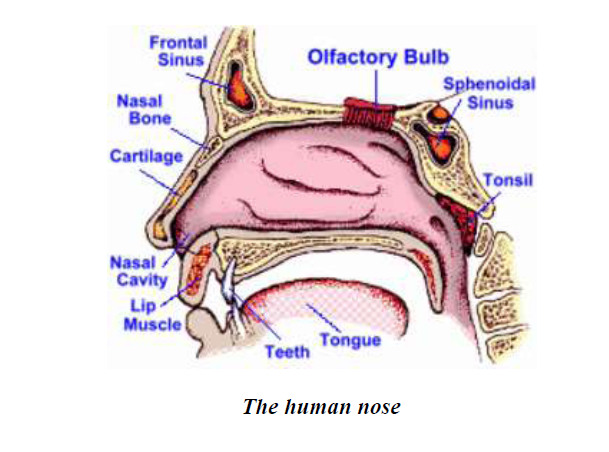
When
we want to ―smell‖ food we draw air high up into the nasal cavity where
thechemicals come into contact with hairs on the sensory cells.
Different chemicalsstimulate different sensory cells and nervous
impulses are set up which pass along theverves to the brain to be
interpreted.
When our nose is blocked with cold, our food may become ―tasteless‖ because we nolonger smell it.
Adaptations of the nose to its functions
The nose is adapted to its functions by possessing the following features:
- There are olfactory nerves, which carry impulse from the nose to the olfactory lobesof the brain for interpretation.The human nose
- Presence of mucus-secreting cells, which produce mucus that keep the surface of thenose moist.
- Presence of hairs in the nose helps the nose to trap dust particles and other foreignbodies. When the mucus is blown out from the nose, it carries the dust and otherforeign bodies with it, thus preventing the olfactory organs from damage.
The human skin
The
skin is the outer covering of the body. In humans, it is the largest
organ of theintegumentary system. The skin has multiple layers of
ectodermal tissue and guards theunderlying muscles, bones, ligaments and
internal organs. It protects us from microbesand the elements; helps
regulate body temperature; and permits the sensations of touch,heat, and
cold.
The skin has three layers:
- The epidermis, the outermost layer of skin, provides a waterproof barrier andcreates our skin tone
- The dermis, beneath the epidermis, contains tough connective tissue, hairfollicles, and sweat glands
- The deeper subcutaneous layer (hypodermis) is made of fat and connectivetissue.
The
skin‘s colour is produced by special cells called melanocytes, which
produce thepigment melanin. Melanocytes are located in the epidermis.
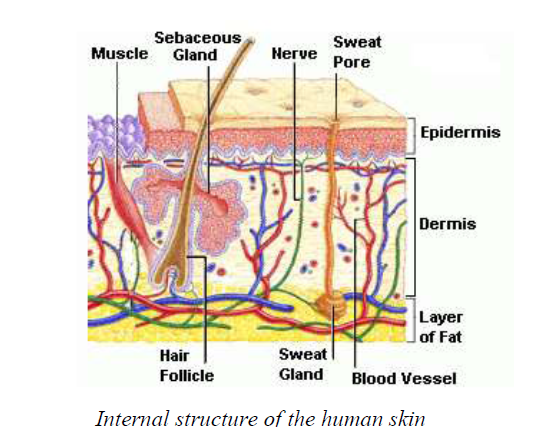
The
skin contains sensory nerve endings which are receptors. They are
sensitive to pain,pressure, touch, heat and coldness. When the nerve
endings are stimulated they set upnervous impulses which are sent to the
spinal cord or brain to be interpreted.
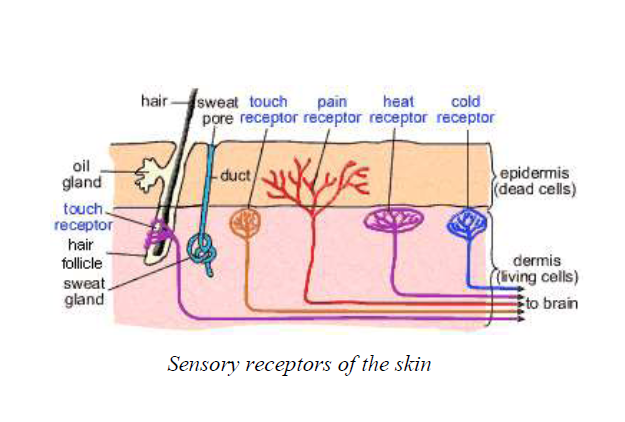
Functions of skin
- Regulation: The skin plays an important role in regulation of body temperature inan organism thus helping to keep the body temperature constant (endothermic).
- The skin manufactures vitamin D through exposure to sunlight. Ergosterol in thefatty layer of the skin converts into vitamin D under the influence of sunlight.
- The skin produces melanin that protects the body from ultra violet radiationswhich can cause skin cancer.
- The skin acts as sensory organ due to the presence of various nerve endings.
- Protection: It prevents micro-organism and other foreign materials from enteringthe body.
- Excretion: Sweat glands produce sweat, which gets rid of excess heat, water, salts,some carbon dioxide and urea.
- Storage: Fat is a food store in the dermis.
Adaptations of the skin to its functions (as a sense organ)
The human skin is adapted to its sensory functions by having the following features:
- It has the hair erector muscle which controls whether the hair stands erect or liesdown depending on the temperature of the surrounding.
- It is supplied with nerves which convey impulses to the CNS to be interpreted.
- Presence of blood vessels (in the dermis) which dilate when the body temperature ishigh to facilitate heat loss by radiation and constrict when the temperature is low toreduce heat loss. The blood vessels also supply nutrients and oxygen to the skin andremove excretory products.
- The skin has sweat glands which produce sweat to help cool the body. During a hotday, the glands produce sweat (through sweat pores). Evaporation of the sweat usesthe body heat and hence helps to cool down the body.
Drugs and Drug Abuse in Relation to Nervous Coordination
The Meaning of Drugs and Drug Abuse, in Relation to Nervous Coordination
Explain the meaning of drugs and drug abuse, in relation to nervous coordination
Drugs
A
drug is any chemical substance, natural or synthetic, that has known
physiologicaleffects on humans or other animals. Foods are generally
excluded from this definition, inspite of their physiological effects on
animal species.
Most
drugs, both useful and harmful, may affect the body (especially the
brain), byaltering the nerve cells' natural reaction to these chemicals,
or by mimicking the body'snormal compounds.
Some
drugs slow down the passage of stimuli by affecting nerve cell
membranes, andothers act like neurotransmitters, perhaps passing
stronger or longer-lasting impulses. Assuch they may alter the way
sensory information is processed, or affect the thinkingprocess.
Stimulants
are drugs which speed up the action of the brain e.g. caffeine, found
in tea andcoffee. Sedatives are drugs which slow down the action of the
brain e.g. alcohol. Evenone alcoholic drink will have some effect on the
brain.
Proper Ways of Handling and Using Drugs
Outline proper ways of handling and using drugs
Proper use and handling of drugs
When using and handling drugs the following precautions must be observed:
- Avoid taking any drug without diagnosing the disease and prescription by the doctor.
- Always stay away from peer pressures and drug addicts to avoid copying their badhabits.
- Keep yourself busy with a number of activities such as sports and games, readingbooks, etc. Remember ‗an idle mind is the devil‘s workshop‘!
- Report any case of drug abuse or trafficking to concerned authorities.
- Form a counselling club to advise people especially youths on how to keep off fromdrugs.
- If one feels addicted, s/he should seek advice from health officials.
- Never take a dose more or less that what has been prescribed by the doctor.
- Complete the prescribed dose even after you start feeling well or after the symptomsof the disease has disappeared.9. Keep all drugs out of reach of children and drug addicts.
Drug addiction
Drug
addiction refers to the compulsive and repeated use of increasing
amounts of drugswith the appearance of withdrawal symptoms when drug use
ceases. While drug use oftenbegins as a way to seek recreation, the
addictive properties of the drug make an addictcrave for it permanently.
This compulsion is uncontrollable and may interfere with aperson‘s
everyday life. Even when the effects of drugs are damaging to a person‘s
bodyand relationships with friends, family members and co-workers, the
constant need for adrug often overcomes any rational thinking.
The
human body has its own ability to produce some chemicals for its
properfunctioning. The continued use of the drug suppresses the body‘s
ability to produce thesechemicals or diminishes its production because
these chemical are replaced by the drug.The body thus uses the drug as a
substitute for its own natural chemicals. Since thesechemicals are no
longer produced, the body perceives that it needs the drug for
itsfunctioning. Therefore, a person craves for the drug so much that
s/he feels cannot livewithout taking it. At this level the drug abuser
becomes addicted to the drug. This iscalled drug addiction.
Causes and Effects of Drug Addiction
Explain causes and effects of drug addiction
Like
many mental health disorders, several causes may contribute to
development of drugaddiction and dependence. Some of the causes of drug
abuse and addiction include thefollowing:
- Some people take drugs to avoid physical or emotional pain, discomfort, stress,boredom, anxiety and depression.
- Some people also take drugs as a way to forget problems and life hardships theyexperience in life.
- Recreation: Drug users believe that taking drugs make them ‗feel better‘ and lively.
- Peer pressure leads people to drug so as to create a sense of belonging and fitting inthe peer group. It‘s often said that teens use drugs when their friends do. Using drugsallows these young people to fit in with their peers and blend in with the crowd
- . Desire for a new experience and arousal: Some people just take drugs as an‗experiment‘ to find out the experience the drug users feel, but badly end upbecoming drug addicts.
- Lack of life and social skills, for example drug resistance skills that would help aperson learn how to say no or avoid bad influence. People who are easy to copyhabits from others, irrespective of the outcome of the given habit, can easily get intodrug use.
Effects of drug abuse and addiction
Effects of drug abuse and addiction
Many
illegal chemicals have extreme effects on the function of the brain,
e.g. some drugscause hallucinations - objects around you may change
colour, shape and size, or you maysee and experience things that are not
there at all. Such experiences may cause fear,depression, and mental
disorders. Mostly, these substances alter one's perception ofreality.
Drugs
produce a variety of short-term effects, but the most common ones
includeincreased heart rate, high blood pressure, dizziness, tremors,
mood changes and paranoia.In high dosages, the risk for more dangerous
effects increases, and the potential for heartattack, stroke,
respiratory failure and coma increases. The various effects of drug
abuseinclude the following:
- Drugs confuse the mental faculties so that many drug users die in accidents, oroverdose on the chemicals. Drugs can also induce them do dangerous activities suchas unsafe sex or reckless driving.
- Many drugs induce a feeling of dependency (addiction) and are linked with criminalactivity.
- Solvent abuse (sniffing glue, lighter fuel, etc.) - on which one can easily overdose -can cause death by heart failure.
- Other substances can incidentally affect the body's "thermostat" - located in thehypothalamus (refer to a topic on homeostasis and osmoregulation) and cause death,following disruption of the body's temperature control and regulation of the body'swater content. Even "legal" chemicals, such as alcohol (a "social" drug!), haveadverse effects on the body.
- They can lead to aggressiveness, crime, violence and divorce.
- Sharing of needles used to inject drugs into the bloodstream cause HIV infections andhepatitis among the addicts. Likewise, because drugs impair one‘s judgement, it canlead to unprotected sex and hence become the cause of contracting other sexuallytransmitted diseases like syphilis, gonorrhoea, chlamydia and herpes.
- Drugs are very expensive to purchase. Therefore, the addicts spend much of theirmoney on drugs at the expense of other family needs.
- Many drug addicts are weak and so they cannot participate in in-come generatingactivities. This leads to poverty, a fact which can lead to failure to meet one‘s basicneeds.
- Drug addiction among women can lead to birth defects which include giving birth tosmall or premature babies or cause the baby to have withdrawal symptoms, birthdefects or learning and behavioural problems. Additionally, illicit drugs may containimpurities that may be harmful to unborn baby
- Medical concerns like depression and anxiety can severely interrupt the addict‘ssocial and professional life, leading to mood swings, chronic fatigue and a diminishedinterest in former hobbies and important life events.
Preventive and Control Measures of Drug Abuse
Suggest preventive and control measures of drug abuse
Drug
abuse is a serious psycho-sociological problem often difficult to be
cured. The bestway to avoid these tragedies is to never start taking
drugs. However, nowadays specifictreatments are available for different
types of mental illness. A regular, prolonged andsincere treatment is
required .Social therapy or rehabilitation has got a very
significantrole. The following activities can be done for the control of
drug addiction:
- Early detection, treatment and rehabilitation of drug addicts can help minimize theproblem.
- Parents should set a warm and friendly atmosphere at home so that the drug users canfeel easy to cooperate with.
- Motivation of the addicts to make up for detoxification.
- The youth should be motivated to get involved in the fight against drug abuse.
- Educating the community about the problems of drug addiction.
- Enforcement of laws, rules and regulation for the control and supply of drugs.
- The school curricula should contain courses about the drug addiction and drug abusein detail (like the topic you are reading now).
- Various effects of drug addiction must be advertised through newspapers, radio,television, magazine, social media, and many other media so as to make the problemknown to as many people as possible.
- The experience of drug users can be advertised to the people through media to makethe general public aware of the effects of drugs so as to discourage those who mightthink of starting taking drugs.
Location of the Different Endocrine Glands in the Mammalian Body
Identify location of the different endocrine glands in the mammalian body
THE ENDOCRINE SYSTEM
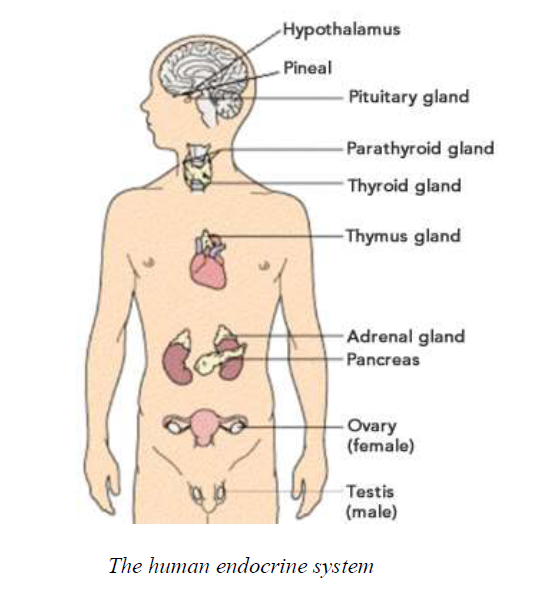
The
endocrine system is a collection of glands that produce hormones which
regulatemetabolism, growth and development, tissue function, sexual
function, reproduction,sleep, and mood, among other functions. The
glands are located in various parts of thehuman body. The function of
these glands is to release various hormones, and as a whole,they are
most commonly referred to as the endocrine system. These glands are
pituitarygland, hypothalamus, thymus, pineal gland, testes, ovaries,
thyroid, adrenal glands,parathyroid and pancreas. The location of these
glands in the human body is as shown inthe diagrams below.
The role of Hormones produced by each Endocrine gland
Explain the role of hormones produced by each endocrine gland
The
hormones released by glands of the endocrine system regulate the
functions of manycells and organs as indicated in the following table.
Disorders of Hormonal Coordination in Mammals
Outline disorders of hormonal coordination in mammals
Causes of endocrine disorders
The causes of endocrine disorders are typically grouped into two categories:
- Endocrine disease that results when a gland produces too much or too little of anendocrine hormone, called a hormone imbalance.
- Endocrine disease due to the development of lesions (such as nodules or tumours) inthe endocrine system, which may or may not affect hormone levels.
The
endocrine's feedback system helps control the balance of hormones in
thebloodstream. If your body has too much or too little of a certain
hormone, the feedbacksystem signals the proper gland or glands to
correct the problem. A hormone imbalancemay occur if this feedback
system has trouble keeping the right level of hormones in
thebloodstream, or if your body doesn't clear them out of the
bloodstream properly.
Increased or decreased levels of endocrine hormone may be caused by:
- A problem with the endocrine feedback system.
- Disease.
- Failure of a gland to stimulate another gland to release hormones (for example, aproblem with the hypothalamus can disrupt hormone production in the pituitarygland).
- A genetic disorder, such as multiple endocrine meoplasia or congenitalhypothyroidism.
- Infection.
- Injury to an endocrine gland.
- Tumour of an endocrine gland.Most endocrine tumors and nodules (lumps) are non-cancerous. They usually do notspread to other parts of the body. However, a tumor or nodule on the gland may interferewith the gland's hormone production.
Types of endocrine disorders
There
are many different types of endocrine disorders. Majority of endocrine
disorderscause the endocrine glands to produce too much (hypersecretion)
or too low(hyposecretion) of a given hormone from a particular gland.
Common problems thatresult from oversecretion (hypersecretion) or
undersecretion (hyposecretion) of givenhormones from given endocrine
glands are explained below.
PITUITARY GLAND
Hypersecretion
of growth hormone: Gigantism in children and acromegaly in adults.If
the pituitary gland produces too much growth hormone, a child's bones
and body partsmay grow abnormally fast.
Hyposecretion of growth hormone: Pituitary dwarfism - if the condition occurs duringchildhood, it slows down long bone growth.
Hypersecretion of ADH:
Causes increased reabsorption of water in the kidney tubulesleading to
production of a little urine but which is more concentrated.
Hyposecretion
of ADH: Less water is absorbed from the glomeruli filtrate back to
thebody, leading to production of large volumes of dilute urine. This is
called diuresis and isa symptom of diabetes inspidus.
THYROID GLAND
Hyperthyroidism
- Grave's disease: The most common cause for an overactive thyroid is an autoimmunedisorder called Grave's disease. Grave's disease, considered an autoimmune disease,shows elevated weight loss, nervousness, excessive perspiration, nervousness, highmetabolic rate and rapid, irregular heartbeat.
- Exophthalmos: protrusion of the eyeballs caused by oedematous tissue behind theeyes.
Hypothyroidism
- Cretinism (infantile hypothyroidism) - shows stunted growth, thickened facialfeatures, abnormal bone development and mental retardation.
- Myxedema - low metabolic rate, lethargy (a condition characterized by extremefatigue or drowsiness, or prolonged sleep patterns.), weight gain, increase in bodyfluids.
- Goitre - abnormal growth of the thyroid gland.
PARATHYROID GLAND
Hyperparathyroidism: demineralization of bone resulting in possible bone deformityand fracture, and stones in the urinary tract
Hypoparathyroidism:
decreased plasma calcium levels which can lead to severe muscletetany
(a condition characterized by or resulting from uncontrolled muscle
spasms).
PANCREAS
Hyperinsulinism:
The liver is overstimulated to convert excess glucose to glycogen
andfats for storage. This leads to low glucose concentration in the
blood, a condition calledhypoglycemia. This condition results in lack of
glucose delivery to the brain causingdisorientation, unconsciousness
and even death (usually the result of an overdose ofinsulin).
Hypoinsulinism:
Under-secretion of isulin causes very little glucose to be converted
toglycogen and fats. This results in elevated glucose levels in the
blood and urine. Thecondition is called hyperglycaemia, and is a symptom
of diabetes mellitus. Over time,diabetics experience vascular and
neural problems. Secondarily, poor circulation maylead to gangrene,
blindness, kidney damage and impotence.
ADRENAL GLAND
Hypersecretion
of corticosteroids: Cushing's syndrome - changes in carbohydrate
andprotein metabolism resulting in a puffy appearance.
Hyposecretion
of glucocorticoids and mineralocorticoids: Addison‘s disease -symptoms
of the disease include fatigue, stomach upset, hypoglycaemia, sodium
andpotassium imbalance, dehydration, hypotension, and rapid weight loss.
Death occurs withlack of treatment.
Hypersecretion
of adrenaline: hypertension, obesity, headache, increased
heartbeat,weak bones, hyperglycaemia, nervousness, sweating and early
onset of sexualdevelopment.
Hyposecretion
of adrenaline: low blood pressure, fatigue, muscular weakness,
musclewasting, inability to withstand stress, and increased dark
pigmentation of the skin.
OVARIES
Hypersecretion of oestrogen: Causes decreased sexual desire, heavy menstrual flow andincreased weight in females.
Hyposecretion
of oestrogen: Causes failure of females to develop some secondarysexual
characteristics, poor development of the reproductive organs, liver,
kidney andlungs.
TESTES
Hypersecretion of testosterone: Causes males to have female features such as enlargedbreasts and a wide pelvis.
Hyposecretion
of testosterone: Causes failure of males to develop some
secondarysexual characteristics, poor development of the reproductive
organs and weak bones andmuscles.
THYMUS
Not responsible for any effects of hypo or hyper secretion of thymosin.
PINEAL
Not responsible for any effects of hypo or hyper secretion of melatonin.
Coordination in Plant, Concept of Tropic and Nastic Responses
The Concept of Tropic and Nastic Responses
Explain the concept of tropic and nastic responses
COORDINATION IN PLANTS
Both,
plants and animals react (or respond) to various stimuli around them.
But themethod of reacting to stimuli is not similar in plants and
animals. They react to stimuli indifferent ways. For example, plants
bend towards light but animals do not bend towardslight. The animal
amoeba reacts to the presence of food by moving towards the
foodparticle.
The
plants do not have a nervous system and sense organs like eyes, ears,
or nose, etc.,like the animals, but they can still sense things. The
plants can sense the presence ofstimuli like light, gravity, chemicals,
water, and touch, etc., and respond to them. Theysense these stimuli by
using hormones in them.
The
stimuli like light, gravity, chemicals, water, and touch, etc., are
called environmentalchanges. So, we can also say that the plants
coordinate their behaviour againstenvironmental changes by using
hormones. The hormones in plants do not act the sameway as in animals.
The
hormones in plants coordinate their behaviour by affecting the growth
of a plant.And the effect on growth of the plant can result in the
movement of a part of the plantlike shoot (stem) or root, etc towards a
certain stimulus.
Experiments to Investigate the Effects of Tropic and Nastic Responses in Plants
Carry out experiments to investigate the effects of tropic and nastic responses in plants
Plants
receive and respond to a variety of stimuli that are important to their
survival in theenvironment. These responses allow the plants to
survive, grow, develop and reproduce.The movement of plants in the
direction of stimulus is known as 'tropism'. Tropisms aregrowth
responses of plants that result in curvatures of plant organs toward or
away fromcertain stimuli. Tropisms can be positive, in which case the
plant will bend toward astimulus, or negative, in which case the plant
will bend away from a stimulus.
The
other movements shown by the plants are associated with the growth of
the plants.For example, the shoot system moves towards sunlight and the
root system towards earth.Thus, the plants also respond to their
environment.
Important tropisms in plants include phototropism, geotropism, hydrotropism,chemotropism and thigmotropism.
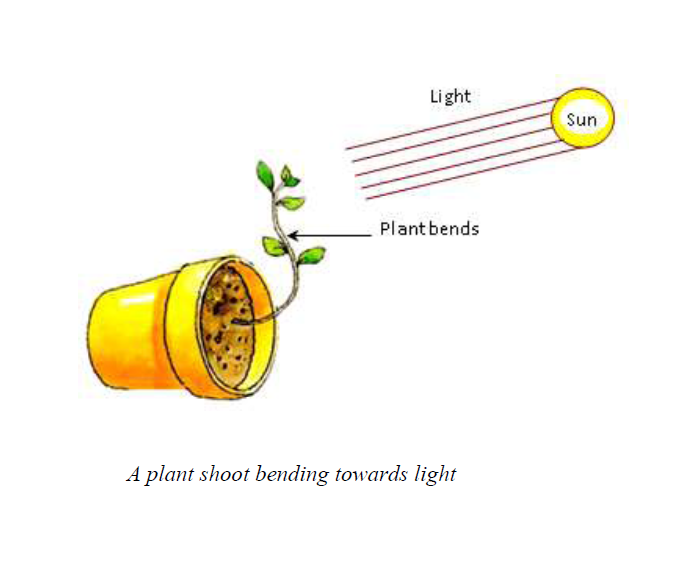
Phototropism
Phototropism
is the tendency for plant organs to bend in response to a directional
lightsource. For example, light streaming in a window from one direction
will often cause thestems of plants placed nearby to bend toward the
window, a positive phototropism.
Most
plant shoots are positively phototropic because they tend to grow
towards light.Most roots are negatively phototropic because they away
from light.
The Importance of Tropic and Nastic Responses
Explain the importance of tropic and nastic responses
Importance of phototropism
Phototropism
is important to plants because of it enables the plant leaves to be
placedunder direct sunlight to absorb maximum light so as to carry out
photosynthesiseffectively.
Geotropism
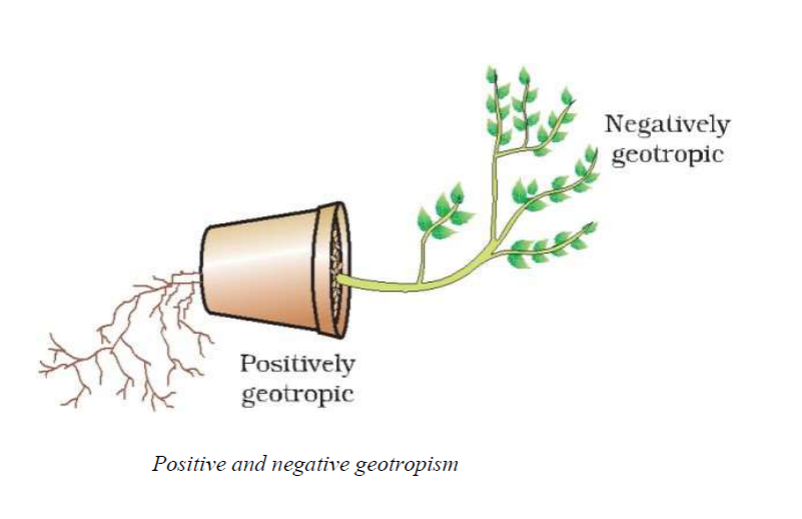
Geotropism
is the movement of a part of the plant towards gravity. In most plants,
rootsgrow downward with gravity while shoots grow upward against
gravity. Within hours,the shoot of a plant placed on its side will
usually bend upward and the roots will benddownward as the plant
reorients its direction of growth in response to gravity.
Most
plant roots grow towards gravity and are said to be positively
geotropic. Mostshoots grow away from gravity and are said be negatively
geotropic.
Importance of geotropism
Geotropisms are important to plants because of the following reasons:
- It enables the plants to send roots into the ground hence anchoring the plant firmlyinto the soil.
- It enables plant roots to absorb water and mineral salts from the soil.
- Negative geotropism exhibited by the shoot enables the shoot to grow upwards, andin so doing, exposes the plant leaves to maximum sunlight for effectivephotosynthesis
Hydrotropism
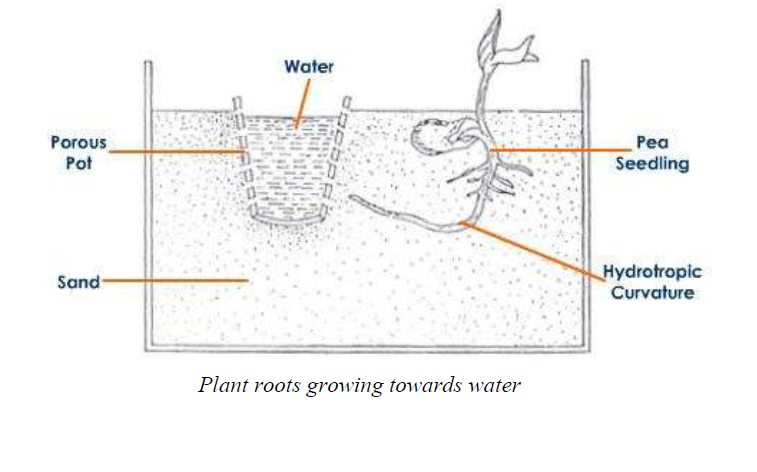
Hydrotropism
is the movement of a plant or part of a plant towards water. Plant
rootsnormally grow towards moisture. They are therefore positively
hydrotropic. If you plant aplant near a water source such as porous pot
or river, the roots will always grow towardswater.
Importance of hydrotropism
It enables the plants to absorb dissolved minerals and water. Water is necessary forvarious functions such as:
- Photosynthesis
- Numerous physiological reactions that take place within plant cells.
- Turgor pressure, which aids in plant support.
- Dissolution of mineral salts.
Chemotropism
An
example of positive and negative chemo-tropism is shown by a plant‘s
roots; the rootsgrow towards useful minerals displaying positive
chemo-tropism, and grow away fromharmful acids displaying negative
chemo-tropism.
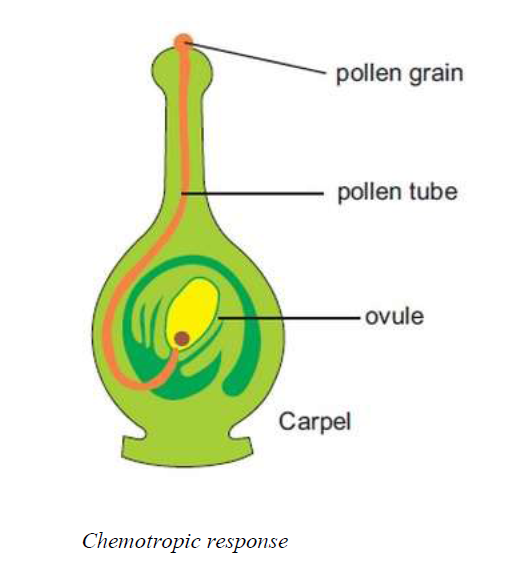
Chemotropism
is the movement or growth of an organism or part of an organism
inresponse to a chemical stimulus. During the process of fertilization
the movement ofpollen tube towards ovule due to secretion of a sugary
chemical in the ovary is anexample of chemotropism
Importance of chemotropism
- It enables the plant to absorb mineral salts from the soil when the roots grow towardsbeneficial chemicals such as fertilizers.
- Negative geotropism, such as when plant roots grow away from the toxins, enablesthe plant to survive by avoiding contact with such harmful chemicals.
- . It facilitates the fertilization process in flowering plants.
Thigmotropism or haptotropism
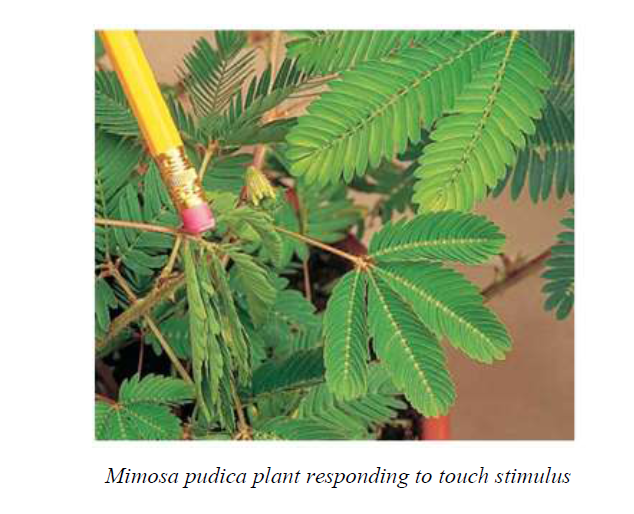
Thigmotropsim
refers to non-directional movements which take place neither towards
noraway from the stimulus. The best example of nastic movement is
folding and drooping ofleaves of Mimosa pudica plant when its leaves are
touched with fingers or any object.The leaves fold even when swayed
about by wind. Also the specialized touch-sensitivetendrils of many
vining plants, such as pea, will bend toward the side receiving a
touchstimulus. Continual stimulation can lead to the coiling of the
tendril around an object,which enables vining plants to grasp objects on
which they can climb
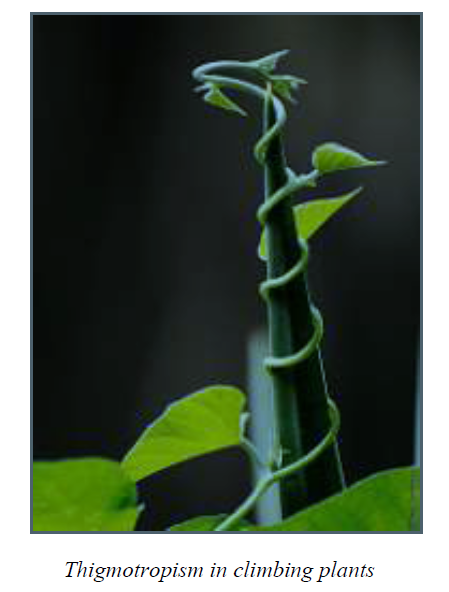
Importance of thigmotropism
- Thigmotropism enables crawling plants to climb up higher plants and expose theirleaves to sunlight for optimum photosythesis.
- It enables the insectivorous plants such as the Venus flytrap to trap insects and digestthem to obtain nutrients.
TOPIC 1: CLASSIFICATION OF LIVING THINGS, TOPIC 2: MOVEMENT
TOPIC 3: COORDINATION
TOPIC 4: EXCRETION
TOPIC 5: REGULATION
TOPIC 6: REPRODUCTION


No comments